C.K. Gupta
You have just retired, and the retirement benefits have landed — provident fund, gratuity, maybe a lump sum from your employer. The question is simple: where do you park it so it pays a steady income without risking the principal?
A fixed deposit is the obvious answer, but for a retiree over 60 SCSS usually beats it: a higher rate, a government guarantee, and money arriving every quarter like a pension top-up. Here’s the catch — a hard cap, a lock-in, and tax rules that catch people out.
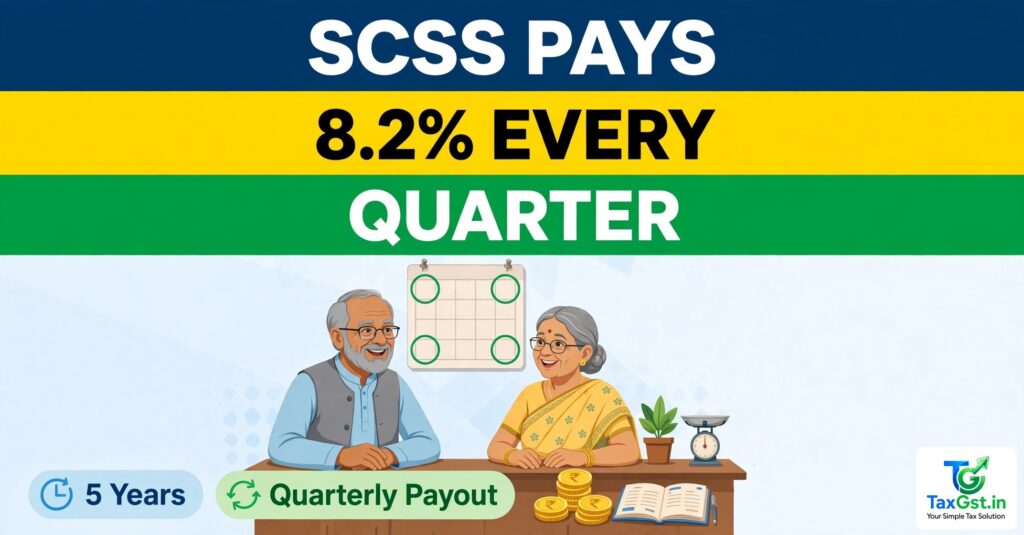
What SCSS pays you — 8.2% a year, every quarter
SCSS currently pays 8.2% a year for the quarter from 1 October to 31 December 2026, unchanged since April 2023. The rate is announced by the Ministry of Finance every quarter; the current figure comes from the Department of Economic Affairs’ Office Memorandum No. 1/4/2019-NS dated 30 September 2026.
Interest is paid every quarter — on 1 April, 1 July, 1 October and 1 January — straight into your linked savings account. That quarterly rhythm turns a lump sum into a predictable income stream.
The rate fixed on opening day stays for the full 5 years, even if the government cuts the rate for new accounts later — and if rates rise, your account does not get the higher rate.
Who can open an account — and who cannot
SCSS is open to resident individuals aged 60 and above. Retired civilians aged 55–60 and retired defence personnel aged 50+ can also join, within three months of receiving retirement benefits.
NRIs and HUFs cannot open an SCSS account. A joint account is allowed only with your spouse. Nomination is available — fill it in when you open the account, not later.
In the 55–60 retired-civilian window, watch that three-month deadline — miss it and you wait until 60. Still deciding? Start with the deductions hub for the full set of tax-saving options.
The ₹30 lakh cap and the 5-year tenure
The minimum deposit is ₹1,000; the maximum is ₹30 lakh per person — the rule people most often get wrong. The cap applies across all your SCSS accounts combined, at every bank and post office together.
Tenure is 5 years. After maturity you can extend in 3-year blocks, but an extension earns the rate in force on the maturity date — not your original rate.
Premature closure costs 1.5% of the deposit after one year and 1% after two years, and is not permitted before one year. That is the trade-off against a fixed deposit — a higher rate, less flexibility.
What the money actually looks like
At 8.2%:
| Deposit | Per quarter | Per year | Over 5 years |
|---|---|---|---|
| ₹30 lakh | ₹61,500 | ₹2,46,000 | ₹12,30,000 |
| ₹10 lakh | ₹20,500 | ₹82,000 | ₹4,10,000 |
| ₹5 lakh | ₹10,250 | ₹41,000 | ₹2,05,000 |
On the full ₹30 lakh deposit you receive ₹61,500 every three months, and ₹12,30,000 over five years, principal returned at maturity. These are pre-tax figures; the next section covers the tax.
Tax: what you keep and what you owe
SCSS interest is fully taxable at your slab, in both regimes. A ₹30 lakh deposit generates ₹2,46,000 of taxable interest a year, which can push you into a higher slab. Do the slab math first — the headline rate is not the after-tax rate.
Two deductions soften the blow, both old-regime only. The deposit qualifies under Section 123 of the Income-tax Act, 2025 (successor to old Section 80C), within the ₹1.5 lakh annual ceiling. Senior citizens can also claim up to ₹50,000 of interest income — including SCSS interest — under Section 153(2)(b) (successor to old Section 80TTB). Under the new regime neither is available, so compare regimes first.
For the detail on how these deductions interact, see our senior and super-senior citizen tax benefits guide and the 80TTA vs 80TTB comparison.
TDS on SCSS interest
No TDS is deducted if your SCSS interest is up to ₹1,00,000 in a year and you are 60 or above — a threshold raised by the Finance Act, 2025 (₹50,000 for others). But “no TDS” is not “no tax”: the interest is still taxable and must be reported in your return.
If your total income is below the taxable limit, submit Form 121 (successor to Forms 15G/15H) so no TDS is deducted at all. For bank-interest thresholds generally, see our guide to TDS on bank FD interest in 2026.
SCSS vs PPF, Sukanya Samriddhi, NSC and Monthly Income Scheme
Here is how SCSS stacks up against the other small-savings schemes for the same October–December 2026 quarter:
| Scheme | Rate | Interest taxable? | Who it is for |
|---|---|---|---|
| Senior Citizen Savings Scheme | 8.2% | Yes | Age 60+ (55+ retired civilians, 50+ retired defence) |
| Sukanya Samriddhi Yojana | 8.2% | No | Girl child under 10 only |
| National Savings Certificate | 7.7% | Yes | Anyone |
| Post Office Monthly Income Scheme | 7.4% | Yes | Anyone; pays monthly |
| Public Provident Fund | 7.1% | No | Anyone; 15-year tenure |
Sukanya Samriddhi matches SCSS at 8.2% and is tax-free — but only for a girl child under 10, so no alternative for a retiree. PPF pays less at 7.1% but is tax-free over 15 years: better for wealth, worse for income. The Monthly Income Scheme pays monthly, but at a lower 7.4%.
For quarterly income from a lump sum, SCSS is the highest-paying option in the small-savings family. For money untouched for 15 years, PPF’s tax-free compounding wins. Our PPF tax benefits in 2026 and Sukanya Samriddhi tax benefits guides cover each in full, to compare after-tax returns, not just headline rates.
How to open an SCSS account: a short checklist
Open an account at a post office or an authorised bank branch — take this checklist:
- Identity and address proof: Aadhaar and PAN card, plus a passport-size photograph.
- Age and retirement proof: proof of age; retirees under 60 need proof of retirement and the date benefits were received — the three-month window runs from that date.
- The deposit: a cheque or demand draft, from ₹1,000 up to the ₹30 lakh per-person cap across all accounts.
- A linked savings account: quarterly interest is credited here, so make sure it is active and in your name.
- Nomination: fill in the nominee details on the form itself, and add your spouse as joint holder if you want one.
Before committing the full amount, run our 15-minute year-end tax health check — deductions, regime choice and TDS position in one pass.
Frequently asked questions
Is the 8.2% SCSS rate guaranteed for the full 5 years?
Yes. The rate fixed on opening day applies for the entire 5 years, even if the government cuts the rate for new accounts.
Can I open SCSS accounts at two different banks to get around the ₹30 lakh cap?
No. The ₹30 lakh maximum is per person across all SCSS accounts combined. Splitting the deposit across institutions does not raise the cap.
Is SCSS interest really taxable even though no TDS is deducted?
Yes. The ₹1,00,000 threshold only means no tax is deducted at source. The interest is still fully taxable at your slab and must be reported in your return.
Can a 58-year-old retiree open an SCSS account?
Yes, if retired — but only within three months of receiving retirement benefits; defence personnel from age 50. Otherwise, eligibility starts at 60.
What happens to the account if the account holder passes away?
The nominee or legal heir claims the balance — deposit plus interest due up to the date of death. That is why nomination matters.
Sources
- Ministry of Finance, Department of Economic Affairs, Office Memorandum No. 1/4/2019-NS dated 30 September 2026 — small-savings rates for 1 October–31 December 2026, including SCSS at 8.2%.
- Senior Citizens’ Savings Scheme Rules, 2019 — eligibility, deposit limits, tenure, extension and premature closure rules.
- India Post — SCSS account opening procedure, quarterly interest payment dates and nomination facility.
- Income-tax Act, 2025 — Section 123 (SCSS deposit deduction, successor to old Section 80C) and Section 153(2)(b) (₹50,000 interest deduction for seniors, successor to old Section 80TTB); Finance Act, 2025 — ₹1,00,000 TDS threshold for senior citizens.
Discover more from TaxGst.in
Subscribe to get the latest posts sent to your email.