C.K. Gupta
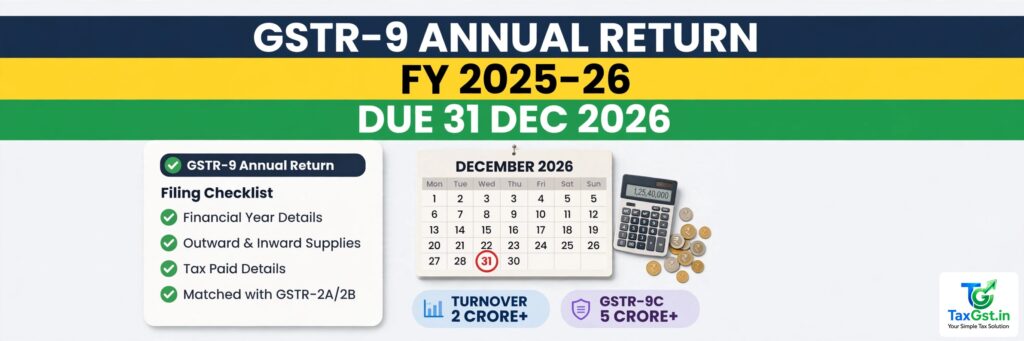
December is the cruellest month in the GST calendar. October’s GSTR-3B is barely filed and November’s returns are queuing up, and sitting at the end of the month is a return most businesses file exactly once a year. GSTR-9 is the year’s closing statement: everything you declared in GSTR-1 and GSTR-3B, reconciled against your books, in one place. Get it right and the year is closed cleanly. Rush it, and the mismatches you bury in December become the notices of next year.
What GSTR-9 actually is
GSTR-9 is the annual return under Section 44 of the CGST Act, read with Rule 80 of the CGST Rules. It has 19 tables across six parts, and it asks for information that should already exist in your monthly returns — outward supplies, inward supplies, input tax credit claimed and reversed, tax paid, refunds, demands. The catch is the word “should”. In practice, the annual return is where the year’s small differences surface: a credit note your accountant booked in April but the supplier reported in May, an invoice that sat in GSTR-2B in a different month from your books, a reversal you meant to make and never did.
The return is largely auto-filled from your GSTR-1 and GSTR-3B data. That saves typing, but it does not save thinking: the auto-filled figures are a starting point, and several tables are editable. If you submit without reconciling, you are certifying numbers you have not checked. For the full picture of the year’s deadlines, see the compliance calendar hub with every GST and income-tax due date.
Who must file — and who can skip it
The test is aggregate turnover for FY 2025-26, counted at PAN level across all your GST registrations in India — not per GSTIN. If you hold three GSTINs in three states with a combined turnover of ₹3 crore, you file GSTR-9 for each GSTIN, even though each state on its own is below ₹2 crore. Aggregate turnover includes taxable supplies, exempt supplies, exports and inter-state supplies, excluding GST itself.
| Aggregate turnover, FY 2025-26 | GSTR-9 | GSTR-9C |
|---|---|---|
| Up to ₹2 crore | Optional | Not required |
| Above ₹2 crore, up to ₹5 crore | Mandatory | Not required |
| Above ₹5 crore | Mandatory | Mandatory (self-certified) |
The ₹2 crore exemption comes from Notification No. 15/2025–Central Tax, dated 17 September 2025, and applies from FY 2024-25 onwards. GSTR-9C, the reconciliation statement, is required under Rule 80(3) once turnover exceeds ₹5 crore — exactly ₹5 crore is below the line — and it has been self-certified by the taxpayer since 1 August 2021; no CA or CMA certification is needed. One trap worth knowing: as per CBIC Circular No. 246/03/2025-GST, dated 30 January 2025, your annual return counts as filed only when both GSTR-9 and GSTR-9C are in. File GSTR-9 on time but leave 9C pending, and the late fee keeps running.
What changed for FY 2025-26
Notification No. 05/2026–Central Tax, dated 26 October 2026, makes the GSTR-9/9C reporting relaxations permanent from FY 2025-26: the tables that were optional last year stay optional, and no new tables are added. And as our practical guide to the 1 November GST changes explains, the inverted-duty refund formula now sits on a statutory footing — if you claimed one this year, check the amount in your GSTR-9 matches the refund order, not just the claim. The GSTN enabled filing on the portal in October 2026, so there is no reason to leave the return to the last week of December.
The 30 November trap: claim your credit first
Here is the sequencing mistake that costs real money. Under Section 16(4) of the CGST Act, you can claim input tax credit on FY 2025-26 invoices only until 30 November 2026 — or the date you file GSTR-9, whichever is earlier. File GSTR-9 on 25 November and you have just cut your own credit window short by five days. File it in December having forgotten a supplier’s invoice, and that credit is gone for good.
So the order of work is fixed: first, reconcile GSTR-2B against your purchase register and chase every missing invoice; second, claim all eligible credit in the October GSTR-3B (due 20 November); third, file GSTR-9. Our guide to the 30 November ITC deadline walks through the exact cut-off mechanics. If your reconciliation throws up a shortfall, pay it through Form DRC-03 before you file GSTR-9, with interest, so the annual return does not itself become the trigger for a demand.
Late fee: what a missed 31 December costs
The late fee for GSTR-9 runs at ₹200 a day (₹100 CGST + ₹100 SGST), capped at 0.04% of your turnover in that state, under Notification No. 7/2023–Central Tax. For a nil return it is ₹20 a day, capped at ₹500. A business with ₹4 crore turnover that files a month late pays roughly ₹6,000 — not ruinous, but the fee is the smallest part of the cost. The real cost is interest on any additional tax the return reveals. If you are also late on monthly returns, the maths compounds: see the worked examples of GSTR-3B late fee and interest.
A five-step checklist before you hit submit
- Reconcile GSTR-2B with your purchase register for all twelve months, and chase suppliers for any invoice missing from 2B before 30 November.
- Match GSTR-1 with your sales register. Every credit note and debit note must appear in both places, in the same month.
- Check the ITC tables. Reversals under Rule 37 (unpaid suppliers past 180 days) and Rule 38 must already be in your 3B filings — GSTR-9 only reports them, it does not fix them.
- Compare turnover with your audited financials. A gap between GST turnover and the profit-and-loss account is the first thing an officer asks about. If the gap is genuine — say, non-GST income — keep the working ready.
- File GSTR-9C in the same sitting if your turnover exceeds ₹5 crore. The return is not complete without it, and the late fee does not pause.
One last practical point: 31 December 2026 is a Thursday, so there is no weekend shift to hide behind, and the portal slows to a crawl in the final week every year. File in the first half of December. The return is not hard — it is just unforgiving of being left to the last day. For the rest of the year’s GST deadlines, keep the GST hub guides bookmarked alongside the calendar.
FAQs
Do I need to file GSTR-9 if my turnover is ₹1.5 crore?
No. Under Notification No. 15/2025–Central Tax, registered persons with aggregate turnover up to ₹2 crore in a financial year are exempt from FY 2024-25 onwards. You may still file voluntarily if you want the year’s reconciliation on record, but it is not compulsory.
My turnover is exactly ₹5 crore. Do I file GSTR-9C?
No. GSTR-9C applies only where aggregate turnover exceeds ₹5 crore. At exactly ₹5 crore you file GSTR-9 alone.
Can I revise GSTR-9 after filing?
No, there is no revision facility for GSTR-9. Errors are corrected through subsequent returns or DRC-03, which is why the pre-filing reconciliation matters more than the filing itself.
What if I file GSTR-9 on time but GSTR-9C late?
The late fee keeps running until both are filed, as clarified by Circular No. 246/03/2025-GST. The annual return is treated as complete only when GSTR-9C is in.
Sources
- Section 44, CGST Act, 2017 and Rule 80, CGST Rules — GSTR-9 and GSTR-9C applicability, thresholds and due date.
- CBIC Notification No. 15/2025–Central Tax, dated 17 September 2025 — exemption from GSTR-9 for aggregate turnover up to ₹2 crore, FY 2024-25 onwards.
- CBIC Notification No. 05/2026–Central Tax, dated 26 October 2026 — GSTR-9/9C optional tables made permanent from FY 2025-26.
- CBIC Notification No. 7/2023–Central Tax — late fee for GSTR-9; CBIC Circular No. 246/03/2025-GST, dated 30 January 2025 — GSTR-9C late-fee treatment.
- GSTN advisory, October 2026 — GSTR-9/9C filing enabled on the portal for FY 2025-26.
Discover more from TaxGst.in
Subscribe to get the latest posts sent to your email.