C.K. Gupta
Here is a number that should bother every salaried taxpayer in India. This year, net tax collected from individuals has grown just 5.3%. Net tax collected from companies has grown 17.8%. And yet the company pays 25.17% on its profit, while an individual earning above ₹24 lakh pays 31.2% — rising to 39% at the top. The company deducts depreciation and interest before it is taxed. The salary-earner gets a flat ₹75,000 standard deduction and, in the default regime, nothing at all for the interest on the home loan. As KBS Sidhu, IAS (retired) and former Special Chief Secretary of Punjab, put it: “The company takes the lift; the salary-earner climbs the ladder.”
Sidhu’s letter to Union Finance Minister Nirmala Sitharaman, sent on 13 November 2026, makes three specific suggestions for Budget 2027-28. None of them is law yet — treat this article as a guide to what has been proposed, not a promise of what will happen. For the collections figures behind the argument, see our report on direct tax collections to 10 November 2026.
The three suggestions, in plain English
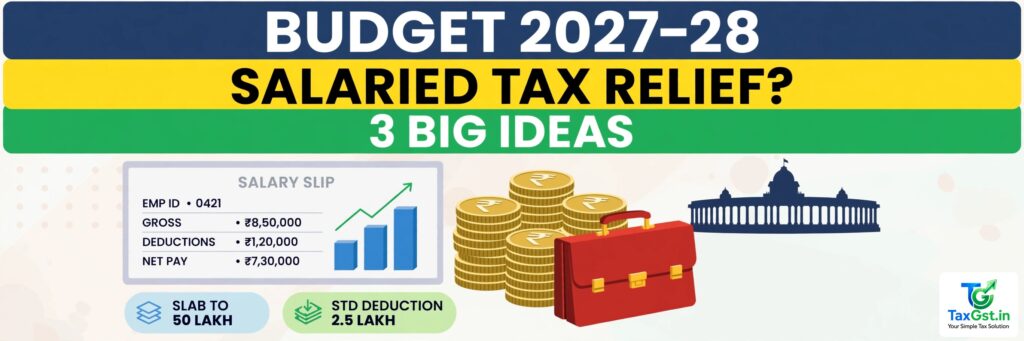
1. Extend the 25% slab up to ₹50 lakh. Today, under the default (new) regime, income above ₹24 lakh is taxed at 30%. Sidhu proposes that the 30% rate should begin only above ₹50 lakh, with everything from ₹20 lakh to ₹50 lakh taxed at 25%. This is the simplest of the three ideas, and the one that reaches the most people: anyone earning above ₹24 lakh benefits, and the benefit grows with income up to ₹50 lakh.
2. Make the standard deduction a proportion of salary. The standard deduction is currently a flat ₹75,000 for every salaried person, whatever they earn. Sidhu proposes 10% of salary, subject to a ceiling of ₹2.5 lakh. On a ₹30 lakh salary, that would mean a deduction of ₹2.5 lakh instead of ₹75,000 — an extra ₹1.75 lakh knocked off taxable income.
3. Allow housing-loan interest in the default regime — and raise the cap to ₹5 lakh. Under the old regime, interest on a home loan for a self-occupied house is deductible up to ₹2 lakh, a ceiling frozen since 2014. In the default regime it is not deductible at all. Sidhu proposes allowing it in the default regime, raising the ceiling to ₹5 lakh, and indexing slabs and limits to prices so they stop being quietly eroded by inflation.
What would you actually save?
Take a salaried person with taxable income of ₹30 lakh. Today’s tax: ₹20,000 on the 4–8 lakh slice, ₹40,000 on 8–12 lakh, ₹60,000 on 12–16 lakh, ₹80,000 on 16–20 lakh, ₹1,00,000 on 20–24 lakh, and ₹1,80,000 on the 24–30 lakh slice at 30% — ₹4,80,000, plus 4% cess, or ₹4,99,200.
| Proposal | Tax after change | Annual saving |
|---|---|---|
| 25% slab extended to ₹50 lakh | ₹4,68,000 | ₹31,200 |
| Standard deduction 10% (capped ₹2.5 lakh) | ₹4,44,600* | ₹54,600 |
| Housing-loan interest ₹5 lakh in default regime | ₹3,43,200* | ₹1,56,000 |
*Each row shows one change on its own against today’s tax of ₹4,99,200. Combined they would save roughly ₹2.4 lakh a year — but they interact, so do not simply add the rows.
The pattern matters more than any single figure. The slab change helps everyone above ₹24 lakh. The standard-deduction change helps higher earners most, because 10% of a bigger salary is a bigger deduction. The housing-interest change helps only people with a home loan — but for them it is by far the largest of the three, which is exactly why it has been frozen at ₹2 lakh since 2014 while house prices doubled. If you are weighing the old regime against the new one today, run the numbers first: our mid-year tax checklist shows which moves are still open before March.
Why the timing is not an accident
Pre-Budget suggestions arrive every November; most go nowhere. Three things make this one worth reading. First, the messenger: Sidhu is a former Principal Secretary (Finance) of Punjab, writing from the Department’s own published figures rather than from a wishlist. Second, the numbers genuinely leave room: net direct tax collections to 10 November 2026 stand at ₹14.42 lakh crore, up 11.76%, with more than half of the year’s Budget estimate of ₹26.97 lakh crore already in hand. Third, the Finance Minister has already shown a willingness to move on this exact question: Budget 2025 made incomes up to ₹12 lakh effectively tax-free under the new regime, and she has said publicly she is open to hearing views on capital-gains reform ahead of the next Budget — a debate our Budget 2027-28 LTCG article and our report on the FM’s LTCG signal both track.
None of that makes these three proposals likely. The Revenue Department will cost them — Sidhu himself has asked it to — and the costing is where proposals usually shrink: the housing-interest change alone would cost thousands of crores, and every crore of relief is a crore the Budget must find elsewhere. The honest way to read this letter is as the opening bid in the Budget 2027-28 debate, not as a forecast. For the full framework of the tax system these changes would sit inside, see the income-tax hub guides.
What to do with this before the Budget
- Do not change your regime choice on the basis of proposals. Your FY 2026-27 tax is governed by the law as it stands today.
- If you have a home loan, keep the interest certificates. Whether or not the cap rises, the old regime still allows ₹2 lakh — and if the default regime ever allows it, you will need the certificate either way.
- Watch 1 February 2027. Budget day is when proposals become law or die. The slab change, if accepted, would show up in the Finance Bill the same day; the standard deduction and housing-interest changes would too.
The salaried middle class pays its tax before it ever sees the money — deducted at source, every month, without a dispute. That is why it rarely makes the news, and why a letter like this one matters: it puts a number on the gap between what companies pay and what salary-earners pay, and it names three concrete ways to close it. Whether the Budget listens is a question for February. Until then, know the proposals, know the maths, and do not mistake either for a promise.
FAQs
Is the 25% slab up to ₹50 lakh now law?
No. It is a proposal in a letter from KBS Sidhu to the Finance Minister dated 13 November 2026. Only the Finance Bill in Budget 2027-28 can change the slabs.
Would the standard deduction change help someone earning ₹10 lakh?
Barely. At 10% of salary, a ₹10 lakh salary gives a ₹1 lakh deduction versus today’s ₹75,000 — an extra ₹25,000 of deduction, worth about ₹2,600 a year at the 10% marginal rate. The proposal is aimed at middle and higher earners.
Why is housing-loan interest not deductible in the new regime?
The default regime was designed as a low-rate, no-exemption system: lower slabs in exchange for giving up most deductions, including the ₹2 lakh housing-interest deduction that the old regime still allows for a self-occupied house.
When is Budget 2027-28 presented?
The Union Budget is traditionally presented on 1 February. The proposals discussed here would be decided then, if at all.
Sources
- Yes Punjab News, 13 November 2026 — “Individual Income Tax Collections Rise Just 5.3%, Corporate Tax Surges 17.8%: KBS Sidhu Writes to FM, Seeks Relief for Salaried Class” (letter dated 13 November 2026; three suggestions quoted verbatim; collections figures as on 10 November 2026).
- Income Tax Department, direct tax collections table (TINMIS), 11 November 2026 — net collections ₹14.42 lakh crore (+11.76%), gross ₹17.50 lakh crore (+14.02%); Budget estimate ₹26.97 lakh crore; STT +51.6%.
- Finance Act, 2025 and Income-tax Act, 2025 — default-regime slabs (30% above ₹24 lakh), standard deduction ₹75,000, housing-loan interest cap ₹2 lakh (old regime, self-occupied house).
Discover more from TaxGst.in
Subscribe to get the latest posts sent to your email.