
 C.K. Gupta
Every November, the Income Tax Department publishes its collections scoreboard — and this year’s tells two different stories. Companies are paying far more tax. Individuals, barely more. And the department is paying back far more in refunds than it did a year ago. If you are a salaried taxpayer wondering why your refund took months, or whether the next Budget might finally cut your slab rates, these numbers are the reason both conversations are happening.
The headline numbers
As per the Income Tax Department’s table “Direct Tax Collections for F.Y. 2026-27 (as on 10.11.2026)”, published on 11 November 2026 — the full context sits in the income-tax hub guides:
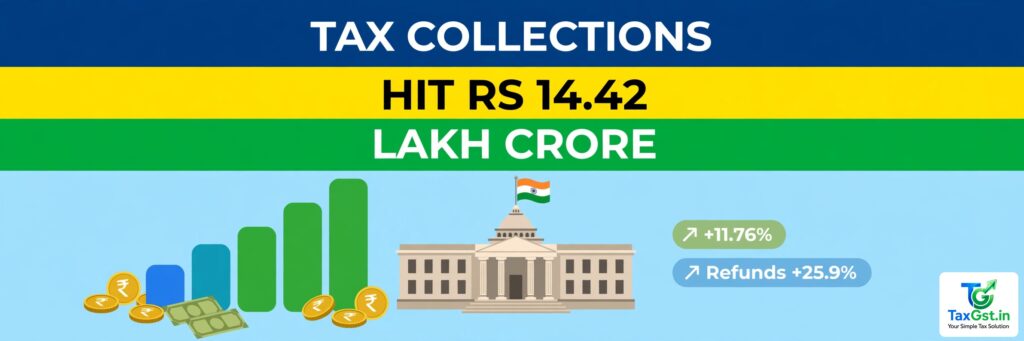
- Net direct tax collections: ₹14.42 lakh crore (₹14,41,978.91 crore), up 11.76% from ₹12.90 lakh crore in the same period last year.
- Gross collections: ₹17.50 lakh crore, up 14.02%.
- Refunds: ₹3.08 lakh crore, up 25.91% — refunds are now 17.6% of gross collections, against 16.0% a year ago.
- Net corporate tax: ₹6.32 lakh crore, up 17.8%.
- Net non-corporate tax: ₹7.56 lakh crore, up just 5.3%.
- Securities transaction tax: up 51.6% — the stock market’s contribution keeps climbing.
The split matters. “Non-corporate tax” covers individuals, HUFs, firms and associations — but for most readers it is, in practice, personal income tax, and it rests largely on tax deducted from salaries. Corporate advance tax alone was up 18.09% as on 17 September. Companies are having a strong year; salaried India is not paying much more tax than last year — and is claiming far bigger refunds.
If your own refund is among those ₹3.08 lakh crore, and it has not arrived, our ITR refund tracking and reissue guide explains every status and how to raise a reissue request. And if a notice followed your filing instead, the scrutiny notice guide covers what a 143(2) notice means and how to reply.
Why refunds jumped 54% for individuals
Look closer at the refund figures and the story sharpens. Non-corporate gross collections rose 10.7% (from ₹8.08 lakh crore to ₹8.95 lakh crore) — but non-corporate refunds rose 54.0%, from ₹0.90 lakh crore to ₹1.39 lakh crore. Corporate refunds, by contrast, rose only 9.6%.
That is why net non-corporate growth is stuck at 5.3% even though gross collections grew twice as fast: the department paid back a much larger share of what it collected from individuals. The department’s table does not explain why refunds rose — it never does — but the pattern fits what filers already know. The new tax regime’s higher basic exemption and the revised slabs mean more salaried taxpayers end the year with excess TDS to claim back, and the department has been processing refunds faster in volume terms. For the individual filer, a 54% jump in refunds paid is good news in the aggregate — even if your own refund is still the one stuck in the queue.
Here is the catch, though: a refund is your own money coming back late, not a benefit. If you consistently get large refunds, your employer is deducting too much through the year. Check your Form 12BB declaration and your regime choice — our salary TDS fix guide shows how to correct it mid-year instead of waiting for a refund.
What it means for Budget 2027-28
The lopsided numbers have already entered the pre-Budget debate. Former Punjab Special Chief Secretary KBS Sidhu, analysing the same department figures, has pointed out that a salaried individual pays 31.2% above ₹24 lakh (rising to 39% with surcharge), while a domestic company pays 25.17% including surcharge and cess at every level of profit — and the Budget papers put the rate companies actually pay at 22.47%. His submission to the Finance Minister asks for three reliefs for the salaried class, including extending the 25% slab up to ₹50 lakh so the 30% rate begins only above that level.
These are suggestions submitted to the Finance Minister, not government decisions — treat them as expectations, not fact. But the direction of travel is worth noting: when corporate collections surge 17.8% and individual collections crawl at 5.3%, the fiscal room for middle-class relief exists, and the political pressure to use it grows. The Budget 2027-28 expectations series on this site has already covered the LTCG debate and the SEBI proposal on foreign-equity gains — see the SEBI LTCG proposal and Budget 2027-28 expectations.
One more date to keep in mind: advance tax. The third instalment falls due on 15 December 2026, and corporate advance tax strength suggests the December numbers will be watched closely. If you are a freelancer or trader, our advance tax third-instalment guide works through the 75% cumulative target and the 234C interest on shortfalls.
What should you actually do with this?
Macro numbers do not file your return. But three practical moves follow from them:
- Check your refund status now, not in March. With refunds running 25.91% higher, processing volumes are heavy — a stuck refund caught early is easier to fix than one chased in the last quarter. Track it on the e-filing portal and raise a reissue request if the status has not moved in 30 days.
- Fix your TDS, don’t celebrate your refund. A ₹60,000 refund means ₹5,000 a month of your salary sat with the government interest-free. Correct your investment declaration with your employer before December payrolls lock in.
- Plan December, not April. The 15 December advance-tax instalment and the 31 December revised-return window are the two dates that decide whether FY 2026-27 ends cleanly for you. The compliance calendar hub lists every December deadline in one place.
FAQs
What are net direct tax collections?
Gross collections minus refunds issued. For 1 April to 10 November 2026: gross ₹17.50 lakh crore minus refunds of ₹3.08 lakh crore gives net collections of ₹14.42 lakh crore.
Why did corporate tax grow 17.8% but individual tax only 5.3%?
Net non-corporate growth was held down by refunds: non-corporate refunds rose 54.0% while gross non-corporate collections rose 10.7%. Corporate refunds rose only 9.6%, so corporate net growth stayed high. The department’s table does not give a reason for the refund surge.
Does this mean income tax rates will fall in Budget 2027-28?
No decision has been announced. Pre-Budget suggestions — including extending the 25% slab to ₹50 lakh — have been submitted to the Finance Minister, but they are proposals. The collections data gives the government fiscal room; it does not guarantee relief.
Is STT part of direct tax collections?
Yes, securities transaction tax is counted in direct tax collections, and it grew 51.6% in this period — reflecting heavy market activity rather than any rate change.
Where do these figures come from?
The Income Tax Department’s official table “Direct Tax Collections for F.Y. 2026-27 (as on 10.11.2026)”, sourced from TINMIS and published on 11 November 2026. The figures are provisional.
Sources
- Income Tax Department, “Direct Tax Collections for F.Y. 2026-27 (as on 10.11.2026)” (TINMIS), published 11 November 2026 — net collections ₹14,41,978.91 crore (+11.76%), gross ₹17,50,285.89 crore (+14.02%), refunds ₹3,08,306.98 crore (+25.91%).
- KBS Sidhu, IAS (retd.), analysis of the Income Tax Department figures, reported 13 November 2026 — pre-Budget suggestions to the Union Finance Minister, including extending the 25% slab to ₹50 lakh.
Discover more from TaxGst.in
Subscribe to get the latest posts sent to your email.