C.K. Gupta
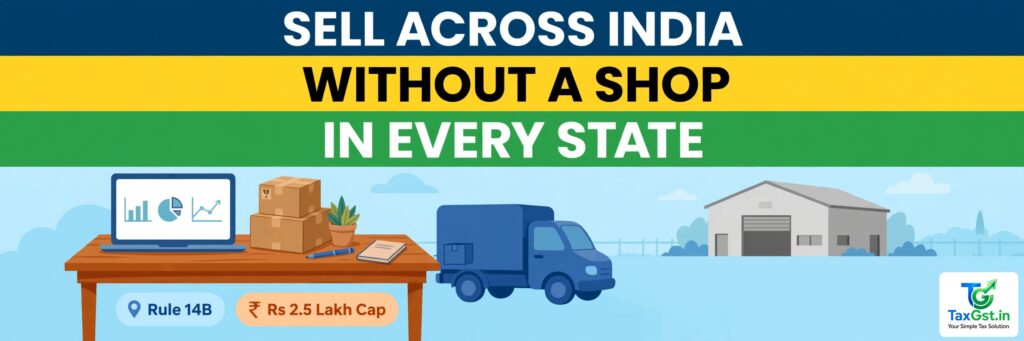
Picture this: you make handmade candles in Jaipur and sell them on Amazon and Flipkart. Orders start coming from customers in Maharashtra, Tamil Nadu and West Bengal — and every marketplace asks for a GST registration in each of those states before it will let you stock goods in its warehouses there. Renting a godown in three states just to get a registration was never realistic. That is exactly the problem Rule 14B, live from 1 November 2026, was written to solve.
Under the new rule, an eligible small seller supplying goods through an e-commerce operator can declare the operator’s warehouse in a state as their principal place of business, and get registered there without any physical premises of their own. Here is how it works in practice, who qualifies, and where the traps are.
What Rule 14B actually says
Rule 14B was inserted into the CGST Rules by the CGST (Amendment) Rules, 2026 — Notification No. 05/2026–Central Tax, dated 26 October 2026 — and a GSTN advisory of 1 November 2026 switched the facility on. It is part of the first phase of the 57th GST Council’s process reforms, approved on 8 October 2026, and it sits alongside the other November changes covered in the GST hub guides.
The mechanics are simple. When you apply for registration in a state where you have no place of business, you can now name the warehouse of the e-commerce operator (Amazon, Flipkart, Meesho and the like) as your principal place of business in that state. The operator’s warehouse address goes on your REG-01 application, and the registration is granted for supplies made through that operator.
If you are new to registration altogether, start with the GST registration threshold, documents and process guide — it explains the ₹40 lakh (goods) and ₹20 lakh (services) limits and the compulsory-registration cases where no threshold applies. For the wider picture of what changed on 1 November, see the complete guide to the 1 November 2026 GST changes.
Who can use it — and the ₹2.5 lakh monthly cap
The facility is deliberately narrow. Three conditions decide eligibility:
- Small sellers only. Your output tax liability on supplies to registered persons in that state must not exceed ₹2.5 lakh per month — CGST, SGST/UTGST and IGST combined. Stock transfers between your own distinct persons (your registrations in different states) do not count towards this cap.
- E-commerce only. The Rule 14B registration must be used exclusively for supplies made through e-commerce operators. The moment you start making offline or direct supplies from that registration, you are outside the facility.
- One warehouse, one state. The registration is tied to the operator’s warehouse you declare. If you stock with two operators in the same state, take advice on which warehouse to declare — the portal expects a single principal place of business.
Here is the catch most sellers miss: the ₹2.5 lakh cap counts only your liability to registered buyers. Supplies to unregistered consumers (B2C) do not eat into the cap. But if your B2B sales through the platform grow past the cap, the facility stops fitting you — you will need a regular registration with your own place of business in that state.
Worked example: a Jaipur seller goes national
Meera sells brass home décor from Jaipur. Her turnover is ₹38 lakh a year, and she is registered in Rajasthan. Flipkart offers her warehouse space in Maharashtra and West Bengal. Before 1 November 2026, she would have needed a rented premises in each state to register there. Now:
- She applies for a Maharashtra registration under Rule 14B, declaring Flipkart’s Bhiwandi warehouse as her principal place of business.
- Her monthly output tax on B2B supplies from that warehouse is about ₹90,000 — well inside the ₹2.5 lakh cap.
- She can stock and sell in Maharashtra without renting a single square foot. The same route works for West Bengal.
The saving is not just rent. It is the difference between selling nationally and staying stuck in one state. That is the whole point of the reform — and it is why the GST hub guides treat Rule 14B as the single most useful 1 November change for small online sellers.
What to file, and what can still go wrong
The application itself runs through the revised REG-01, which was also overhauled on 1 November 2026 — standardised premises proofs, up to 10 bank accounts, and online CIN/LLPIN validation. Our revised REG-01 guide walks through every new field.
A short checklist before you apply:
- Confirm the warehouse address with the operator — get it in writing, with the operator’s GSTIN for that state. A wrong address is the commonest reason for a clarification notice.
- Track the ₹2.5 lakh cap monthly, state by state. Set a simple spreadsheet: month, state, output tax on B2B supplies. Breach it and you need a regular registration.
- Keep supplies through the operator only under this registration. A single direct sale invoiced from that GSTIN can put the registration itself in question.
- Watch your ITC. The cap limits the tax you pass on; it does not change your input tax credit rules. Reconcile your ITC every month — and remember that 30 November 2026 is the last day to claim FY 2025-26 ITC under Section 16(4).
One more thing: Rule 14B does not remove the e-commerce operator’s own obligations. TCS under Section 52 still applies to the operator, and your supplies through the platform still show up in your GSTR-1. The facility changes where you can register — not how much tax you pay.
FAQs
Can I use Rule 14B if I already have a regular registration in that state?
No — Rule 14B is for states where you have no place of business and no registration. If you already hold a regular registration there, you do not need it.
Does the ₹2.5 lakh cap include IGST on inter-state supplies?
Yes. The cap is your total output tax liability — CGST, SGST/UTGST and IGST combined — on supplies to registered persons in that state. Only stock transfers to your own distinct persons are excluded.
Can I sell on two marketplaces from one Rule 14B registration?
The registration must be used exclusively for supplies through e-commerce operators, and it is tied to the warehouse you declare as your principal place of business. If you stock with a second operator in the same state, check with your adviser whether a separate registration or an amendment is the right route — do not assume one registration covers both warehouses.
What happens if my B2B tax crosses ₹2.5 lakh in a month?
You outgrow the facility. You will need a regular registration in that state with your own principal place of business. Track the number monthly so the switch happens on your terms, not after a department notice.
Is Rule 14B available to service sellers?
It is designed for sellers of goods stocking with e-commerce operators. Service providers supplying through operators should check the advisory wording for their specific case before applying.
Sources
- Notification No. 05/2026–Central Tax, dated 26 October 2026 (CBIC) — CGST (Amendment) Rules, 2026, inserting Rule 14B and substituting Rules 19 to 21.
- GSTN advisory dated 1 November 2026 — simplified registration facility under Rule 14B for e-commerce sellers; ₹2.5 lakh monthly output-tax ceiling.
- 57th GST Council meeting decisions, 8 October 2026 (GST Council) — process reforms approved for phased implementation from 1 November 2026.
Discover more from TaxGst.in
Subscribe to get the latest posts sent to your email.