C.K. Gupta
In short
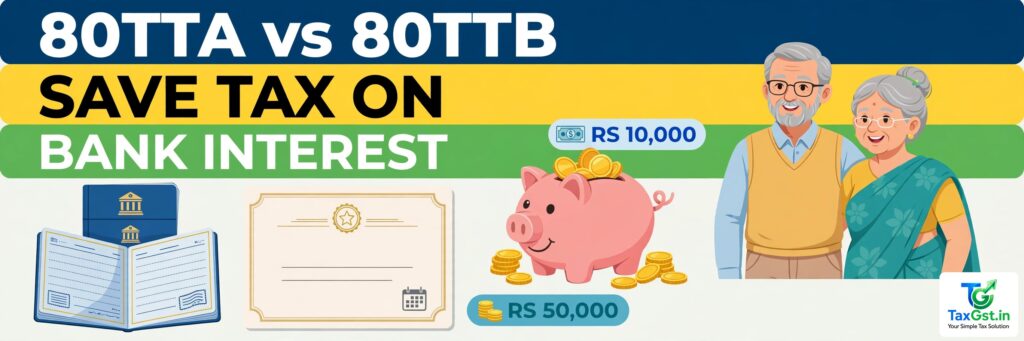
Section 80TTA lets individuals under 60 and HUFs deduct up to ₹10,000 a year of savings-account interest only — fixed-deposit and recurring-deposit interest does not count. Section 80TTB replaces it for resident senior citizens aged 60 and above: up to ₹50,000 a year, and it covers savings, fixed-deposit and recurring-deposit interest together. You claim one or the other, never both, and both exist only under the old tax regime — the new regime gives no deduction for interest income at all. Under the Income-tax Act, 2025, both provisions sit together in Section 153(2)(a) and (2)(b). Verified November 2026 · TaxGST.in
Ramesh, 58, earned ₹14,000 interest on his savings account and ₹60,000 on fixed deposits last year. He claimed a ₹50,000 deduction for the lot and filed happily — until the processing intimation disallowed ₹40,000 of it. His mistake was assuming every rupee of bank interest is deductible. It is not: under 60, only savings-account interest qualifies, and only up to ₹10,000. His father, 68, earned the same interest and claimed the full ₹50,000 without a problem — because at 60 the rules change completely. For the wider set of deductions these two sit among, keep the deductions hub — 80C, 80D, 80CCD and the rest in one place open alongside this guide.
What each section covers
| Section 80TTA | Section 80TTB | |
|---|---|---|
| Who | Individuals below 60 and HUFs | Resident senior citizens, 60 and above |
| Cap | ₹10,000 per year | ₹50,000 per year |
| Interest that counts | Savings account only (bank, co-operative bank, post office) | Savings + fixed deposits + recurring deposits |
| Regime | Old regime only | Old regime only |
| New-Act home | Section 153(2)(a), Income-tax Act, 2025 | Section 153(2)(b), Income-tax Act, 2025 |
The dividing line is age, not choice: anyone below 60 must use 80TTA, anyone 60 or above must use 80TTB, and the two are never available together to the same person. Section 80TTB was introduced by the Finance Act, 2018 specifically for senior citizens, and it is the more generous provision in every dimension — five times the cap, and fixed and recurring deposits included. If you turned 60 at any time during the financial year, you are a senior citizen for that year and 80TTB is your section.
Worked examples: the same interest, two different answers
Ramesh, 58 — savings interest ₹14,000, FD interest ₹60,000. Under 80TTA he can deduct ₹10,000 — the savings interest, capped. The ₹60,000 of FD interest gets no deduction at all. Total interest income ₹74,000; deduction ₹10,000; taxable interest ₹64,000, taxed at his slab rate. His claim of ₹50,000 was wrong by ₹40,000, which is exactly what the intimation disallowed.
His father, 68 — savings interest ₹12,000, FD interest ₹58,000. Under 80TTB the whole ₹70,000 of interest is eligible, and the cap is ₹50,000. Deduction ₹50,000; taxable interest ₹20,000. At a 30% slab rate, the deduction is worth ₹15,000 of tax saved — and if his total FD interest had stayed under ₹50,000, the interest would have been effectively tax-free in the old regime, subject to his overall income and slab position. To see what the two regimes do to your own numbers, run both regimes on the income-tax calculator — for many pensioners, the 80TTB deduction alone is what makes the old regime win.
One more comparison, because it decides real filings: a senior citizen with ₹45,000 of FD interest and ₹8,000 of savings interest — ₹53,000 in total — deducts ₹50,000 under 80TTB and pays tax on ₹3,000. A 58-year-old with the identical ₹53,000 deducts ₹8,000 (the savings interest, under the ₹10,000 cap) and pays tax on ₹45,000. Same interest, same bank, ₹37,000 of extra taxable income — decided by a birthday.
Three mistakes that cost real money
1. Claiming FD interest under 80TTA. This is the single most common error in this area, and it is exactly what Ramesh did. Fixed-deposit and recurring-deposit interest is fully taxable for non-seniors, with no deduction of any kind — not under 80TTA, and not anywhere else. If your return claims it, the department’s processing will strip it out, and the mismatch can invite a closer look at the rest of the return.
2. Confusing “no TDS” with “no tax”. Banks deduct TDS on FD interest once it crosses ₹50,000 a year for non-seniors and ₹1,00,000 for senior citizens per bank — thresholds raised by the Finance Act, 2025 with effect from 1 April 2025. TDS is a withholding mechanism, not the tax itself: interest below the threshold still has to be reported under Income from Other Sources and taxed at your slab rate. From 1 April 2026 the withholding rule sits in Section 393 of the Income-tax Act, 2025 (earlier Section 194A of the 1961 Act). Our guide to TDS on FD interest — thresholds, Form 15G and the senior-citizen rules covers the withholding side in full.
3. Choosing the new regime and forgetting the deduction dies with it. Both sections sit in Chapter VI-A, and Chapter VI-A is almost entirely blocked under the new regime — the same way 80C and 80D are blocked. Under the new regime, every rupee of savings, FD and RD interest is taxed at slab rate with no deduction at all, for non-seniors and seniors alike. For a senior citizen with ₹50,000 of FD interest, that is a ₹15,000 swing at the 30% slab — enough, on its own, to make the old regime the better choice. Before you lock in a regime, read the deductions beyond 80C, 80D and 80CCD and the senior and super-senior citizen tax benefits guide, and compare the two regimes on your actual figures rather than on habit. And if you are 75 or above with only pension and bank interest, your bank may file your return for you under Section 194P — worth knowing before you do the paperwork yourself.
How to claim it
The deduction is not automatic. Report the full interest income under Income from Other Sources first — every account, every bank — and then claim the deduction under the right section in the Chapter VI-A schedule. Report what your AIS shows and reconcile any difference before filing rather than after a notice arrives. If a bank has deducted TDS, claim the credit in the TDS schedule against the same return; the deduction and the TDS credit are separate lines, and both need to be right. For tax year 2026-27, the new-Act references are Section 153(2)(a) for the ₹10,000 deduction and Section 153(2)(b) for the ₹50,000 one — the old 80TTA/80TTB numbers still appear in older guidance and in the 1961 Act, which continues to govern returns for FY 2025-26 (AY 2026-27).
FAQs
Can I claim both 80TTA and 80TTB?
No. Age decides: below 60 you use 80TTA (₹10,000, savings interest only); at 60 or above you use 80TTB (₹50,000, savings plus FD and RD interest). The two are never available together to the same person in the same year.
Is FD interest covered under 80TTA?
No. Section 80TTA covers savings-account interest only, up to ₹10,000 a year. Fixed-deposit and recurring-deposit interest is fully taxable for non-senior taxpayers, with no deduction under any section.
Are 80TTA and 80TTB available in the new tax regime?
No. Both are Chapter VI-A deductions and are available only under the old regime. Under the new regime, all bank interest is taxed at slab rate with no deduction — which is why senior citizens with large FD interest often pay less tax under the old regime.
What is the TDS threshold on FD interest?
Banks deduct TDS on FD interest above ₹50,000 a year for non-seniors and ₹1,00,000 for senior citizens, per bank (thresholds raised by the Finance Act, 2025, effective 1 April 2025). No TDS does not mean no tax — the interest must still be reported and taxed.
At what age does 80TTB start applying?
At 60. A resident individual who is 60 or above at any time during the financial year is a senior citizen for that year and claims under 80TTB instead of 80TTA.
Sources
Section 153(2)(a) and (2)(b) of the Income-tax Act, 2025 (earlier Sections 80TTA and 80TTB of the Income-tax Act, 1961); Finance Act, 2018 (introduction of Section 80TTB); Finance Act, 2025 (TDS thresholds on interest, effective 1 April 2025); Section 393 of the Income-tax Act, 2025 (TDS on interest from 1 April 2026; earlier Section 194A of the 1961 Act).
Discover more from TaxGst.in
Subscribe to get the latest posts sent to your email.