C.K. Gupta
In short
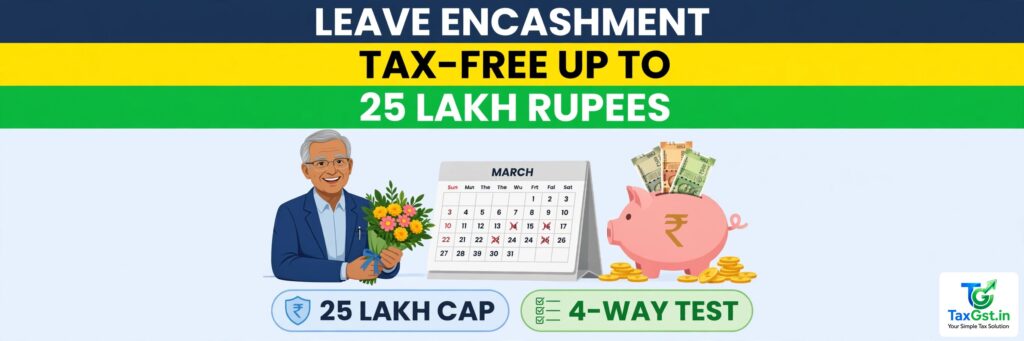
Leave encashment received at retirement is tax-free up to ₹25 lakh for private-sector employees — but only the least of four amounts: what you actually received, ₹25 lakh, ten months’ average salary, and the cash value of your unused leave (capped at 30 days per completed year of service). The ₹25 lakh is a lifetime cap across all employers, not per job. Government employees get the full amount exempt with no cap. Encashment taken during service is fully taxable. The exemption applies under both the old and the new tax regime. Verified November 2026 · TaxGST.in
Rajesh retired last month after 28 years with the same company. His employer paid him ₹18 lakh for 240 days of unused earned leave — and his Form 16 showed the entire ₹18 lakh as taxable salary. He assumed the ₹25 lakh leave-encashment exemption he had read about would apply automatically. It did not: the exemption is the least of four amounts, and in his case the leave-value limb came to far less than ₹18 lakh. The difference was taxed at his slab rate. For the full picture on salary taxation, keep the deductions and exemptions hub open alongside this guide.
The rule in one paragraph
Leave encashment is cash paid by an employer against unused earned leave standing to an employee’s credit. Under Section 10(10AA) of the Income-tax Act, 1961 — carried forward as Section 11 read with Schedule II of the Income-tax Act, 2025, which applies from 1 April 2026 — the tax treatment turns on when you receive it and who employs you. Encashment during service is fully taxable as salary, with no exemption at all. Encashment at retirement is fully exempt for Central and State Government employees, with no ceiling. For everyone else — private companies, PSUs, banks, LLPs, trusts — the exemption is the least of four amounts, capped at ₹25 lakh over your whole career.
The ₹25 lakh figure was raised from ₹3 lakh by the Finance Act, 2023, notified by CBDT Notification No. 31/2023 dated 24 May 2023 with effect from 1 April 2023. The old ₹3 lakh limit had stood unchanged since 2002. The new limit applies unchanged for tax year 2026-27.
The four-way test — where most mistakes happen
For a non-government employee, the exempt amount is the lowest of:
- The actual leave encashment received — the gross cash amount the employer pays.
- ₹25,00,000 — the notified ceiling, reduced by any exemption you have already claimed in an earlier year. It is a lifetime aggregate, not a fresh allowance at each job.
- Ten months’ average salary — your average monthly salary (basic plus dearness allowance forming part of retirement benefits) over the ten months immediately before retirement, multiplied by ten.
- Cash equivalent of earned leave to your credit — computed as (average monthly salary ÷ 30) × the number of days of earned leave standing to your credit, capped at 30 days for each completed year of service.
Here is the catch: limb 4 is the one that usually decides the answer, and it is the one people forget. Your employer may owe you 240 days of leave, but if you worked 28 years, only 30 × 28 = 840 days can count — that is rarely binding. What usually binds is the salary: if your average monthly salary in the last ten months was ₹1,20,000, limb 3 caps the exemption at ₹12,00,000 and limb 4 caps it at (₹1,20,000 ÷ 30) × your leave days. Rajesh’s 240 days at ₹1,20,000 a month gives (₹4,000 × 240) = ₹9,60,000 — that, not ₹18 lakh and not ₹25 lakh, was his exempt amount. The remaining ₹8,40,000 was taxable salary.
Worked example: the numbers side by side
Take Meena, retiring after 25 years with an average monthly salary (basic + DA) of ₹1,50,000 in her last ten months, and 300 days of earned leave to her credit. Her employer pays ₹15,00,000.
| Limb | Amount |
|---|---|
| 1. Actual received | ₹15,00,000 |
| 2. Notified ceiling | ₹25,00,000 |
| 3. Ten months’ average salary (₹1,50,000 × 10) | ₹15,00,000 |
| 4. Leave value: (₹1,50,000 ÷ 30) × 300 days | ₹15,00,000 |
| Exempt (least of the four) | ₹15,00,000 — fully exempt |
Now change one fact: Meena’s leave balance is only 120 days. Limb 4 becomes (₹1,50,000 ÷ 30) × 120 = ₹6,00,000. Her exemption drops to ₹6,00,000 and ₹9,00,000 of the ₹15,00,000 becomes taxable — even though the employer paid the same amount for the same career. The leave balance, not the headline ceiling, decides the tax. In practice, this is why taking your leave — or checking your balance years before retirement — is a tax decision, not just a lifestyle one.
Five traps that cost real money
1. The ₹25 lakh cap is once in your career, not once per employer. If you claimed a ₹5,00,000 exemption when you left Company A in 2024, your remaining ceiling at Company B is ₹20,00,000. The employer will not know what you claimed before — you have to track it, and the figure sits in your old Form 16s.
2. Encashment during service is fully taxable. Many employers pay out accumulated leave at year-end or on a salary revision. That money is salary under Section 17(1) with no exemption, however large it is. If your employer offers a choice between encashing now or carrying leave forward to retirement, the tax difference is the whole exemption.
3. Resignation is a grey area — confirm before you rely on it. The section is framed for retirement (superannuation, voluntary retirement, or other formal retirement). In practice, most employers apply the same exemption when an employee resigns — but because the wording says retirement, a resignation claim is the one to get confirmed by your CA before you file. Do not assume it, and do not discover the problem from a notice.
4. Only earned leave counts. The exemption covers earned leave (privilege leave). Casual leave and sick leave encashed do not get the same treatment — check what your employer’s payout actually comprises before you apply the four-way test.
5. The new regime does not kill this exemption. Leave encashment under Section 10(10AA) is one of the few salary exemptions the new regime kept — it applies whether you file under the old regime or the default new regime. If your employer or your Form 16 suggests otherwise, that is a payroll error worth correcting. And if your salary TDS looks higher than your actual tax, our guide to salary TDS — Form 12BB, regime declaration and mid-year fixes — explains how to correct it.
What to do before you retire
Check your leave balance now, not in your last month — every 30 days of unused earned leave is worth one month’s average salary of exemption, up to the caps. Collect your old Form 16s and note any exemption already claimed, since that reduces your remaining ₹25 lakh ceiling. Ask HR for the four-limb computation in writing before the payment is made — errors are far easier to fix before the money is paid than after the return is filed. Then work out your tax position on the income-tax calculator with and without the exemption, and run the 15-minute year-end tax health check to catch what you missed. If you are approaching 60, also read when your bank files your return for you after 75 and the extra ₹50,000 NPS deduction under Section 80CCD(1B).
FAQs
Is leave encashment tax-free up to ₹25 lakh for everyone?
No. The ₹25 lakh is a ceiling, not a flat exemption. The exempt amount is the least of four figures — actual receipt, ₹25 lakh, ten months’ average salary, and the cash value of leave capped at 30 days per year of service. Government employees are the only group with a fully exempt, uncapped amount.
I encashed leave while still employed. Is any of it exempt?
No. Encashment during service is fully taxable as salary. The exemption applies only to encashment received at retirement (and, in practice, usually at resignation — confirm with your CA).
Does the exemption apply under the new tax regime?
Yes. Section 10(10AA) is one of the exemptions retained under the new regime, so it applies under both regimes. If your Form 16 shows the full amount as taxable under the new regime, ask your employer to correct it.
Can I claim ₹25 lakh again if I change jobs?
No. The ceiling is a lifetime aggregate across all employers, reduced by whatever exemption you have already claimed. Your old Form 16s are the record of what you have used.
What counts as “salary” for the ten-month average?
Basic salary plus dearness allowance that forms part of retirement benefits, averaged over the ten months immediately before retirement. Allowances that do not form part of retirement benefits are excluded — which is why the figure in the computation can be lower than your take-home pay.
Sources
Section 10(10AA) of the Income-tax Act, 1961, carried forward as Section 11 read with Schedule II of the Income-tax Act, 2025 (in force from 1 April 2026). CBDT Notification No. 31/2023, dated 24 May 2023 — ceiling for non-government employees raised from ₹3,00,000 to ₹25,00,000 with effect from 1 April 2023. Finance Act, 2023 — the amending Act. Section 17(1) of the Income-tax Act, 1961 (Section 392 of the Income-tax Act, 2025) — leave encashment during service taxed as salary. CBDT Circular No. 573/1990 — clarifications on the Section 10(10AA) computation.
Discover more from TaxGst.in
Subscribe to get the latest posts sent to your email.