C.K. Gupta
In short
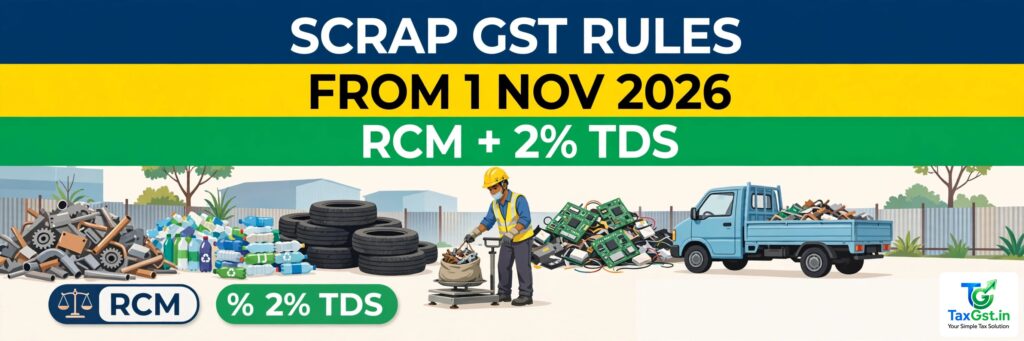
From 1 November 2026, used cooking oil, plastic waste and scrap, tyre waste and scrap, and e-waste join metal scrap under GST reverse charge and 2% GST TDS. Buy from an unregistered seller and you pay the GST yourself under reverse charge; buy from a registered seller on a contract above ₹2,50,000 and you deduct 2% TDS. Sellers of these goods must now register once turnover crosses the threshold, even if every sale is under reverse charge. Verified November 2026 · TaxGST.in
A recycler in Indore buys used cooking oil from a street collector for ₹40,000 a month. Until 31 October 2026, that purchase was simple: no GST on the invoice, no deduction, no return entry beyond the purchase itself. From 1 November, the same purchase carries a tax obligation — the recycler must pay GST on it under reverse charge, issue a self-invoice, and claim the credit back. And if the collector registers next month and the contract crosses ₹2,50,000, the recycler switches from paying GST to deducting 2% TDS instead. Same goods, same supplier, two different compliance regimes — and the switch depends entirely on whether the seller is registered. For the full GST picture, start with the complete GST compliance guides on the GST hub.
The change comes from three notifications issued on 26–27 October 2026 on the recommendations of the 57th GST Council (8 October 2026): Notification No. 4/2026–Central Tax (Rate) extends reverse charge, Notification No. 6/2026–Central Tax removes the registration exemption for these sellers, and Notification No. 7/2026–Central Tax extends the 2% GST TDS. It is the same three-rule model that has applied to metal scrap since 10 October 2024 — reverse charge, compulsory registration, TDS — now extended to four more categories of goods.
Which goods are covered now
The four additions, with their HSN chapters, are:
- Used cooking oil — HSN 1518, covered by Notification 4/2026–CT(R) S. No. 2A.
- Plastic waste and scrap — HSN 3915, S. No. 3B.
- Tyre waste and scrap — HSN 4004, S. No. 3C.
- Electrical and electronic waste and scrap — HSN 8549, S. No. 9.
- Metal scrap (Chapters 72 to 81) was already covered and stays covered.
If you deal in any of these — a recycler, a re-refiner buying used oil, a plastic granule maker, a tyre pyrolysis unit, an e-waste dismantler — the new rules touch you from 1 November 2026, whether you are the buyer or the seller.
Rule 1: reverse charge when the seller is unregistered
When a registered buyer purchases any of these goods from an unregistered seller, the buyer pays the GST under reverse charge (RCM). The seller charges nothing; the buyer computes the tax on the purchase value, pays it in cash (RCM tax cannot be paid from the credit ledger), and claims the input tax credit afterwards.
Here is the catch most buyers miss: reverse charge is not just a payment. For every such purchase you must issue a self-invoice under Section 31(3)(f) of the CGST Act and a payment voucher under Section 31(3)(g). No self-invoice, no valid credit — and the credit is the whole point of the exercise, since the tax you pay under RCM is otherwise a straight cost. Our e-invoicing guide explains who must issue e-invoices and the IRN mistakes that silently void one; note also that from 1 January 2027, buyers who must issue e-invoices will also have to report inward supplies taxed under reverse charge from unregistered persons (Notification No. 4/2026–Central Tax).
Worked example: a recycler buys plastic scrap worth ₹1,00,000 from an unregistered collector. GST at 18% is ₹18,000, paid in cash under RCM and claimed back as credit in the same month’s return — provided the purchase is used for taxable supplies. Net cash cost after credit: nil, but only if the paperwork is right.
Rule 2: 2% GST TDS when the seller is registered
Once the seller registers, reverse charge stops and a different rule starts. A registered buyer purchasing these goods from a registered seller must deduct 2% GST TDS — 1% CGST + 1% SGST/UTGST, or 2% IGST on inter-state purchases — from the payment, but only where the contract value exceeds ₹2,50,000 (excluding GST). The rate and threshold come from Section 51 of the CGST Act; Notification 7/2026–Central Tax substitutes clause (d) of Notification 50/2018–Central Tax to bring these goods in.
Two practical points. First, the ₹2,50,000 test applies per contract, not per invoice and not per month — a ₹3,00,000 annual supply contract triggers TDS on every payment under it, while three separate ₹1,00,000 contracts do not. Second, if you are not already registered as a tax deductor under Section 24(vi), you must register on FORM GST REG-07 and file GSTR-7 by the 10th of the following month, so the seller can see the TDS credit in their electronic cash ledger. The TDS is deposited through the challan system — see our step-by-step guide to paying GST online with a PMT-06 challan for the mechanics.
Worked example: the same recycler now buys from a registered plastic-waste dealer under a ₹4,00,000 contract (excluding GST). GST at 18% is ₹72,000, so the invoice totals ₹4,72,000. The recycler deducts 2% of ₹4,00,000 — ₹8,000 — and pays the dealer ₹4,64,000. The ₹8,000 reaches the dealer’s cash ledger after the recycler files GSTR-7.
Rule 3: sellers must register — the old exemption is gone
This is the rule that catches small collectors. Until now, a person whose supplies were entirely under reverse charge did not need to register at all, because Notification 5/2017–Central Tax exempted them. Notification 6/2026–Central Tax removes that exemption for suppliers of used cooking oil, plastic, tyre and metal scrap, and e-waste. The practical result: once your aggregate turnover crosses the registration threshold, you must register — even if every single buyer pays the tax under reverse charge. For the thresholds and the documents you will need, see the GST registration limits, documents and process guide.
And once you are registered, the loop closes: you charge GST on your invoices, and your buyers deduct 2% TDS on contracts above ₹2,50,000 instead of paying reverse charge. That is the design — an unregistered collector triggers reverse charge; a registered collector triggers TDS. Either way, the tax is captured at the buyer’s end.
The 1 November checklist for buyers and sellers
If you buy scrap, waste or used oil: list every unregistered supplier today and set up self-invoicing and payment vouchers for them. Check every supplier’s registration status at the time of purchase — the rule that applies turns on that status. If your contracts with registered sellers exceed ₹2,50,000, get your TDS registration (REG-07) in place and diarise GSTR-7 for the 10th of each month.
If you sell these goods: track your aggregate turnover against the threshold and register the moment you cross it — waiting for a buyer to ask is not a strategy. Once registered, expect 2% TDS on larger contracts and claim it in your electronic cash ledger after the buyer files GSTR-7.
One thing that has not changed: the 57th Council’s wider reforms that need a law amendment — including the higher prosecution threshold and the ₹10,000 notice floor — are not live yet. The notice floor is already in force as an administrative direction, as CBIC Instruction No. 02/2026-GST explains — no arrests, and no show-cause notice below ₹10,000. If a notice has already landed on your portal, the GST notice portal survival guide sets out the weekly check routine that stops ex-parte orders.
FAQs
Does the 2% GST TDS apply on every scrap purchase from a registered seller?
No. It applies only where the contract value exceeds ₹2,50,000 (excluding GST). Below that, the buyer pays the full invoice value and deducts nothing. The ₹2,50,000 test is per contract, not per invoice.
I buy used cooking oil from unregistered collectors. Do I pay GST on every purchase?
Yes — under reverse charge, from 1 November 2026. You pay the tax in cash, issue a self-invoice and payment voucher, and claim the credit in your return. The tax is a cost only if the paperwork is missing.
I am a small scrap collector with turnover below the threshold. Must I register?
Not yet. The registration rule bites once your aggregate turnover crosses the threshold. But track it monthly — the exemption that used to protect reverse-charge-only suppliers is gone, so crossing the threshold now means registration, with no grace period built into the notification.
What is the GST rate on these goods?
The rate itself did not change on 1 November — what changed is who pays it and how it is collected. Metal scrap, plastic scrap, tyre scrap and e-waste are generally taxed at 18%; used cooking oil follows its own classification. Check the rate on your invoice against the HSN, and use the Section 14 time-of-supply test for supplies straddling 1 November.
Does the TDS replace reverse charge?
No — they apply to different situations. Reverse charge applies when the seller is unregistered; TDS applies when the seller is registered and the contract exceeds ₹2,50,000. The two never apply to the same purchase.
Sources
Notification No. 4/2026–Central Tax (Rate), dated 27 October 2026 (CBIC) — reverse charge on used cooking oil, plastic waste and scrap, tyre waste and scrap, and e-waste supplied by unregistered persons, amending Notification No. 4/2017–Central Tax (Rate). Notification No. 6/2026–Central Tax, dated 27 October 2026 (CBIC) — removal of the registration exemption for suppliers of these goods, amending Notification No. 5/2017–Central Tax. Notification No. 7/2026–Central Tax, dated 27 October 2026 (CBIC) — 2% GST TDS on purchases of these goods from registered persons above ₹2,50,000 per contract, substituting clause (d) of Notification No. 50/2018–Central Tax. All issued on the recommendations of the 57th GST Council meeting, 8 October 2026. Section 51 (TDS) and Section 14 (time of supply) of the CGST Act, 2017.
Discover more from TaxGst.in
Subscribe to get the latest posts sent to your email.