 C.K. Gupta
In short
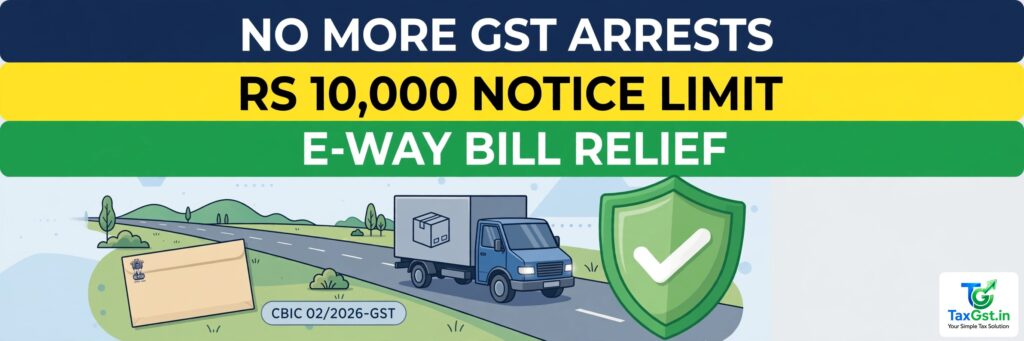
CBIC Instruction No. 02/2026-GST, dated 30 October 2026, tells all central GST field formations to stop making GST arrests with immediate effect, to stop vehicles only on specific intelligence authorised by an officer of at least Joint Commissioner rank, and not to issue show-cause notices where the tax involved is below ₹10,000. These are interim administrative directions until the 57th GST Council’s recommended law changes take effect from 1 April 2027 – they do not themselves delete Section 69 from the CGST Act.
Verified October 2026 · TaxGST.in
For the wider GST picture, see the complete GST compliance guides on the GST hub, and for what else changes this month, the 1 November GST reforms rollout explained. If a notice has already landed on your portal, the GST notice portal survival guide sets out the weekly check routine that stops ex-parte orders, and the step-by-step DRC-01 demand notice reply guide covers the reply itself. Transporters should also read what to do when an e-way bill expires in transit, and every November deadline sits in November 2026’s full tax due-date calendar.
Picture a transporter whose truck is stopped for the third time on one route, or a small trader who receives a show-cause notice demanding ₹4,000 in tax – a notice that costs more to answer, with a consultant’s fee, than the tax itself. Both of those experiences are exactly what the Central Board of Indirect Taxes and Customs (CBIC) moved against on 30 October 2026. The instruction does not change a single rate or deadline. It changes how enforcement behaves on the ground, months before Parliament is expected to change the law itself.
What the instruction actually says
The instruction implements three recommendations of the 57th GST Council meeting of 8 October 2026, as an interim measure of trade facilitation, and it says so in terms: the reforms “shall be implemented by the field formations of the CBIC” until the legislative amendments come into force. Three directions matter.
1. No further GST arrests. The Council recommended omitting Section 69 of the CGST Act, 2017, which gives officers the power to arrest after the Commissioner’s approval. CBIC has directed that no further arrests may be carried out under GST. Note the careful wording: the instruction stops arrests by central field formations now, but it does not itself delete Section 69. The deletion needs an amendment to the CGST Act and corresponding state GST laws, recommended to take effect from 1 April 2027. If anyone tells you “arrest powers are already gone from the statute books”, that overstates it – what has gone, for now, is the practice.
2. E-way bill checks only on intelligence, with senior authorisation. A conveyance may be intercepted only on the basis of specific intelligence, duly authorised by an officer not below the rank of Joint Commissioner, who must record the reasons in writing for believing the goods are being transported in contravention of the CGST Act or the rules. Inspection, detention or seizure is generally restricted to cases where the supplier or the recipient falls within the officer’s own state or union territory jurisdiction. There is one exception worth knowing: where neither an e-way bill nor documents establishing the origin or destination of the goods are available, action may be taken irrespective of jurisdiction. And goods and conveyances in transit are not to be confiscated under Section 130. In practice, a transporter carrying a valid e-way bill and proper documents should no longer face a random roadside stop – and if a stop does happen, the first question to ask, politely, is whether the interception is intelligence-based and authorised, because that is now the test the officer’s own instructions set.
3. No show-cause notice below ₹10,000. Show-cause notices under Sections 73, 74 and 74A are not to be issued where the aggregate amount involved is below ₹10,000. The ₹10,000 is the total tax across CGST, SGST/UTGST, IGST and compensation cess – interest and penalty are excluded from the calculation. A ₹8,000 tax difference, with ₹3,000 of interest on top, is still below the threshold, because the interest does not count. The point, as CBIC put it, is to cut low-value litigation and the compliance cost of answering notices that cost more than they recover.
What has NOT changed
This is where misreading the news gets expensive. The instruction does not waive any tax, interest or penalty you already owe, and it does not stop the department from raising a demand above ₹10,000, from scrutinising returns, or from pursuing prosecution where the law still allows it – the Council separately recommended raising the prosecution threshold from ₹1 crore of tax evaded to ₹5 crore, but that too awaits legislation. And the 1 April 2027 date is itself a recommendation, not yet an enacted commencement date. Treat everything in this instruction as “in force as departmental practice now, in the statute from the amendment date”.
What to do if you are affected
- Already facing a small demand? Check whether the tax in the notice is below ₹10,000 in aggregate. If it is, the instruction supports asking for the notice to be dropped – but do not simply ignore it. Reply citing Instruction No. 02/2026-GST and keep the acknowledgement.
- Transporting goods? Carry the e-way bill and the invoice or delivery challan showing origin and destination. Those two documents are what keep you inside the general rule and outside the no-documents exception.
- Stopped on the road? Stay calm, cooperate, and note the officer’s name, rank and the reason given. If the interception looks routine rather than intelligence-based, that record is what your consultant needs.
- Pending arrest-related proceedings? Talk to your counsel before assuming anything is closed – the instruction stops fresh arrests, but existing cases need their own legal handling.
- Still file and pay on time. Nothing in this instruction extends a single due date. November’s GSTR-1 and GSTR-3B deadlines apply exactly as before.
Why CBIC moved before the law did
The gap between a Council recommendation and an amended statute is normally months — here, roughly six months, from October 2026 to the recommended 1 April 2027 start. In that gap, officers following the old law could keep arresting, stopping vehicles and issuing small notices that the new law is designed to end. The instruction closes that gap administratively. For taxpayers, the practical consequence is simple – the relief is real today, but it rests on an instruction, so keep the instruction’s number and date in your file.
FAQs
Has GST arrest power been removed from the law?
Not yet. CBIC Instruction No. 02/2026-GST directs central formations to carry out no further arrests, but Section 69 of the CGST Act is deleted only when the recommended amendment takes effect, proposed from 1 April 2027.
Does the ₹10,000 notice threshold include interest and penalty?
No. It is the aggregate tax across CGST, SGST/UTGST, IGST and cess. Interest and penalty are excluded, so a notice whose tax is below ₹10,000 stays below the threshold even if interest pushes the total higher.
Can my vehicle still be stopped at all?
Yes, but only on specific intelligence authorised by an officer of at least Joint Commissioner rank with reasons recorded in writing — or where no e-way bill or origin/destination documents are available at all.
Does this change my GST return or payment deadlines?
No. Filing and payment dates are untouched. The instruction changes enforcement behaviour, not compliance calendars.
What if I get a notice below ₹10,000 anyway?
Do not ignore it. Reply within the time given, cite Instruction No. 02/2026-GST dated 30 October 2026, and ask for the notice to be dropped as below threshold.
Sources
CBIC Instruction No. 02/2026-GST, dated 30 October 2026 (Central Board of Indirect Taxes and Customs) – directions to CGST field formations on arrest, e-way bill verification and the ₹10,000 show-cause notice threshold, implementing the 57th GST Council’s recommendations of 8 October 2026 pending legislative amendments proposed from 1 April 2027. 57th GST Council meeting decisions, 8 October 2026 (GST Council) – omission of Section 69, rationalised e-way bill verification, and the ₹10,000 minimum threshold for notices under Sections 73, 74 and 74A of the CGST Act, 2017. CBIC’s statement that the measures are “trade friendly and would help in ease of living and doing business for the taxpayers” is quoted from the Board’s instruction as reported on 30 October 2026.
Discover more from TaxGst.in
Subscribe to get the latest posts sent to your email.