C.K. Gupta
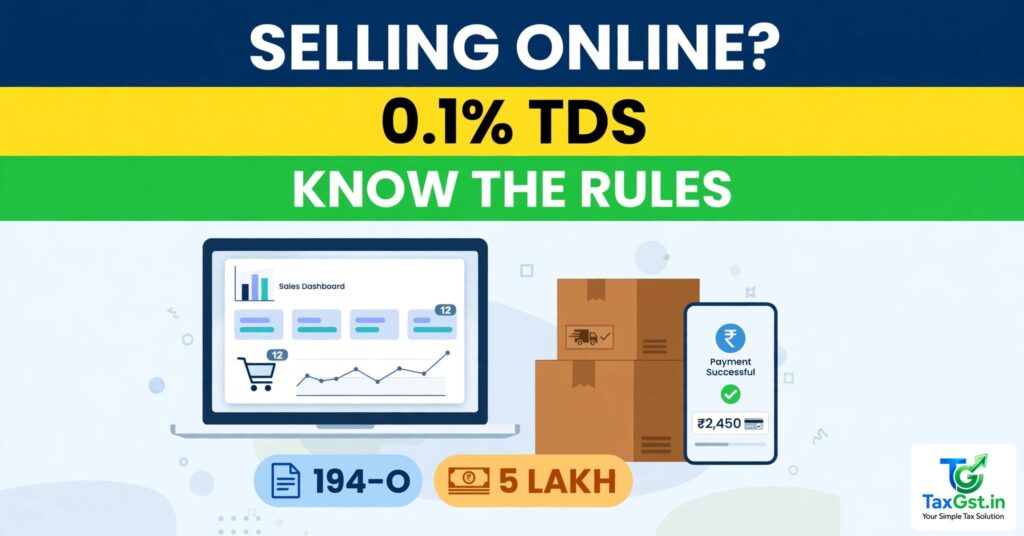
Meera sells handmade candles on two marketplaces. Last month her payout statement showed a small line she had never noticed: “TDS deducted ₹214”. She assumed it was a platform fee and moved on. It was not a fee. It was income tax — deducted by the marketplace, credited to her PAN, and refundable if her total tax for the year is lower. She had been leaving it unclaimed in her returns for two years.
If you sell anything through an e-commerce operator in India, this deduction applies to you. The good news is that it is tiny now — one-tenth of what it used to be. The bad news is that most small sellers still do not know it exists, do not check it, and do not claim it back.
For the full map of TDS rates and thresholds, see the TDS hub — every section, rate and form in one place.
What Section 194-O actually says
Section 194-O of the Income-tax Act, 1961 was introduced by the Finance Act, 2020 and took effect on 1 October 2020. It requires an e-commerce operator — Amazon, Flipkart, Meesho, and any platform that facilitates sales through a digital facility — to deduct tax at source on the gross amount of sales it facilitates.
From 1 April 2026, the same obligation sits in Section 393(1), Table Sl. No. 8(v) of the Income-tax Act, 2025. The rate, the payer and the exemption carried over unchanged. If you are filing for tax year 2026-27 onwards, quote Section 393 — but if a marketplace statement still says “194-O”, it means the same thing.
The deduction happens at the time the amount is credited to your account or paid to you, whichever is earlier. It applies to the gross amount — the full sale value, not your profit, not the amount after the platform’s commission, and not the amount after returns are adjusted in a later cycle. That is why the rate matters so much: a deduction on gross sales bites harder than the same rate on profit would.
The rate: 1% became 0.1% on 1 October 2024
Here is the detail that trips up most sellers. The original rate was 1%. The Finance (No. 2) Act, 2024 cut it to 0.1% with effect from 1 October 2024 — a tenfold reduction, made precisely because 1% on gross sales was strangling small sellers whose margins are often thinner than 1% itself.
| Period | Rate on gross sales |
|---|---|
| 1 October 2020 – 30 September 2024 | 1% |
| 1 October 2024 onwards | 0.1% |
The cut applies prospectively: sales facilitated on or before 30 September 2024 carry 1% even if the payout settled in October. If your marketplace is still deducting 1% on current sales, that is an error — raise it with the operator’s seller support and check your Form 168 (the new name for Form 26AS) to see what was actually deposited against your PAN.
A worked example. A seller with ₹24,00,000 of gross annual sales through one marketplace:
- At the old 1% rate: ₹24,000 deducted
- At the current 0.1% rate: ₹2,400 deducted
- Difference kept in the seller’s working capital: ₹21,600 a year
On a 10% net margin, that seller’s profit is about ₹2,40,000 — so the old 1% deduction was 10% of the entire year’s profit, held back as advance tax. At 0.1% it is 1%. That is the scale of the change.
The ₹5 lakh exemption — and who does not get it
There is one exemption, and it is narrow. If the seller is a resident individual or HUF, and the gross sales facilitated by that operator during the tax year do not exceed ₹5,00,000, and the seller has furnished PAN or Aadhaar to the operator — no TDS is deducted at all.
All three conditions must hold together. Miss one, and the exemption fails:
- Individual or HUF only. A company, LLP or partnership firm suffers TDS from the first rupee of sales, with no ₹5 lakh shelter.
- ₹5 lakh per operator. The test is per e-commerce operator, not across all your platforms. ₹4 lakh on Amazon and ₹4 lakh on Flipkart means no TDS on either — even though your total is ₹8 lakh.
- PAN or Aadhaar on record. Without it, there is no exemption — and the rate jumps to 5% (see below).
Once your year-to-date sales with an operator cross ₹5 lakh, the operator starts deducting 0.1% on sales from that point. It does not go back and deduct on the earlier ₹5 lakh.
No PAN? The rate jumps to 5%
This is the expensive mistake. If you have not furnished your PAN or Aadhaar to the operator, the deduction is 5% of the gross amount under Section 397(2) of the Income-tax Act, 2025 (old Section 206AA) — fifty times the normal rate. On ₹24 lakh of sales, that is ₹1,20,000 held back instead of ₹2,400.
It is recoverable — the whole amount sits as your tax credit and comes back as a refund if your final tax is lower — but it is locked up until your return is processed. If you sell under a trade name, a proprietorship or a new GSTIN, make sure the PAN linked to that seller account is correct and active. An inoperative PAN triggers the same 5%.
Non-resident sellers are outside this section altogether: the operator credits their gross sales without deducting under this provision.
Don’t confuse it with GST TCS
Sellers often mix up two different deductions on the same payout statement. They are separate taxes, under separate laws:
| Income-tax TDS (Section 393 / old 194-O) | GST TCS (Section 52, CGST Act) | |
|---|---|---|
| Rate | 0.1% of gross sales | 1% (0.5% CGST + 0.5% SGST/UTGST; 1% IGST) |
| Goes to | Your income-tax credit (Form 168 / AIS) | Your GST electronic cash ledger |
| Threshold | ₹5 lakh for individuals/HUFs with PAN | No threshold — from the first rupee |
| Claimed via | Income-tax return | GSTR-3B / GSTR-8 reconciliation |
Both appear on your marketplace statement. The 0.1% is your income-tax advance; the 1% is GST collected at source and credited to your GST cash ledger, which you use to pay GST. Neither is a platform fee, and neither is lost money — but only if you reconcile both.
For the other TDS rates sellers commonly meet, see TDS on commission and brokerage — the 194H rate and ₹20,000 threshold, TDS on professional and technical fees under Section 393, and TDS on dividends — the ₹10,000 limit and 10% rate.
Claiming it back: the quarterly check
The deduction is not a cost. It is advance tax, and it belongs to you. Build this into a quarterly routine:
- Check Form 168 (old Form 26AS) and your AIS every quarter. The operator’s TDS should appear there within a few weeks of the payout. If a quarter’s deduction is missing, the operator may have filed its TDS return late — or under the wrong PAN.
- Match it to the operator’s statement. Download the TDS certificate — Form 131 (old Form 16A) — from the operator or from TRACES. The certificate is your proof if the credit does not show up.
- Claim the full credit in your return. The TDS reduces your final tax bill rupee for rupee. If your total tax is lower than the TDS deducted, the excess comes back as a refund with interest.
- Watch for the 5% trap. If you see a deduction far above 0.1% of your sales, check your PAN status with the operator first — it is almost always a missing or inoperative PAN.
Sellers who also travel abroad or remit money for foreign purchases should note the parallel levy on the other side: TCS on foreign trips and LRS remittances — thresholds, rates and how it adjusts against salary TDS.
To see how the TDS credit changes your final bill, work out your numbers on the income tax calculator with and without the credit included.
FAQs
What is the current TDS rate on e-commerce sales under Section 194-O?
0.1% of the gross amount of sales or services, since 1 October 2024 (Finance (No. 2) Act, 2024). Before that it was 1%. From 1 April 2026 the provision sits in Section 393(1), Table Sl. No. 8(v) of the Income-tax Act, 2025.
Do small sellers on Amazon or Flipkart pay TDS?
Not if they are resident individuals or HUFs with gross sales up to ₹5 lakh in the tax year through that operator and have furnished PAN or Aadhaar. Above ₹5 lakh, the operator deducts 0.1%. Companies, firms and LLPs pay from the first rupee.
What happens if I don’t give my PAN to the marketplace?
The operator must deduct 5% instead of 0.1% under Section 397(2) (old Section 206AA). The excess is still your tax credit and is refundable, but it stays locked until your return is processed.
Is the 0.1% TDS a marketplace fee?
No. It is income tax deducted in advance and credited to your PAN. It appears in Form 168 (old Form 26AS) and your AIS, and you claim it in your income-tax return. Platform commissions and fees are charged separately.
How is this different from GST TCS of 1%?
GST TCS under Section 52 of the CGST Act is 1% collected by the operator and credited to your GST electronic cash ledger for paying GST. Income-tax TDS under Section 393 is 0.1% credited to your income-tax account. Both appear on your payout statement; reconcile both separately.
Sources
- Income-tax Act, 2025 — Section 393(1), Table Sl. No. 8(v) (TDS on e-commerce transactions, 0.1% of the gross amount); Section 397(2) (higher 5% rate where PAN is not furnished). Corresponding to Section 194-O and Section 206AA of the Income-tax Act, 1961.
- Finance (No. 2) Act, 2024 — reduced the Section 194-O rate from 1% to 0.1% with effect from 1 October 2024.
- Finance Act, 2020 — inserted Section 194-O with effect from 1 October 2020.
- Central Goods and Services Tax Act, 2017 — Section 52 (tax collected at source by e-commerce operators, 1%).
Discover more from TaxGst.in
Subscribe to get the latest posts sent to your email.