C.K. Gupta
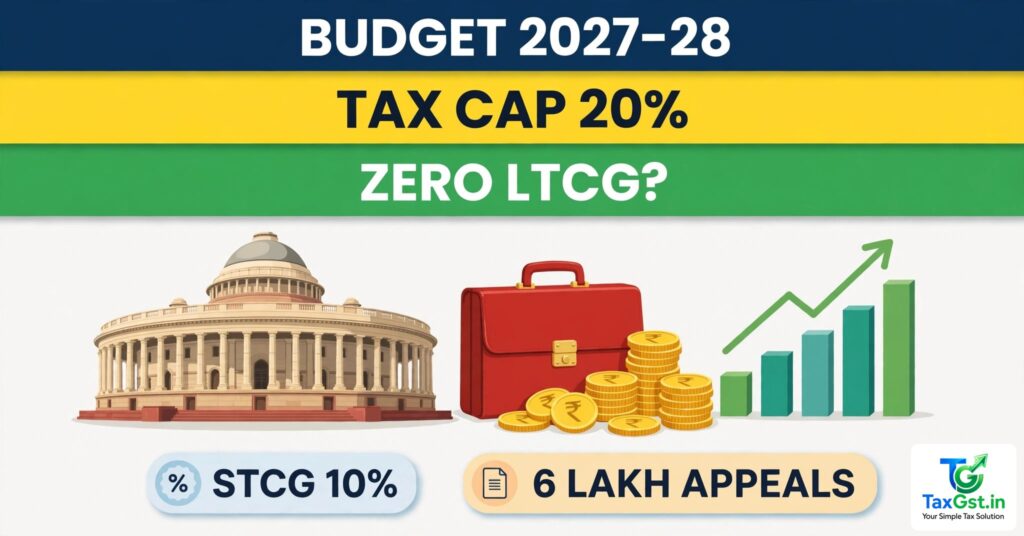
Take a salaried professional earning ₹30 lakh a year. Under the current new-regime slabs, the slice of income between ₹24 lakh and ₹30 lakh is taxed at 30% — the same top rate as someone earning ₹3 crore. PHDCCI, one of India’s oldest industry chambers, says that is exactly the problem: a person at ₹30 lakh and a person at ₹3 crore should not face the same marginal rate. Its pre-Budget submission to Finance Minister Nirmala Sitharaman, made public on 18 November 2026, asks for a lower ceiling, zero tax on long-term capital gains, and faster disposal of the nearly six lakh income-tax appeals stuck in the system.
None of this is law — it is a wish list, and the Budget is months away. But wish lists shape the debate, and the numbers behind them show where the pressure for change is building. For the current framework these proposals would change, see the income-tax hub — slabs, regimes and filing guides in one place.
What PHDCCI actually asked for
Mukul Bagla, chair of PHDCCI’s Direct Tax Committee, put the rate proposal in one sentence to news agency ANI: a maximum rate of 20% on income up to ₹30 lakh, 25% on income between ₹30 lakh and ₹50 lakh, and 30% only above ₹50 lakh. Here is how that compares with what you pay today under the new regime, which is the default for tax year 2026-27:
| Income slice | Current new-regime rate | PHDCCI proposal |
|---|---|---|
| Up to ₹4 lakh | Nil | No change proposed |
| ₹4–8 lakh | 5% | Within the 20% ceiling |
| ₹8–12 lakh | 10% | Within the 20% ceiling |
| ₹12–16 lakh | 15% | Within the 20% ceiling |
| ₹16–20 lakh | 20% | Within the 20% ceiling |
| ₹20–24 lakh | 25% | Above the 20% ceiling — cut implied |
| Above ₹24 lakh | 30% | 20% up to ₹30 lakh; 25% to ₹50 lakh; 30% only above ₹50 lakh |
The headline saving is easy to see. On the ₹24–30 lakh slice alone, the rate would fall from 30% to 20% — a saving of ₹60,000 a year before cess on that slice. Someone earning ₹50 lakh would save on every rupee between ₹24 lakh and ₹50 lakh. But note the careful wording: PHDCCI proposed a ceiling on rates, not a full new slab table. The exact slabs, the rebate and the surcharge treatment would all be for the Budget to decide — if it accepts the idea at all.
Bagla’s argument is that lower rates raise more revenue, not less: after the 2019 corporate tax cut (effective rate from close to 35% to about 25% all-in), corporate collections rose from around ₹6.6 lakh crore to about ₹12 lakh crore. Personal income-tax collections still grew about 8% during April–October 2026 despite the Budget 2025 relief.
Zero LTCG, 10% STCG — the capital-gains ask
The second proposal is bolder. PHDCCI wants long-term capital gains tax on listed securities reduced to zero — for foreign portfolio investors and domestic investors alike — and short-term capital gains cut from 20% to 10%. Today, listed-equity gains are taxed at 12.5% if held over a year (above the ₹1.25 lakh annual exemption) and 20% if sold within a year.
The reason given is foreign money leaving India: foreign investors withdrew around ₹3 lakh crore in the previous year and about ₹1.6 lakh crore until October this year. “We cannot afford, as a country, to have FPI money going out,” Bagla said — capital markets fund IPOs, expansion and jobs.
Here is the catch for investors: do not restructure your portfolio on a proposal. If you sell holdings today to “beat” a change that may never come, you pay today’s 12.5% or 20% for certain. Our earlier piece on the FM’s LTCG signal explains why the debate matters and what would actually have to change in the law.
The appeals backlog: six lakh cases, some 7–8 years old
The third part of the submission is about administration, and it affects ordinary taxpayers more directly than any rate cut. Nearly six lakh appeals are pending before Commissioners of Income Tax (Appeals), PHDCCI said, with some cases filed seven to eight years ago still awaiting disposal. Bagla urged the CBDT and the Revenue Secretary to speed up disposal.
He also flagged a specific grievance: during the pendency of an appeal, the department recovers 20% of the disputed demand from small taxpayers — despite the Finance Minister’s earlier assurance that the amount would be limited to 10%. According to Bagla, the relief was never implemented because no formal CBDT notification or circular was issued, creating liquidity problems for small businesses and individuals. If you have a disputed demand under appeal, that 20%-versus-10% gap is worth checking with a tax professional — it is a live, practical issue, not a Budget abstraction.
Separately, PHDCCI asked for the 1994 guidelines on seizure of gold and jewellery during income-tax searches to be revised — the current limits (500 grams for a married woman, 250 grams for an unmarried woman, 200 grams for an adult male) have not changed in 32 years. Bagla suggested raising them to one kilogram or more.
What to do with this information
First, file this under “Budget expectations”, not “tax planning” — the proposals need the Finance Minister’s acceptance, a Finance Bill and Parliament’s approval before a single rupee of your tax changes. Second, if you are salaried, the practical question is which regime wins for you today — work out your numbers on the income tax calculator and compare both regimes on your actual salary. Third, if you are an investor, the LTCG debate is a reason to watch the Budget, not to churn your portfolio. And if you have an appeal pending, the 20% recovery point is worth raising with your adviser.
Budget 2027-28 is expected in February 2027. Expect more such submissions before then; we will track the ones that move from proposal to policy. This is not the first zero-LTCG voice this season: SEBI has separately proposed scrapping the 12.5% LTCG on foreign equity, and former Punjab chief secretary KBS Sidhu has written to the Finance Minister seeking salaried-class relief on the back of the same collections data.
Frequently asked questions
Has the income-tax rate actually changed?
No. PHDCCI’s 20%/25%/30% structure is a proposal submitted to the Finance Minister on 18 November 2026. Current new-regime slabs — 30% above ₹24 lakh — remain in force for tax year 2026-27 until a Finance Act changes them.
What would I save if the 20% cap up to ₹30 lakh were accepted?
On the ₹24–30 lakh slice alone, the rate would drop from 30% to 20%, saving ₹60,000 a year before cess. The full saving depends on the final slab structure, which PHDCCI has not specified in detail.
Is LTCG really going to zero?
Nobody knows yet. Three voices — PHDCCI, SEBI and the Finance Minister’s openness to views — point the same way, but the current rate is 12.5% above ₹1.25 lakh a year, and it stays until the Budget says otherwise.
What is the 20% vs 10% disputed-demand issue?
During an appeal, the department currently recovers 20% of the disputed tax demand. The Finance Minister had assured the amount would be capped at 10%, but PHDCCI says no CBDT notification was issued, so the 20% recovery continues.
When is Budget 2027-28?
The Union Budget is traditionally presented on 1 February. Expect the Finance Bill then; any rate changes would apply from 1 April 2027 unless the Bill says otherwise.
Sources
ANI report, “PHDCCI seeks income tax cap, zero LTCG and lower STCG tax”, 18 November 2026 — Mukul Bagla, Chair, Direct Tax Committee, PHDCCI, speaking to ANI in New Delhi; rate proposal, FPI outflow figures (₹3 lakh crore previous year; ₹1.6 lakh crore till October 2026), appeals backlog (~6 lakh before CIT(A)), 20% demand recovery, gold-seizure limits. Income Tax Department collections data to 10 November 2026 — net direct tax collections ₹14.42 lakh crore (+11.76%); personal income-tax collections ~8% growth April–October 2026. Finance Act, 2026 — current LTCG 12.5% and STCG 20% on listed equity; new-regime slabs for tax year 2026-27. SEBI proposal on LTCG for foreign equity and KBS Sidhu letter to the Finance Minister (13 November 2026) — cited as related Budget 2027-28 proposals, not law.
Discover more from TaxGst.in
Subscribe to get the latest posts sent to your email.