C.K. Gupta
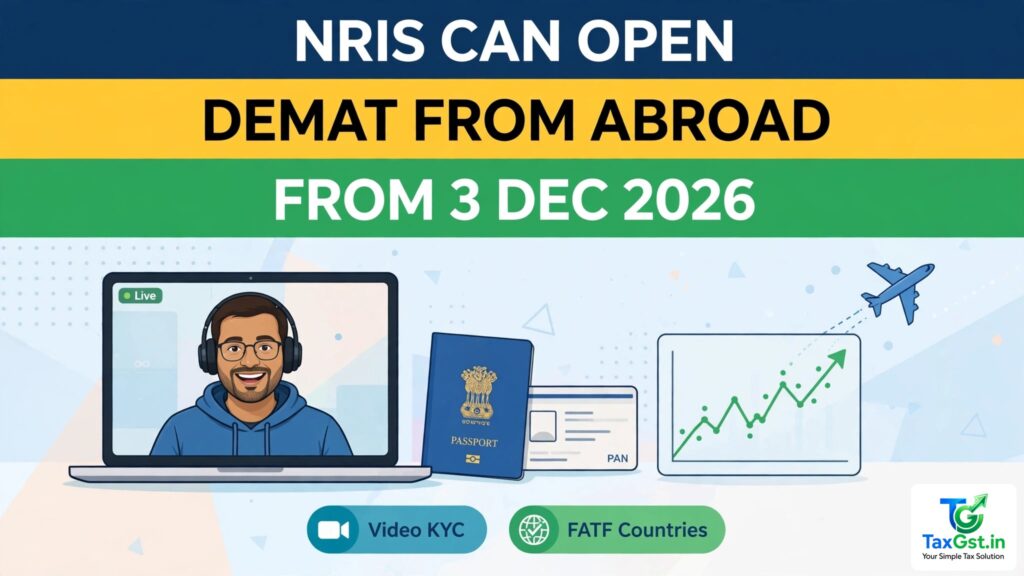
For years, the conversation went the same way. An NRI in Toronto or Dubai wanted to open a demat account back home, and the broker’s answer was: come to India, or courier attested documents and wait weeks. The rule behind it was SEBI’s KYC Master Circular of October 2023, which required anyone completing digital KYC to be physically present in India. From 3 December 2026, that requirement goes away for investors in FATF-compliant countries.
The change comes from a SEBI circular dated 4 November 2026. It is the same reform wave as the SEBI circular of 11 November 2026 on FATCA and CRS reporting — which our SEBI FATCA/CRS guide covers in detail — but this one is about opening the account in the first place, not reporting it afterwards.
What changes on 3 December 2026
From that date, an individual non-resident — an NRI, an Overseas Citizen of India (OCI) cardholder, or an eligible foreign national — who lives in a country that complies with the standards of the Financial Action Task Force (FATF) can complete the whole KYC process remotely. The United States and Canada are both FATF-compliant, as are most of the countries where Indian expatriates live. Investors in countries that do not meet FATF standards must continue with the existing process.
The process itself is straightforward. You submit the account-opening forms online, upload scanned documents, and sign electronically. The broker, depository participant or asset management company then conducts a live video-based identity verification. Brokers are already preparing for it — Zerodha, which says it has more than 80,000 NRI accounts, plans to introduce the new process on 3 December itself.
Two practical consequences matter. First, KYC done with one intermediary can now be relied on by another, because the record is stored centrally with a KYC Registration Agency (KRA) and shared across SEBI-registered intermediaries. Do it right once, and you should not have to repeat the full process with every broker. Second, the intermediary opening your account keeps ultimate responsibility for your KYC — portability is a convenience, not a transfer of liability.
The safeguards — this is not a casual video call
SEBI has not removed verification; it has moved it onto video, with controls designed to stop the obvious abuses. Expect all of these:
- Live, not recorded. The call must be live, with random action prompts — turn your head, hold up a document — to prove you are a real person on camera, not a pre-recorded video.
- A wet signature. If you submit a specimen signature digitally, the circular still requires a wet signature — ink on paper — made in the presence of the broker’s official during the video call. Keep a pen and paper ready.
- IP location must match. Your IP address during the call must match the country on your documents. A VPN will fail the check — SEBI’s framework includes controls against spoofed IP addresses and proxy servers, plus facial liveness checks, GPS coordinates and timestamps.
- Documents verified, not just uploaded. PAN, passport, OCI card if applicable, and proof of your overseas address are the core documents. Aadhaar is optional for NRIs, and a foreign mobile number works.
What does NOT change
Here is the catch that will disappoint some readers: the new route covers only SEBI-regulated demat, trading and mutual fund KYC. Opening an NRE or NRO bank account is still not a digital process — it follows RBI rules, and that remains slow. Approval under the Portfolio Investment Scheme (PIS), where applicable, is a separate bank-level requirement that the SEBI circular does not touch. And easier KYC is not the same as automatic investment eligibility: FEMA rules, tax rules and account-opening requirements still apply separately.
The tax side is where NRIs most often trip up. Dividends from Indian shares now carry 10% TDS above ₹10,000 per company — the dividend TDS guide explains the limit and the treaty route. Capital gains on shares are taxed in India even for non-residents. And if you hold foreign assets or income that was never disclosed, the FAST-DS window closes on 31 December 2026 — the FAST-DS disclosure guide explains the 60% settlement for assets up to ₹1 crore. Opening the demat account is the easy part; getting the tax reporting right is the part that needs care. For the wider NRI tax picture, see the income tax hub.
Checklist: opening your account from abroad after 3 December
- Confirm your country qualifies. Check that your country of residence is FATF-compliant — the US, Canada, UK, UAE, Singapore and Australia are; if you live in a grey-listed country such as Kuwait (grey-listed since February 2026), confirm eligibility with your intermediary first.
- Keep your documents ready. PAN card, passport, OCI card if you hold one, and proof of overseas address. Scanned copies must be clear — a blurry upload is the most common reason for rejection.
- Do the call without a VPN. Your IP must match your declared country. Switch the VPN off before the call, and take it from a stable connection.
- Have a pen and paper ready. The wet signature is done live on camera — do not assume a digital signature is enough.
- Ask about PIS and the bank account. If you need a Portfolio Investment Scheme approval or a new NRE/NRO account, start those in parallel — they run on separate timelines and neither is covered by the video-KYC change.
- Buying property instead of shares? The TDS rules are entirely different — the guide to TDS when buying property from an NRI seller covers the 12.5% rate, the PAN-based challan and Form 13.
Frequently asked questions
I am an NRI in the US. Can I open a demat account without visiting India from 3 December?
Yes. The US is FATF-compliant, so you can complete KYC by live video call from the US — forms online, scanned documents, e-signature, and a live video verification with a wet signature on camera.
Does Aadhaar matter for NRI KYC?
No. Aadhaar is optional for NRIs under this framework; PAN, passport and overseas address proof are the documents that matter.
Can I use the KYC done with one broker to open an account with another?
Yes — the KYC record is stored with a KRA and can be relied on by other SEBI-registered intermediaries, subject to their validation. The new broker still bears responsibility for your onboarding.
Does this change anything for my NRE/NRO bank account?
No. Bank account KYC follows RBI rules and is unchanged. The SEBI change covers only demat, trading and mutual fund accounts.
What if I live in a country that is not FATF-compliant?
You must follow the existing process — physical presence in India or couriered attested documents. Check with your intermediary before starting, because eligibility is decided country by country.
Sources
SEBI circular dated 4 November 2026 — relaxes digital KYC for individual non-residents (NRIs, OCIs and eligible foreign nationals) resident in FATF-compliant countries, effective 3 December 2026; live video verification with wet signature, liveness checks and IP-location controls. SEBI circular dated 11 November 2026 (HO/38/14/(18)2026-MIRSD-POD2/I/25560/2026) — FATCA/CRS reporting under Rules 238–240 of the Income-tax Rules, 2026 and Form 166. SEBI KYC Master Circular, October 2023 — the earlier framework requiring physical presence in India for digital KYC. CBDT Guidance Note on FATCA and CRS, 24 July 2026. For the wider NRI tax picture, see the income tax hub.
Discover more from TaxGst.in
Subscribe to get the latest posts sent to your email.