C.K. Gupta
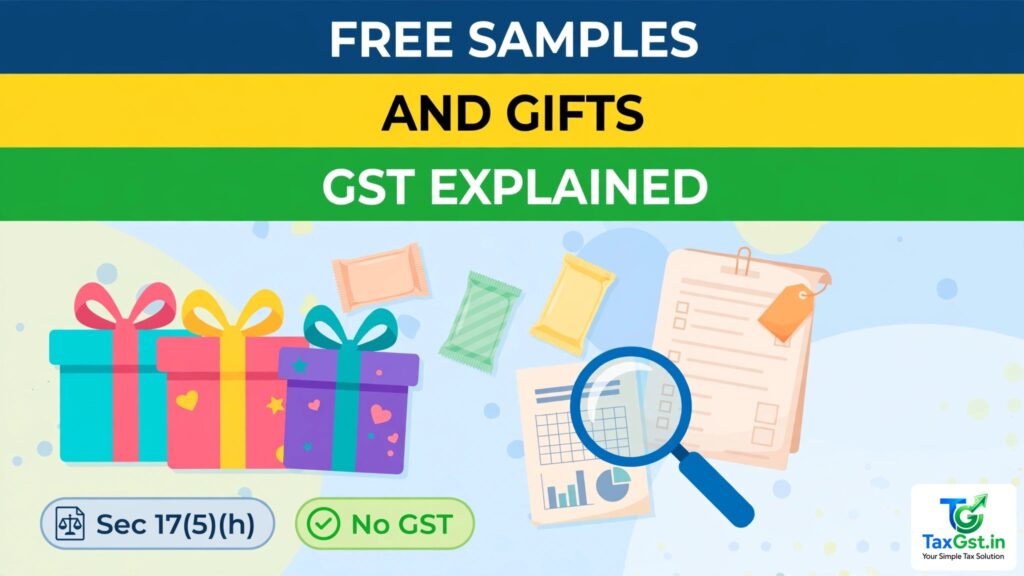
A pharmaceutical company sends free drug samples worth ₹1 lakh to doctors. A cosmetics brand hands out trial sachets at a mall. A dealer gets a Diwali hamper from a supplier. None of them pays a rupee for the goods — so is there any GST? The answer splits in two, and getting it wrong is expensive: in most cases there is no output GST, but the input tax credit on the goods is blocked, so the GST paid on purchase becomes a dead cost. In a few cases, GST is payable in full.
The rules sit in three places: Schedule I of the CGST Act (what counts as a supply without consideration), Section 17(5)(h) (which credits are blocked), and CBIC Circular No. 92/11/2019-GST dated 7 March 2019, which ties them together for free samples.
Question one: is giving it away a supply at all?
GST applies to a supply made for consideration. Giving goods away free is, by default, not a supply — no consideration, no tax. The exception is Schedule I, which treats certain transactions as supplies even without consideration. Paragraph 2 of Schedule I covers supplies between related persons or between distinct persons (for example, two GST registrations of the same business) made in the course or furtherance of business.
That gives three clear cases:
Free samples or gifts to ordinary customers, dealers and doctors — not a supply. A customer or dealer is normally not a related person, so the gift falls outside Schedule I. No output GST, and no tax invoice — the goods travel on a delivery challan marked “Free sample, not for sale”.
Gifts to a related person or to another registration of your own business — a deemed supply. It is taxable: issue a tax invoice, pay GST on the open market value under Rule 28, and the credit is not blocked. Sending free stock to your own branch in another state is not a freebie, it is a taxable supply.
Gifts from an employer to an employee — not a supply up to ₹50,000 per employee per financial year, under the proviso to Schedule I paragraph 2. Above ₹50,000, the protection ends and the gift becomes a deemed supply between related persons. Our Diwali gifting guide covers the employee side in detail — Diwali corporate gifting 2026: the ₹15,000 perquisite limit, GST and ITC.
Question two: what happens to the input tax credit?
Here is the catch, and it applies even when there is no output GST. Section 17(5)(h) of the CGST Act says input tax credit is not available on goods “lost, stolen, destroyed, written off or disposed of by way of gift or free samples”. CBIC Circular No. 92/11/2019-GST confirms it: the credit on inputs used for gifts or free samples distributed without consideration is blocked.
So the pharma company that buys ₹1,00,000 of samples plus ₹18,000 GST and gives them to doctors pays no output GST — but it also cannot claim the ₹18,000, which becomes a real cost of the promotion. If the credit was already claimed when the goods were bought, reverse it in GSTR-3B.
There is one important exception, and it follows from the logic above: where the gift is a deemed supply — to a related person, or to an employee above the ₹50,000 limit — the department’s stated view in Circular No. 92/11/2019-GST is that the supplier is eligible for the ITC, because output GST is paid on the gift. Note the caution: the circular binds the department, not a court, and Section 17(5)(h) itself contains no such exception. For the full map of credits you can never claim, see the blocked-ITC guide under Section 17(5).
The Madras High Court has backed the block: in M/s. ARS Steels and Alloy International Pvt. Ltd. v. The State Tax Officer (W.P. Nos. 31, 33 and 35 of 2022, order dated 24 October 2024), the court applied Section 17(5)(h) to promotional gifts. This is settled law, not a grey area.
Worked example: the true cost of a free sample
A cosmetics company buys trial sachets for ₹5,00,000 plus 18% GST (₹90,000) and distributes them free at malls.
- Output GST: Nil — the sachets go to unrelated customers, so there is no supply.
- ITC: Blocked — the full ₹90,000 under Section 17(5)(h).
- True cost of the promotion: ₹5,90,000, not ₹5,00,000. The GST is a marketing cost, and it belongs in the campaign budget.
Now change one fact: the same sachets are sent to the company’s own branch in another state for a launch event. That is a supply between distinct persons under Schedule I. The company issues a tax invoice, pays ₹90,000 GST on the open market value — and can claim the ₹90,000 ITC, because the goods are not disposed of by way of gift. Same goods, same value, opposite tax result: the recipient is everything.
Before pricing a promotion, run the GST on the sample value on the GST calculator so the blocked credit is in the budget from the start.
What is NOT a gift: buy-one-get-one and combo offers
Buy-one-get-one-free is not a gift for GST purposes. The “free” item is part of a single composite supply for one consideration — the customer pays for the bundle. The credit on the goods stays available, and the taxable value is the price actually paid. The same logic applies to combo packs and “free with purchase” offers where the free item is tied to a paid purchase. The 17(5)(h) block bites only where goods are given away with no consideration at all.
Change is coming — but it is not law yet
The 57th GST Council, at its meeting on 8 October 2026, recommended removing the ITC restriction on free samples under Section 17(5). But a Council recommendation is not law: as of November 2026 the amendment has not been enacted, and the Council did not propose retrospective relief or a general relaxation for gifts — only for free samples. Until the statute changes, reverse the credit. For the rest of the 1 November reform package, read the practical guide to the GST changes from 1 November 2026.
Checklist: freebies without a notice
- Identify the recipient first. Unrelated customer or dealer: no supply, no invoice, block the ITC. Related person or own branch: deemed supply, tax invoice, GST on open market value, ITC available.
- Reverse the credit in GSTR-3B. If ITC was claimed when the goods were purchased, reverse it in the month the goods are given away — do not wait for a notice.
- Use a delivery challan, not a tax invoice, for free samples. Mark it “Free sample, not for sale” and keep the recipient list.
- Track employee gifts per person per year. The ₹50,000 safe harbour is per employee per financial year — cross it and the gift becomes a deemed supply.
- Price the blocked GST into the campaign. A ₹5 lakh sample drive at 18% GST costs ₹5.9 lakh, not ₹5 lakh.
- Keep buy-one-get-one separate. Document that the “free” item is part of a paid bundle, so the credit stays available.
Frequently asked questions
Do I charge GST when I give free samples to customers?
No — free samples to unrelated customers are not a supply, so no output GST. But the ITC on them is blocked under Section 17(5)(h) and must be reversed.
What if I give free samples to my own branch in another state?
That is a deemed supply between distinct persons under Schedule I. Issue a tax invoice, pay GST on the open market value, and the ITC is available.
Can I claim ITC on Diwali gifts given to employees?
No, up to ₹50,000 per employee per year the gift is not a supply and the ITC is blocked. Above ₹50,000 it becomes a deemed supply and the department’s view is that ITC becomes available — but that rests on a circular, not on the statute itself.
Is buy-one-get-one-free affected by the gift rule?
No. The free item is part of a single supply for consideration, so it is not a gift and the ITC stays available.
Will the 57th Council’s recommendation let me keep ITC on free samples?
Not yet. The Council recommended removing the block on free samples, but no amendment has been enacted as of November 2026. Keep reversing the credit until the law actually changes.
Sources
CGST Act, 2017, Schedule I, paragraph 2 — supplies between related or distinct persons without consideration treated as supplies; proviso excluding employer-to-employee gifts up to ₹50,000 per financial year. Section 17(5)(h), CGST Act — ITC blocked on goods disposed of by way of gift or free samples. CBIC Circular No. 92/11/2019-GST, dated 7 March 2019 — free samples are not a supply unless Schedule I applies; ITC on gifts and free samples is not available. 57th GST Council meeting, 8 October 2026 — recommended removing the ITC restriction on free samples (not yet law). Madras High Court, ARS Steels and Alloy International Pvt. Ltd. v. State Tax Officer, W.P. Nos. 31, 33 and 35 of 2022, 24 October 2024 — Section 17(5)(h) block applied to promotional gifts. For the wider GST framework, see the GST hub — rates, registration, returns and compliance.
Discover more from TaxGst.in
Subscribe to get the latest posts sent to your email.