
 C.K. Gupta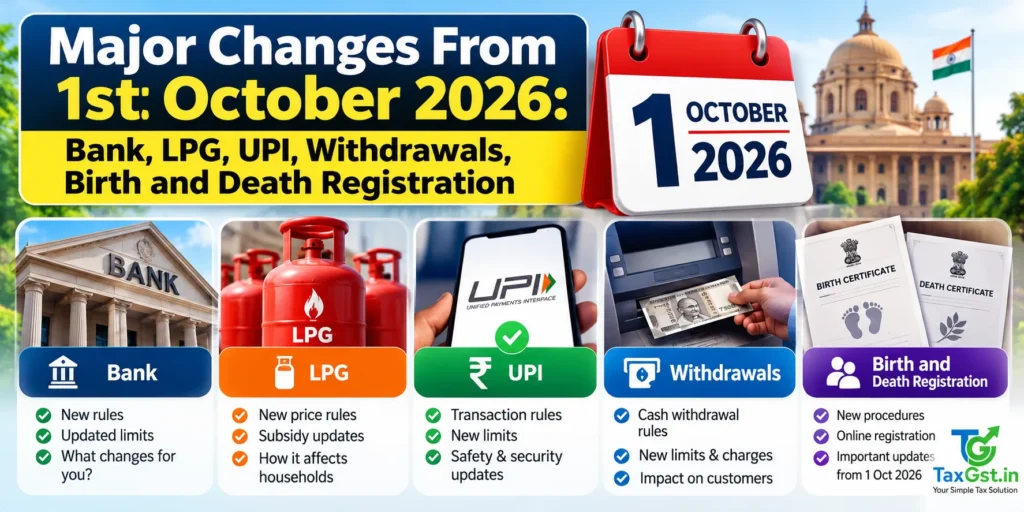
Several important regulatory changes are now effective from 1 October 2026 across UPI payments, bank deposits, LPG subsidy access and banking regulations. The key changes covered in this article include the new UPI Merchant Discount Rate (MDR) framework for specified higher-value merchant transactions, mandatory Biometric Aadhaar Authentication for subsidised domestic LPG refills, revised RBI rules on bulk-deposit interest-rate disclosure and pricing, and a new one-time approval mechanism for certain subsequent bank-share acquisitions by mutual funds, insurance companies and pension funds.
Also Read-BRICS Summit 2026 in India: New Delhi Summit, Members, Agenda, Key Outcomes and Complete Guide
Important: Not every change discussed below is a consumer-facing change effective on 1 October. Some RBI amendments became effective immediately in September 2026, while the UPI and LPG changes have specific effective dates. The article therefore identifies the applicable effective date for each measure.
Quick Summary of Major Changes From 1 October 2026
- UPI MDR: Person-to-person UPI transactions remain free. MDR applies only to specified person-to-merchant transactions above ₹2,000, with different rates for specified categories.
- UPI small merchants: Small merchants covered by the existing zero-MDR framework continue to receive the stated protection.
- LPG Aadhaar authentication: Biometric Aadhaar Authentication (BAA) is required from 1 October 2026 for domestic LPG consumers who want to book subsidised refills at the regulated Retail Selling Price.
- Existing LPG authentication: Consumers who had already completed BAA before the effective date do not need to repeat it.
- Bulk deposits: RBI’s revised deposit-interest directions require disclosed rates and uniform pricing across branches/customers for comparable deposits, while separately permitting differential rates on bulk deposits based on applicable LCR run-off rates.
- Bulk-rate disclosure: For bulk deposits, banks must disclose the applicable interest rate on their website at 10:00 am, with a grace period up to 10:10 am, on each business day.
- UPI-linked credit: RBI has clarified the prudential treatment of credit facilities linked to specific payment instruments, including eligible pre-sanctioned credit lines used through UPI.
- FPI KYC: An RBI amendment for Urban Co-operative Banks effective 18 September 2026 expanded the specified alternative certified-copy facility to Foreign Portfolio Investors.
- Bank shareholding: From 1 October 2026, qualifying mutual funds, insurance companies and pension funds can seek one-time approval for subsequent acquisitions of major shareholding in a banking company, subject to RBI conditions and the applicable limit.
1. What Is the New UPI MDR Framework From October 2026?
A new UPI Merchant Discount Rate framework was announced in September 2026 for specified merchant transactions. The framework does not introduce a general charge on all UPI payments.
Person-to-person (P2P) UPI transactions continue to remain completely free, irrespective of the amount transferred. Payments made by individuals to merchants up to ₹2,000 also remain free of MDR. The government has stated that approximately 96% of P2M transactions remain unaffected by the new framework.
The MDR is a charge within the merchant-payment ecosystem. It is not a tax collected by the Government or NPCI. According to the government explanation, the MDR is distributed among relevant payment-system participants such as banks and payment service/application providers.
UPI MDR Rates From October 2026
| Transaction Category | MDR | Important Condition |
|---|---|---|
| P2P UPI transactions | 0% | Free irrespective of amount |
| P2M transactions up to ₹2,000 | 0% | No MDR |
| Eligible small merchants under P2PM framework | 0% | Government framework states zero MDR for qualifying small merchants receiving up to ₹1 lakh/month through UPI QR codes |
| General P2M above ₹2,000 | 0.4% | For transactions of ₹75,000 and above, MDR is capped at ₹300 per transaction |
| Specified essential sectors above ₹2,000 | ₹5 per transaction | Includes specified sectors such as railways, telecom, insurance, fuel and agricultural inputs |
| Specified capital-market transactions | 0.02% | Capped at ₹300 per transaction |
Source: Ministry of Finance/PIB explanation of the UPI framework announced in September 2026. Exact applicability depends on the transaction classification and applicable NPCI/payment-system rules.
2. Will UPI Users Have to Pay MDR?
No general customer-facing MDR has been introduced. The government has clarified that P2P transactions remain free and that the MDR applies within the merchant payment ecosystem.
Banks have been advised to ensure that merchants do not pass MDR charges on to customers, while UPI application providers are not permitted to impose platform fees or hidden charges in place of the MDR framework.
Example: ₹5,000 UPI Merchant Payment
Suppose a qualifying general P2M transaction is ₹5,000. At 0.4%, the MDR calculation is:
₹5,000 × 0.4% = ₹20 MDR
This ₹20 represents the applicable MDR within the payment ecosystem. It should not automatically be treated as a ₹20 surcharge payable by the customer.
3. What Should UPI Merchants Do?
- Review the business’s UPI transaction classification with the acquiring/payment service provider.
- Check whether the business falls under a zero-MDR small-merchant category.
- Identify transactions above ₹2,000 that may attract MDR.
- Check whether the business operates in one of the specified essential sectors with the ₹5 MDR treatment.
- Check whether any transactions fall within the specified capital-market category.
- Review settlement reports and payment-provider statements after the new framework becomes operational.
- Do not add an unauthorised UPI surcharge to customers merely to recover MDR.
4. LPG Biometric Aadhaar Authentication Becomes Mandatory for Subsidised Refills
From 1 October 2026, domestic LPG consumers need to have completed Biometric Aadhaar Authentication (BAA) to book refills at the regulated Retail Selling Price with applicable subsidy.
According to the Ministry of Petroleum and Natural Gas release issued on 19 September 2026, 27.43 crore active domestic LPG consumers, representing 89.9% coverage, had already completed BAA by that date. Consumers who had already completed authentication do not need to repeat it.
What Happens If BAA Is Not Completed?
For consumers who have not completed BAA, subsidised refill booking at the regulated Retail Selling Price becomes available after authentication is completed.
Consumers who are unwilling or unable to complete BAA can still receive LPG if they register that choice through the available OMC digital channels. The PIB release states that such consumers will receive LPG at the applicable market price without subsidy, in 5 kg or 10 kg cylinders, subject to local availability with the OMC.
Important correction: It is not accurate to say that a consumer who has not completed BAA can never receive LPG. The government specifically provides an option to register a choice and receive LPG at market price without subsidy, subject to the stated cylinder-size and availability conditions.
5. How to Complete LPG Biometric Aadhaar Authentication
The government has provided multiple channels for completing BAA. Consumers do not have to rely on only one method.
Method 1: During LPG Delivery
The delivery person can complete authentication at the time of refill delivery using the Oil Marketing Company’s mobile application.
Method 2: Visit the LPG Distributor
Consumers can visit their LPG distributor’s showroom and complete the authentication process there.
Method 3: Complete It Through the OMC Mobile App
- Indane: IndianOil ONE
- Bharatgas: HelloBPCL
- HP Gas: HP PAY
The PIB release also states that video tutorials for self e-KYC are available through the PMUY portal.
6. LPG Subsidy: What Is the Actual Financial Impact?
The government stated that the implicit subsidy for September 2026 was around ₹210 per 14.2 kg cylinder. The same PIB release notes that the figure had reached ₹721 per cylinder in June 2026.
These figures should not be treated as a fixed annual subsidy because the implicit subsidy can change over time. Therefore, the earlier calculation in this article showing a guaranteed ₹2,520 annual additional cost has been removed.
For a household using one 14.2 kg cylinder per month, ₹210 is the September 2026 reference subsidy per cylinder. The actual future financial effect depends on the subsidy applicable when each refill is purchased and the household’s actual consumption.
7. RBI Bulk Deposit Interest Rate Changes From 1 October 2026
The Reserve Bank of India (Commercial Banks – Interest Rate on Deposits) Second Amendment Directions, 2026, dated 30 July 2026, take effect from 1 October 2026.
The amended framework requires interest rates on deposits, including bulk deposits, to be as per the schedule disclosed by the bank in advance. For bulk deposits, the applicable rates must be disclosed on the bank’s website at 10:00 am with a grace period of 10 minutes, latest by 10:10 am, on each business day.
Uniform Pricing Rule
The amended paragraph 7(2) provides that interest rates offered on deposits, including bulk deposits, should be uniform across branches and customers, with no discrimination between deposits of similar amount accepted on the same date at the bank’s offices.
Important: How Does LCR-Based Differential Pricing Fit In?
The same amendment separately inserts a provision allowing a bank to offer differential interest rates on bulk deposits by considering the differential run-off rate applicable to deposits or unsecured wholesale funding under the Liquidity Coverage Ratio (LCR) framework.
Therefore, the correct interpretation is not that banks can freely negotiate a different rate with individual customers for comparable deposits. Rather, the bank can structure differential bulk-deposit rates using the regulatory LCR run-off treatment specified by RBI.
What Does This Mean for Depositors?
- Check the bank’s published rate schedule before placing a bulk deposit.
- Compare the applicable rate and deposit size category.
- Do not rely solely on a verbal rate quoted by an individual branch.
- For large corporate deposits, review the applicable bulk-deposit and LCR treatment with the bank.
- Existing deposits should be distinguished from new deposits accepted under the amended framework.
8. How to Check Bulk Deposit Rates Before Investing
- Visit the bank’s official website.
- Locate the latest deposit-interest-rate schedule.
- Check whether the deposit falls within the bank’s bulk-deposit category.
- Check the rate applicable to the deposit amount and tenor.
- For corporate/large deposits, ask the bank how the applicable LCR run-off category affects the offered bulk-deposit rate.
- Keep a copy/screenshot of the published rate schedule used when making the deposit.
9. RBI Clarification on Credit Facilities Linked to UPI
RBI’s Commercial Banks – Credit Facilities Fourth Amendment Directions, 2026, dated 23 June 2026, introduced provisions dealing with credit facilities linked to specific payment instruments.
The amendment clarifies that the prudential treatment of an underlying credit facility is determined by the nature of that credit facility and the applicable prudential norms, rather than merely by the payment instrument or delivery channel through which the facility is accessed.
This is particularly relevant to eligible pre-sanctioned credit lines that can be used through UPI. The amendment does not mean that every UPI transaction automatically becomes a credit transaction; it addresses the regulatory treatment of credit facilities that are specifically permitted and linked to payment instruments.
10. RBI KYC Change for Foreign Portfolio Investors Through Urban Co-operative Banks
RBI issued the Urban Co-operative Banks – Know Your Customer Amendment Directions, 2026 on 18 September 2026, with immediate effect.
The amendment extends the specified alternative certified-copy facility to Foreign Portfolio Investors (FPIs), in addition to the categories previously covered by the provision.
For NRIs, PIOs and FPIs, the amendment permits an alternative route for obtaining original certified copies through specified overseas authorities/entities, including authorised officials of overseas branches of Scheduled Commercial Banks registered in India, branches of overseas banks with which Indian banks have relationships, Notary Public abroad, Court Magistrates, Judges, and Indian Embassy/Consulate General in the country where the non-resident customer resides.
What Should Urban Co-operative Banks Do?
- Update internal KYC procedures to reflect the amended permitted certification routes.
- Ensure staff can identify documents received through the specified overseas channels.
- Maintain appropriate records and comply with the broader KYC and AML framework.
- Do not treat the amendment as a relaxation of the underlying KYC obligations.
11. New One-Time Approval for Certain Bank Share Acquisitions From 1 October 2026
A further RBI change effective from 1 October 2026 concerns the acquisition and holding of shares or voting rights in banking companies.
Under the amended framework, qualifying mutual funds, insurance companies and pension funds can seek one-time RBI approval for subsequent acquisitions of major shareholding in the same banking company, subject to specified conditions. The one-time approval can cover subsequent acquisitions up to 10% of the paid-up share capital or voting rights of the banking company, subject to the applicable rules and aggregate-basis calculation.
Initial acquisition is different: the requirement for prior RBI approval for an initial acquisition of major shareholding continues.
The one-time approval application is made through the RBI’s PRAVAAH portal, and the concerned banking company is required to provide its comments as prescribed. The RBI may revoke the approval for non-compliance or if the qualifying person or an associated person is subsequently found not to be fit and proper.
Who Is a Qualifying Investor?
- A mutual fund registered with SEBI;
- A pension fund registered with PFRDA; or
- An insurance company registered with IRDAI;
The applicable framework also contains conditions concerning the promoter group and other eligibility requirements. Therefore, an investor should not assume that every mutual fund, insurer or pension fund automatically qualifies.
12. What Should Businesses, Consumers and Financial Professionals Do?
| Who | Recommended Action |
|---|---|
| UPI users | No action is required for ordinary P2P UPI payments. Continue checking the payment amount and merchant details before confirming transactions. |
| UPI merchants | Confirm transaction classification, MDR category and settlement charges with the acquiring/payment service provider. |
| LPG consumers | Check BAA status. If incomplete, complete authentication through delivery, distributor showroom or the relevant OMC app. |
| Corporate depositors | Check the bank’s published bulk-deposit rate and understand the applicable LCR-based pricing category. |
| Urban co-operative banks | Update KYC procedures for the expanded certified-copy provisions applicable to FPIs, NRIs and PIOs. |
| Institutional investors | Review eligibility and RBI approval requirements before making subsequent major-shareholding acquisitions in banking companies. |
13. What Has NOT Changed?
- UPI has not become generally chargeable to individuals.
- P2P UPI transactions remain free.
- UPI MDR is not a GST or government tax imposed directly on customers.
- LPG consumers who already completed BAA do not need to repeat the process.
- The LPG BAA change does not mean that genuine consumers are completely denied LPG; the government has specified an unsubsidised market-price route for consumers who register their choice.
- The bulk-deposit amendments do not mean that banks can privately quote arbitrary rates to different customers for otherwise comparable deposits.
- The new bank-shareholding approval mechanism does not remove the prior-approval requirement for an initial acquisition of major shareholding.
14. Frequently Asked Questions
Will I have to pay a UPI charge for sending money to family or friends?
No. Person-to-person UPI transactions remain free irrespective of the amount transferred.
Will every UPI payment above ₹2,000 attract 0.4% MDR?
No. The 0.4% rate applies to specified general P2M transactions above ₹2,000. Other specified categories, including qualifying small merchants, essential sectors and capital-market transactions, have different treatment.
Can a merchant add MDR separately to my UPI bill?
The government framework states that banks should ensure MDR is not passed on to customers. UPI application providers are also prohibited from imposing platform fees or hidden charges in this context.
What happens if I have not completed LPG biometric Aadhaar authentication?
From 1 October 2026, subsidised refill booking at the regulated Retail Selling Price is enabled after BAA is completed. Consumers who do not wish or are unable to complete BAA can register their choice and receive LPG at applicable market price without subsidy, in 5 kg or 10 kg cylinders subject to local availability.
How can I complete LPG BAA?
You can complete it during refill delivery, at your LPG distributor’s showroom, or through the relevant OMC mobile application: IndianOil ONE for Indane, HelloBPCL for Bharatgas and HP PAY for HP Gas.
How much was the LPG implicit subsidy in September 2026?
The Ministry of Petroleum and Natural Gas stated that the implicit subsidy for September 2026 was around ₹210 per 14.2 kg cylinder. This amount can change over time and should not be treated as a fixed annual subsidy.
Will the new bank deposit rules change my existing fixed deposit rate?
The October 2026 amendment concerns the framework for deposit interest rates and disclosure going forward. An existing deposit should be considered according to the terms applicable when that deposit was accepted and the contractual/regulatory provisions governing it. For any specific FD, check the deposit agreement and bank’s current guidance rather than assuming that the new rule retrospectively changes the contracted rate.
Can banks offer differential rates on bulk deposits?
RBI’s amended framework permits banks to offer differential interest rates on bulk deposits by considering applicable differential run-off rates under the LCR framework. At the same time, paragraph 7(2) requires uniform pricing across branches and customers for deposits of similar amount accepted on the same date. These provisions must be read together.
What time must banks disclose bulk-deposit rates?
For bulk deposits, the rate must be disclosed on the bank’s website at 10:00 am, with a grace period of 10 minutes, latest by 10:10 am, on each business day.
What is the new RBI one-time approval for bank share acquisitions?
Eligible mutual funds, insurance companies and pension funds can seek one-time RBI approval for subsequent acquisitions of major shareholding in the same banking company, subject to the applicable conditions and a limit of up to 10% of paid-up share capital or voting rights under the one-time approval framework. Initial acquisition still requires prior approval.
Does the FPI KYC amendment apply to every bank?
The September 18, 2026 amendment specifically concerns Urban Co-operative Banks and the KYC directions applicable to them. It should not be interpreted as a universal change to every type of bank’s KYC procedure.
15. Key Takeaway
The October 2026 regulatory changes are not one single rule. They cover several different areas and affect different groups.
For ordinary UPI users, P2P payments remain free. For merchants, the important issue is whether a transaction falls into a category that attracts MDR and whether the merchant qualifies for zero-MDR treatment.
For LPG consumers receiving subsidy, the immediate practical issue is Biometric Aadhaar Authentication. Consumers who have already completed BAA need not repeat it, while those who have not should complete it through one of the available channels if they want subsidised refills at the regulated Retail Selling Price.
For corporate depositors and banks, the revised bulk-deposit framework introduces more structured disclosure and pricing rules, including the 10:00 am/10:10 am website disclosure window and the separate LCR-based differential-rate provision.
For institutional investors in banks, the new one-time approval framework for qualifying subsequent acquisitions is an important compliance change from 1 October 2026.
Official Sources
- PIB — Biometric Aadhaar Authentication Mandatory for Subsidised Domestic LPG Refills from 1 October 2026
- PIB — UPI Continues to Remain Free for Peer-to-Peer Transactions and 96% of Merchant Transactions
- RBI — Commercial Banks (Interest Rate on Deposits) Second Amendment Directions, 2026
- RBI — Payments Banks (Interest Rate on Deposits) Amendment Directions, 2026
- RBI — Commercial Banks (Credit Facilities) Fourth Amendment Directions, 2026
- RBI — Urban Co-operative Banks (Know Your Customer) Amendment Directions, 2026
- RBI — Simplified Approval Process for Subsequent Major Shareholding Acquisitions
Have questions about how these regulatory changes affect your taxes? Speak to a GST consultant for personalised guidance.
Disclaimer: This article is for general informational purposes and is not legal, tax, banking or investment advice. Regulatory provisions, portal procedures, payment classifications and operational requirements may be updated. For a specific transaction or compliance decision, refer to the applicable RBI, government, NPCI or Oil Marketing Company communication.
Discover more from TaxGst.in
Subscribe to get the latest posts sent to your email.



Never Miss a Tax Deadline Again
Due-date alerts, GST updates and tax tips — free on the app you already use.
event Next: GSTR-3B (QRMP) · 24 Oct