
 C.K. Gupta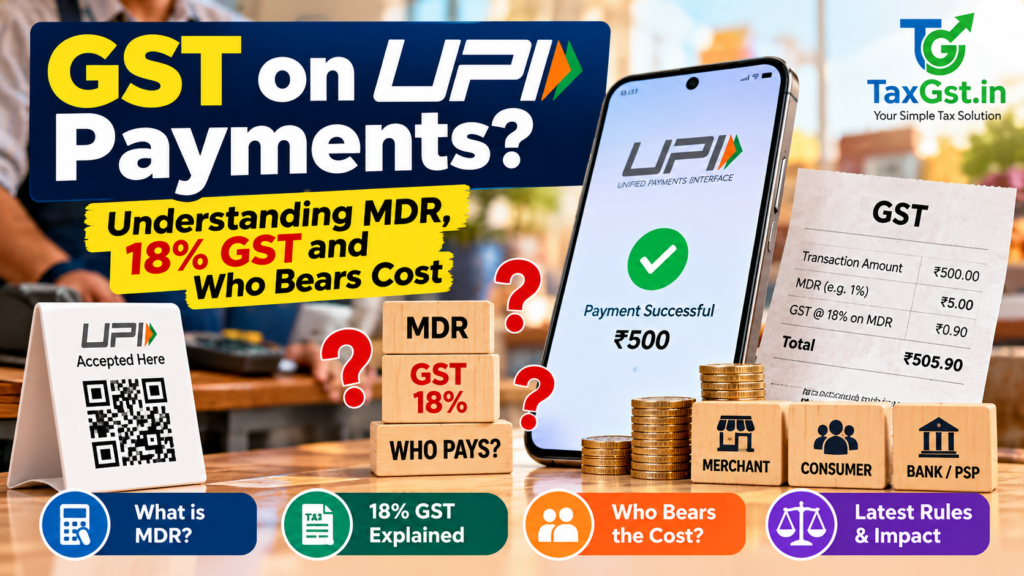
No, GST is not levied on UPI payments themselves. As clarified in the PIB press release dated 18 April 2025, GST applies only to charges such as the Merchant Discount Rate (MDR) recovered for facilitating certain merchant payments — never on the money you transfer. From 15 October 2026, the announced MDR framework will apply to specified person-to-merchant UPI transactions above ₹2,000. GST, where applicable to the MDR service fee, is charged on that fee—not on the underlying UPI payment. The merchant bears the MDR; customers are not to be charged the MDR as a separate UPI payment fee.
September 2026 status: The revised UPI MDR framework is announced to take effect from 15 October 2026. Until that date, the earlier zero-MDR framework remains the relevant position. Always verify the latest bank/NPCI implementation instructions before posting or charging any amount.
Quick Summary
- Transferring money through UPI does not attract GST — under the Central Goods and Services Tax Act, 2017, money is excluded from the definitions of goods and services, so the transfer itself is not a taxable supply.
- The PIB press release dated 18 April 2025 termed claims of GST on UPI transactions over ₹2,000 completely false and baseless; GST applies only to payment charges such as MDR.
- Under the new UPI framework announced by PIB on 15 September 2026, all person-to-person transfers and merchant payments up to ₹2,000 remain free — about 96% of merchant transactions stay outside MDR.
- MDR of 0.4% applies only to specified person-to-merchant transactions above ₹2,000, capped at ₹300 per transaction for payments of ₹75,000 and above.
- MDR is neither a tax nor a Government or NPCI charge; it is shared among banks, payment service providers and UPI app providers under the framework introduced under the Payment and Settlement Systems Act, 2007.
Is GST Levied on UPI Payments in India?
The short answer is no — and the confusion comes from mixing up two very different things: the payment and the fee for processing the payment. Think of it like courier charges on an online order. GST is not charged on the parcel’s contents; it is charged on the courier fee. Similarly, GST is not charged on the ₹5,000 you send or spend through UPI; it is charged on the processing fee a bank or payment service provider levies for facilitating that merchant payment.
Under the Central Goods and Services Tax Act, 2017, money is excluded from the definitions of goods and services, so merely transferring money through UPI does not itself attract GST. The PIB press release dated 18 April 2025 reiterated this, adding that GST is levied on charges such as MDR relating to payments made using certain instruments.
Historically, no MDR was permitted on the prescribed electronic modes under the framework brought into effect from January 2020. CBDT Notification No. 105/2019 prescribed UPI/BHIM-UPI and UPI QR as electronic modes, while CBDT Circular No. 32/2019 explained that Section 10A of the Payment and Settlement Systems Act, 2007 prevented banks or system providers from imposing charges, including MDR, on those prescribed modes. The September 2026 framework changes that position for specified UPI P2M transactions above ₹2,000 from 15 October 2026. GST applies to a taxable MDR/service fee, not to the underlying payment amount.
What Is MDR on UPI and How Does It Work?
Who Bears the Cost from 15 October 2026?
MDR is the fee a merchant pays to the payment ecosystem for accepting digital payments — a small percentage of the transaction value, shared among banks, payment service providers and UPI application providers. The framework announced on 15 September 2026, introduced under the Payment and Settlement Systems Act, 2007 after deliberations by the UPI Steering Committee, keeps it tightly ring-fenced.
All person-to-person transactions remain completely free, irrespective of amount, covering about 70% of total transaction value. Merchant payments up to ₹2,000 stay free, and small merchants — including street vendors receiving up to ₹1 lakh per month through UPI QR codes under the person-to-person-merchant category — continue to enjoy zero MDR.
MDR of 0.4% applies only to specified merchant transactions above ₹2,000, capped at ₹300 for transactions of ₹75,000 and above. Essential and thin-margin sectors such as railways, telecommunications, insurance, fuel and agricultural inputs attract a flat ₹5 per transaction above ₹2,000, while capital market payments attract 0.02%, capped at ₹300. Banks have been advised to ensure merchants do not pass MDR on to customers, and UPI application providers are expressly prohibited from imposing platform fees or hidden charges.
How Much MDR and GST Will a Merchant Actually Pay from 15 October 2026?
The structure is deliberately tiered so that individuals and small merchants stay outside the charge entirely. As per the PIB press release dated 15 September 2026, data analysis indicates MDR will apply to only about 4% of merchant transactions, leaving approximately 96% unaffected. The full rate card under the framework introduced under the Payment and Settlement Systems Act, 2007 looks like this:
| Transaction Category | MDR Applicable | Cap | Who Bears It |
|---|---|---|---|
| Person-to-person (P2P) transfers, any amount | Nil | Not applicable | Nobody — completely free |
| Merchant payments (P2M) up to ₹2,000 | Nil | Not applicable | Nobody |
| Small merchants under the P2PM category — UPI QR receipts up to ₹1 lakh per month | Nil on all transactions | Not applicable | Nobody |
| P2M transactions above ₹2,000 (general) | 0.4% | ₹300 per transaction for payments of ₹75,000 and above | Merchant ecosystem |
| Essential and thin-margin sectors above ₹2,000 — railways, telecommunications, insurance, fuel, agricultural inputs | Flat ₹5 per transaction | Fixed charge | Merchant ecosystem |
| Capital market payments — mutual funds, securities, stockbrokers and dealers | 0.02% | ₹300 per transaction | Merchant ecosystem |
On whichever MDR is actually charged, GST at the applicable rate applies to the taxable MDR/service fee—not to the underlying transaction value. For the examples below, the article uses 18% GST on MDR. Banks have been advised to ensure merchants do not pass MDR charges on to customers, and UPI application providers are expressly prohibited from imposing platform fees or hidden charges. Daily transaction limits of ₹1 lakh to ₹5 lakh prescribed by banks and NPCI remain security and risk-management safeguards, not charging thresholds.
Here is how the numbers play out for a GST-registered furniture retailer who receives a ₹50,000 UPI payment from a customer after 15 October 2026:
- MDR at 0.4% of ₹50,000 = ₹200
- GST at 18% on the MDR fee = ₹36
- Total processing cost = ₹236, absorbed within the merchant ecosystem
- The customer pays exactly ₹50,000 — nothing more
Two contrasts sharpen the picture. A car dealer receiving ₹1,00,000 would notionally compute 0.4% (₹400), but the MDR is capped at ₹300 for transactions of ₹75,000 and above, so GST is 18% of ₹300, i.e. ₹54 — a total of ₹354. A fuel outlet taking a ₹5,000 payment attracts the flat ₹5 MDR prescribed for essential sectors, plus 18% GST of ₹0.90 — a total of ₹5.90.
One relief worth noting: because the MDR invoice from the bank or payment service provider is for a service used in the course of business, the GST-registered merchant can claim the GST charged on MDR as input tax credit under Section 16(1) of the CGST Act, 2017, subject to the conditions and the manner specified under the provisions governing utilisation of input tax credit, including Section 49 of the CGST Act,
How Can GST-Registered Merchants Claim Input Tax Credit on the GST Paid on MDR?
The GST charged on the MDR fee is not a dead cost for a GST-registered merchant — it is recoverable as input tax credit under Section 16(1) of the CGST Act, 2017, which entitles a registered person to take credit of input tax charged on inward supplies used in the course or furtherance of business. The MDR invoice from the bank or payment service provider qualifies as a supply of service used for business purposes, so the GST component — 18% of the MDR amount — can be credited to the merchant’s electronic credit ledger in the manner provided under the provisions governing utilisation of input tax credit, including Section 49 of the CGST Act, 2017.
There is a practical catch: the credit is available only if the merchant holds a valid tax invoice or debit note issued by the bank or payment service provider, the goods or services have been received, the tax has been actually paid to the Government, and the merchant has filed the relevant returns. For most GST-registered merchants, the bank will issue a consolidated monthly invoice or a transaction-level charge advice reflecting the MDR and GST thereon. That document is the anchor for claiming credit.
Continuing the earlier furniture retailer example: on a ₹50,000 UPI payment, the MDR is ₹200 and the GST is ₹36. The retailer can claim ₹36 as input tax credit, reducing the net processing cost to ₹200. For the car dealer on ₹1,00,000, the MDR is capped at ₹300 and GST at ₹54 — the claimable credit is ₹54. The credit flows through the regular GSTR-3B and GSTR-1 cycle, with no special form or procedure required for MDR-related credit alone.
Illustrative example only; actual figures, terms and outcomes vary.
What Records and Documents Must Merchants Maintain for MDR and GST Compliance?
The compliance burden is light but specific. A GST-registered merchant must retain the tax invoice or charge advice issued by the acquiring bank or payment service provider showing the MDR amount and the GST charged thereon. These documents are the primary evidence for input tax credit claims under Section 16(1) of the CGST Act, 2017. Banks and payment service providers may issue periodic statements or invoices consolidating the MDR and GST for each merchant, which the merchant should reconcile against their own UPI settlement reports.
Beyond the invoice, the merchant should maintain a reconciliation statement matching UPI settlement data from the bank or NPCI with the MDR charges levied. This is not a statutory form prescribed under the CGST Rules, but it is the practical backbone of a defensible credit claim during assessment or audit. The reconciliation should show transaction-level UPI credits, the MDR rate applied, the GST charged, and the net settlement amount credited to the bank account. For merchants in essential sectors where a flat ₹5 MDR applies per transaction above ₹2,000, the reconciliation should clearly flag those transactions to justify the flat rate rather than the percentage-based rate.
There is no separate filing requirement for MDR-related GST in any special return. The credit is claimed in the regular GSTR-3B return under the input tax credit table, and the outward supply side is unaffected because MDR is a charge on the merchant, not on the customer. The merchant’s GSTR-1 continues to reflect only the supply of goods or services to the customer, not the payment processing fee. The only additional discipline is document retention — tax invoices and reconciliation statements should be kept for the period prescribed under the CGST Act, 2017, which is currently six years from the due date of the annual return for the relevant year.
How Does GST on UPI MDR Compare With MDR on Credit and Debit Cards?
The GST treatment of MDR follows the same principle across payment modes — GST applies to the processing fee, not the transaction value — but the exemption thresholds differ, and that difference matters for merchants who accept both UPI and card payments.
For credit and debit card transactions, the GST exemption under Sl. No. 34 of notification No. 12/2017-CTR dated 28.06.2017 has long been available to acquiring banks for settlement amounts up to ₹2,000 in a single transaction. Through Circular No. 245/02/2025-GST/2025-GST, the 55th GST Council clarified that RBI-regulated Payment Aggregators also fall within the definition of ‘acquiring bank’ for this purpose and can avail the exemption for card settlements up to ₹2,000. The exemption covers the payment settlement function only — Payment Gateway services involving no fund handling remain outside its scope.
The UPI framework from 15 October 2026 mirrors this ₹2,000 threshold for person-to-merchant transactions, but the structural difference is important. For cards, the ₹2,000 exemption applies per transaction to the acquiring bank or Payment Aggregator — the merchant still bears MDR on the full amount, but the intermediary’s small-ticket settlements are GST-exempt. For UPI, the ₹2,000 threshold operates as a zero-MDR zone for the merchant directly: no MDR means no GST at all on transactions up to ₹2,000.
| Parameter | UPI (from 15 Oct 2026) | Credit/Debit Cards |
|---|---|---|
| MDR on transactions up to ₹2,000 | Nil — zero MDR for merchant | MDR may apply; GST exemption available to acquiring bank/PA on settlement |
| MDR on transactions above ₹2,000 | 0.4% (general), capped at ₹300 | As per card network agreement, typically 0.5%–2% |
| GST on MDR fee | 18% on MDR charged | 18% on MDR charged |
| Who bears MDR | Merchant ecosystem, not customer | Merchant ecosystem, not customer |
| ITC on GST paid by merchant | Available under Section 16(1) of CGST Act | Available under Section 16(1) of CGST Act |
What Are the Key GST Pitfalls Merchants Should Avoid When MDR Returns?
Three recurring mistakes surface whenever a new charge enters the payment ecosystem, and each carries a compliance risk that can trigger scrutiny or deny legitimate credit.
First, some merchants mistakenly compute GST on the entire UPI transaction value rather than on the MDR fee alone. If a customer pays ₹10,000 through UPI, the taxable base for GST is the ₹40 MDR (0.4%), not ₹10,000. Computing GST on ₹10,000 would overstate the liability by a factor of 250 — an error that creates an incorrect tax invoice and potential mismatch in GSTR-2B.
Second, merchants sometimes fail to claim input tax credit on the GST component of MDR, treating it as a non-creditworthy expense. Under Section 16(1) of the CGST Act, 2017, the GST charged on the MDR invoice from the bank or payment service provider is input tax on a business input service, and it may be claimed subject to the statutory conditions and applicable time limit for input-tax credit. Unclaimed ITC accumulates as a cost and can distort margin calculations.
Third, and most critically, merchants must not pass the MDR or GST cost on to customers as a separate line item or surcharge. Banks have been advised to ensure merchants do not pass MDR charges to customers, and UPI application providers are expressly prohibited from imposing platform fees or hidden charges. Adding a “GST surcharge” or “convenience fee” on UPI payments at the counter not only violates the framework introduced under the Payment and Settlement Systems Act, 2007 but also risks complaints under consumer protection guidelines.
Here is a second worked example for a GST-registered pharmaceutical retailer — an essential sector — that receives a ₹4,000 UPI payment after 15 October 2026:
- Transaction value: ₹4,000 (above ₹2,000 threshold)
- Sector: Pharmaceutical retail falls under essential/thin-margin category
- MDR: Flat ₹5 per transaction (not a percentage)
- GST at 18% on ₹5 = ₹0.90
- Total processing cost: ₹5.90, fully absorbed by merchant ecosystem
- ITC claimable by merchant: ₹0.90 in the relevant return period
The flat-rupee structure for essential sectors means the effective MDR percentage drops sharply as the ticket size rises. On a ₹4,000 transaction, ₹5 is 0.125%; on a ₹20,000 transaction, it is just 0.025%. This design protects thin-margin businesses while keeping the GST compliance base simple and predictable.
What Should You Do Next?
MDR returns on specified UPI merchant transactions from 15 October 2026, so a little preparation now saves both cost and compliance pain later. Here is a practical action list for merchants, accountants and business owners:
- Pull three months of UPI statements and split receipts into person-to-person, merchant payments up to ₹2,000, and merchant payments above ₹2,000 — only the last slice attracts the 0.4% MDR.
- If you receive up to ₹1 lakh per month through UPI QR codes, confirm your person-to-person-merchant (P2PM) classification with your bank so zero MDR continues to apply.
- Check your sector rate — railways, telecommunications, insurance, fuel and agricultural inputs attract a flat ₹5 per transaction above ₹2,000, while capital market payments attract 0.02% capped at ₹300.
- Ask your bank or payment service provider to raise GST invoices for MDR in your registered name and GSTIN — without this, the 18% GST on MDR cannot be claimed as credit.
- Absorb the MDR in your pricing rather than passing it to customers — banks have been advised to ensure merchants do not pass MDR charges on to customers.
- Book MDR and the GST on it as separate ledger lines from 15 October 2026 so input tax credit reconciliation on the GST portal stays clean.
- Track NPCI and PIB announcements for the operative circular confirming the rates and the effective date before 15 October 2026.
Official Sources for UPI MDR and GST
- Ministry of Finance / PIB: UPI framework and MDR clarification, 15 September 2026
- NPCI UPI Circulars
- PIB: GST is not levied on UPI transactions themselves, 18 April 2025
- CBDT Notification No. 105/2019
- CBDT Circular No. 32/2019
Related Reading
Frequently Asked Questions
Will I pay any charge or GST when I send money to friends or family through UPI after 15 October 2026?
No. As per the PIB press release dated 15 September 2026, all person-to-person UPI transactions remain completely free, irrespective of the amount transferred, and no transaction fee, platform fee or other charge may be imposed on individuals. Since no fee is charged, no GST arises on these transfers.
Is the 18% GST charged on my full UPI payment value or only on the MDR fee?
Only on the MDR fee. Under the Central Goods and Services Tax Act, 2017, money is excluded from the definitions of goods and services, so the transfer itself is not a taxable supply. On a ₹50,000 merchant payment, MDR at 0.4% is ₹200, and the 18% GST of ₹36 applies to that fee — never to the ₹50,000.
Do street vendors and small shopkeepers pay MDR on UPI QR code payments?
No. Small merchants, including street vendors, receiving up to ₹1 lakh per month through UPI QR codes under the person-to-person-merchant (P2PM) category continue to enjoy zero MDR on all transactions. Every merchant payment up to ₹2,000 also stays free, which is why about 96% of merchant transactions remain unaffected.
Can a GST-registered merchant claim input tax credit on the GST charged on MDR?
Yes. The MDR fee is consideration for a service used in the course of business, so the GST charged on it qualifies as input tax credit under Section 16(1) of the CGST Act, 2017, subject to the conditions and manner specified under the provisions governing utilisation of input tax credit, including Section 49 of the CGST Act, 2017. Insist on a GST invoice in your registered name and GSTIN to claim the credit.
Does GST exemption apply to payment aggregators on small card transactions?
Yes. Based on the 55th GST Council recommendations, it has been clarified that RBI-regulated Payment Aggregators fall within the definition of ‘acquiring bank’ under the Explanation to Sl. No. 34 of notification No. 12/2017-CTR dated 28.06.2017. Consequently, they are eligible for the GST exemption on settlement of amounts up to ₹2,000 in a single transaction through credit card, debit card, charge card or other payment card services. The exemption is limited to the payment settlement function involving handling of money and does not extend to Payment Gateway services, which only route transactions without handling funds.
Is GST applicable on penal charges levied by banks and NBFCs for loan defaults?
No. As clarified in Circular No. 245/02/2025-GST/2025-GST, penal charges levied by Regulated Entities such as banks and NBFCs, in compliance with RBI directions dated 18.08.2023, are not consideration for tolerating an act or situation. They are charges for breach of contract terms, meant to inculcate credit discipline. Following the principle in Circular No. 178/10/2022-GST/2022-GST, the essence of a contract is its performance, not its breach. Therefore, no GST is payable on such penal charges.
Are government incentives for promoting RuPay and BHIM-UPI taxable under GST?
No. As clarified by Circular No. 190/02/2023-GST/2023-GST following the 48th GST Council meeting, incentives paid by the Ministry of Electronics and Information Technology to acquiring banks under the Incentive Scheme for promotion of RuPay Debit Cards and low value BHIM-UPI transactions are in the nature of subsidy and thus not taxable. The 53rd GST Council further clarified that the subsequent sharing of this incentive by the acquiring bank with issuer banks, Payer Payment Service Providers and UPI apps — in the proportion and manner decided by NPCI in consultation with participating banks — also retains its character as a subsidy and remains outside GST.
Sources
- GST Council – April 2025 Newsletter
- Press Information Bureau – GST Council Meeting Outcomes
- Press Information Bureau – UPI MDR Framework
- CBIC GST – Circular on Service Tax Clarifications
- GST Council – FAQ Document September 2025
- Press Information Bureau – GST Rate Changes
- GST Council – Circular No. 245/02/2025-GST/2025-GST
- Press Information Bureau – UPI Free for P2P and 96% Merchant Transactions
Try the free GST calculator for instant figures.
Discover more from TaxGst.in
Subscribe to get the latest posts sent to your email.

Never Miss a Tax Deadline Again
Due-date alerts, GST updates and tax tips — free on the app you already use.
event Next: GSTR-3B (QRMP) · 24 Oct