
 C.K. Gupta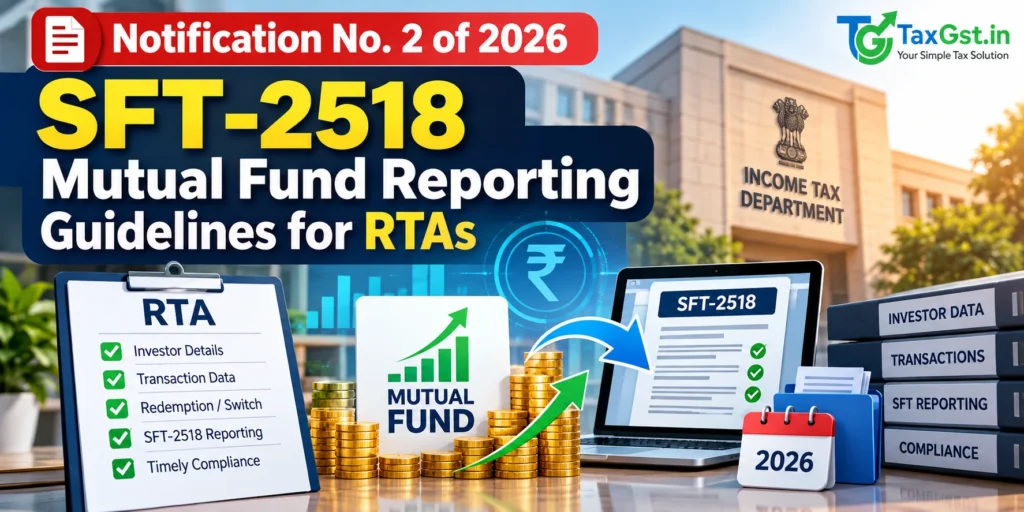
Notification No. 2 of 2026, dated 10 September 2026, prescribes the format, procedure, data structure and validation guidelines for SFT-2518 relating to mutual fund transactions for pre-filling capital-gains information in income-tax returns. It applies to Registrar and Share Transfer Agents (RTAs) registered under section 12(1) of the Securities and Exchange Board of India Act, 1992, under section 508(1) of the Income-tax Act, 2025 read with sub-rule (6) of rule 237 of the Income-tax Rules, 2026.
Quick Summary
- Notification No. 2 of 2026, dated 10 September 2026, issued by the Directorate of Income Tax (Systems) with CBDT approval, prescribes the SFT-2518 framework for mutual fund transactions under section 508(1) of the Income-tax Act, 2025 read with sub-rule (6) of rule 237 of the Income-tax Rules, 2026.
- Applies to all Registrar and Share Transfer Agents (RTAs) registered under section 12(1) of the SEBI Act, 1992, for the specified mutual-fund reporting function.
- Important: Notification No. 2 of 2026 does not prescribe a ₹10 lakh annual acquisition threshold for SFT-2518. The notification deals with reporting of mutual-fund transaction information, including capital-gains-related data, for return pre-filling.
- SFT-2518 data is submitted electronically through the prescribed SFTP process, with a separate control statement signed, verified and furnished by the Designated Director. Form 165 is the new-law successor to the earlier Form 61A framework.
- For the SFT-2518 framework, filing is half-yearly: the period ending 30 September is due by 31 October and the period ending 31 March is due by 30 April.
- The Income-tax Act, 2025 and Income-tax Rules, 2026 operate from 1 April 2026; Notification No. 2 of 2026 itself is dated 10 September 2026 and takes effect from the date of issue.
What is Notification No. 2 of 2026 and Who Must Comply?
Notification No. 2 of 2026 was issued on 10 September 2026 by the Directorate of Income Tax (Systems), with the approval of CBDT. It prescribes the format, procedure and guidelines for submission of SFT-2518 for mutual-fund transactions under section 508(1) of the Income-tax Act, 2025 read with sub-rule (6) of rule 237 of the Income-tax Rules, 2026. The stated purpose is to provide transaction information relating to capital gains on transfer of mutual-fund units for pre-filling income-tax returns.
The notification specifically requires all Registrar and Share Transfer Agents registered under section 12(1) of the Securities and Exchange Board of India Act, 1992 to prepare the prescribed data files from their internal systems and submit them through the SFTP server using credentials communicated by the Income Tax Department. The control statement includes the reporting entity details and ITDREIN. The broader registration process for reporting entities is governed separately under the Income-tax Rules, 2026. The new Rules operate from 1 April 2026.
What Mutual Fund Transactions Must Be Reported?
Is There a ₹10 Lakh Threshold for SFT-2518?
Under the September 2026 SFT-2518 framework, the focus is not a ₹10 lakh annual purchase threshold. Notification No. 2 of 2026 prescribes transaction-level information relating to mutual-fund units, particularly information needed for capital-gains pre-filling. It requires RTAs to prepare the prescribed account-summary, transaction and off-market data files in accordance with the annexures and validation rules. Accordingly, an investor does not become reportable merely because mutual-fund purchases cross ₹10 lakh; the RTA reporting obligation arises from the prescribed SFT-2518 data framework.
The RTA data structure nevertheless requires careful identification of account holders and joint holders. The prescribed files capture client details, account-level summary values and transaction information, and the guidelines permit guardian details to be provided for minor accounts. Joint-holder information therefore needs to be maintained accurately for matching and pre-filling purposes. Under the new-law framework, Form 165 is the successor to the earlier Form 61A for statements of specified financial transactions.
How Are Holding Period, Cost of Acquisition, and Filing Due Dates Determined Under SFT-2518?
For pre-filling capital gains in the return of income, the holding period is used to classify the mutual fund unit as a short-term or long-term asset. As per the guidelines for furnishing SFT in respect of mutual fund units, the First in First out (FIFO) method must be used for the identification of corresponding purchases and computation of the period of holding. This applies uniformly to determine the applicable tax rate on the transaction.
The estimated sale consideration for a debit transaction should be determined on the best possible available price of the asset with the Registrar and Transfer Agent (RTA). In case the sale consideration related to a sale or transfer is not available, the Redemption Offer Price (Exit Load adjusted NAV) on the date of sale or transfer may be taken. Similarly, the estimated cost of acquisition for the corresponding credit is determined on the best possible available price with the RTA, or the NAV for the end of the day of the credit if unavailable. The taxpayer retains the ability to modify the sales consideration or cost of acquisition before filing the return of income.
Reporting entities must submit the data files using the SFTP Server using the login credentials provided by the Income Tax Department, along with a separate control statement signed, verified, and furnished by the Designated Director.
| Applicable Periodicity | Period / Quarter Ending | Due Date for Furnishing SFT-2518 |
|---|---|---|
| Quarterly (FY 2021-22 and 2022-23) | 30th June (1st Quarter) | 25th July |
| Quarterly (FY 2021-22 and 2022-23) | 30th September (2nd Quarter) | 25th October |
| Quarterly (FY 2021-22 and 2022-23) | 31st December (3rd Quarter) | 25th January |
| Quarterly (FY 2021-22 and 2022-23) | 31st March (4th Quarter) | 25th April |
| Half-yearly (From FY 2023-24 onwards) | 1st April to 30th September | 31st October |
| Half-yearly (From FY 2023-24 onwards) | 1st October to 31st March | 30th April |
Practical Example: How SFT-2518 Data Can Support Capital-Gains Pre-Filling
Consider Mr. Arjun, who holds units of an equity-oriented mutual fund and redeems part of his holding during FY 2026-27. Suppose the RTA has purchase records for several lots acquired on different dates. For the SFT-2518 capital-gains data, the corresponding purchases are identified using the First In First Out (FIFO) method so that the period of holding can be determined. The RTA then reports the prescribed sale consideration and acquisition-cost information using the available records and valuation methodology in the guidelines. The information can subsequently be used for pre-filling, while the taxpayer remains responsible for reviewing and correcting the figures before filing the return. This example illustrates the purpose of SFT-2518; it should not be treated as a ₹10 lakh purchase-threshold test.
Illustrative example only; actual figures, terms and outcomes vary.
How Do You Register and File the SFT Statement Electronically?
The filing process under Notification No. 2 of 2026 follows a structured electronic workflow. Every reporting entity — being a trustee of a Mutual Fund or such other person managing the affairs of a Mutual Fund — must first register with the Income Tax Department and generate a Tax Department Reporting Entity Identification Number (ITDREIN). This registration is a prerequisite before any data file can be submitted.
Step 1 — Prepare the data file: The reporting entity must prepare the data file in the prescribed format from its internal system. For mutual fund transactions, this includes the Mutual Fund Account Summary (covering client details and summary values for the reporting period) and the Mutual Funds Off-Market Transactions file (covering transactions effected through transmission and off-market transactions recorded by the RTA during the year).
Step 2 — Submit via SFTP Server: The data files must be submitted using the SFTP Server with the login credentials communicated separately by the Income Tax Department. Any file that does not meet the validation requirements will be rejected, so it is critical to ensure the data structure and validation rules are strictly followed before upload.
Step 3 — Furnish the control statement: A separate control statement must be signed, verified, and furnished by the Designated Director. This control statement accompanies the submitted data files and confirms that the information is correct and complete in accordance with the provisions of the Income-tax Act, 2025.
Step 4 — Handle corrections and deletions: If the reporting entity needs to modify uploaded data, a Correction Statement must be filed containing only those records in which correction is required. If uploaded data needs to be deleted, a Deletion request must be filed. Both mechanisms ensure data integrity without requiring a complete re-submission.
The Statement of Financial Transaction is furnished electronically in Form 165 under the digital signature of the person responsible for verification of the statement, as prescribed under sub-rule 6 of rule 237 of the Income-tax Rules, 2026.
What Are the Specific Guidelines for Reporting Mutual Fund Transactions?
Notification No. 2 of 2026 prescribes detailed guidelines for furnishing SFT in respect of transactions in units of mutual funds. These guidelines ensure that the data submitted is consistent, accurate, and usable for pre-filling the taxpayer’s return of income.
Scope of transactions: The Mutual Fund transaction summary is required to be prepared for user-initiated debit transactions during the reporting period. For debits through transfers, information need not be provided if the transferor and transferee are the same person. Data with respect to exchange-traded funds and exchange-based transactions may not be provided.
Minor accounts: In the case of a minor, details of the legal or natural guardian — including PAN and name — may be provided in the statement.
Valuation methodology: The estimated sale consideration for a debit transaction should be determined on the best possible available price of the asset with the RTA. Where the sale consideration related to a sale or transfer is not available, the Redemption Offer Price (Exit Load adjusted NAV) on the date of sale or transfer may be taken. Similarly, the estimated cost of acquisition for the corresponding credit is determined on the best possible available price with the RTA, or the NAV for the end of the day of the credit if unavailable. The taxpayer retains the ability to modify both the sales consideration and the cost of acquisition before filing the return of income.
Asset classification and holding period: Securities must be classified into specified security classes for determining the type of asset — short-term or long-term — and the applicable tax rate. The period of holding, computed using the First in First out (FIFO) method for identification of corresponding purchases, determines whether the asset is short-term or long-term. The specified minimum period of holding for different asset classes is as under:
| Security Class Code | Description | Security Class / Holding-Period Treatment |
|---|---|---|
| EMF | Unit of Equity Oriented Mutual Fund | Refer to the applicable capital-gains holding-period rule |
| UTI | Unit of UTI | Refer to the applicable capital-gains holding-period rule |
| OTU | Other Units | Refer to the applicable capital-gains holding-period rule |
Off-market and transmission transactions: The details of transactions effected through transmission and recorded by the RTA during the year, along with off-market transactions recorded in the RTA system, must be reported in the Mutual Funds Off-Market Transactions file. This ensures comprehensive coverage of all mutual fund unit transactions, not just those executed on the exchange platform.
How Does Mutual Fund SFT Differ from Depository SFT?
While both mutual fund and depository transactions are reported in Form 165 under the Income-tax Rules, 2026, the reporting guidelines differ in material respects. Mutual fund SFT focuses on unit acquisitions and redemptions processed through the Registrar and Transfer Agent (RTA), whereas depository SFT captures transactions in demat securities. Understanding these distinctions is essential for reporting entities that may be responsible for both categories.
| Parameter | Mutual Fund SFT (Notification No. 2 of 2026) | Depository SFT (Notification No. 1 of 2026) |
|---|---|---|
| Governing Provision | Section 508(1) of the Income-tax Act, 2025 read with sub-rule 6 of rule 237 of the Income-tax Rules, 2026 | Section 508(1) of the Income-tax Act, 2025 read with rule 237 of the Income-tax Rules, 2026 |
| Reporting Entity | Trustee or authorised person of a Mutual Fund | Depositories as defined under the Depositories Act, 1996, under the current SFT-2517 framework |
| Transaction Scope | User-initiated debit transactions in mutual fund units; ETFs and exchange-based transactions are excluded | Depository transactions reported under the SFT-2517 framework, with separate treatment for prescribed off-market transactions |
| Summary File | Mutual Fund Account Summary (client details and summary values) | Depository Account Summary under SFT-2517 |
| Off-Market Transactions | Reported in Mutual Funds Off-Market Transactions file covering transmission and off-market transactions recorded by RTA | Reported in Depository Off-Market Transaction (DEP_OFF_TRN) file |
| Cost of Acquisition | Best available price with RTA; if unavailable, NAV for end of day of credit | Best available price with depository (e.g. end of day price) |
| Sale Consideration | Best available price with RTA; if unavailable, Redemption Offer Price (Exit Load adjusted NAV) on date of sale | Best available price with depository (e.g. end of day price) |
What Are the Common Pitfalls and Edge Cases in Mutual Fund SFT Reporting?
Several scenarios create confusion for reporting entities under Notification No. 2 of 2026. The prescribed SFT-2518 data structure requires careful treatment when accounts are held jointly, when transactions involve minors, or when units are transmitted due to death of the holder. These are data-quality and identification issues rather than a ₹10 lakh acquisition-threshold test.
Pitfall 1 — Joint account identification: Where a mutual-fund account is held jointly, the RTA data structure captures holder information for the account, including additional holder details where applicable. Reporting entities should not arbitrarily split transaction values between holders; they should follow the prescribed field structure and PAN/name requirements so the transaction can be correctly associated with the account holders.
Pitfall 2 — Minor accounts: In the case of a minor, details of the legal or natural guardian may be provided. The guardian’s PAN and name should be reported alongside the minor’s details to ensure proper pre-filling in the guardian’s return of income where the minor’s income is clubbed under the applicable provisions of the Income-tax Act, 2025.
Pitfall 3 — ETF exclusion: Data with respect to exchange-traded funds and exchange-based transactions may not be provided in the mutual fund SFT. Reporting entities must ensure that ETF transactions are excluded from the mutual fund transaction summary file, even though such transactions may appear in the RTA system.
Pitfall 4 — Inter-scheme transfers: Reporting entities should distinguish transfers between schemes from transactions that represent fresh acquisitions or redemptions. The underlying transaction records should be maintained consistently with the RTA system and the prescribed SFT-2518 data structure so that the reported information can be reconciled.
Pitfall 5 — Transmission and off-market transactions: Transactions effected through transmission and recorded by the RTA during the year, along with off-market transactions recorded in the RTA system, must be reported in the Mutual Funds Off-Market Transactions file. These are distinct from the regular mutual fund transaction summary and must not be omitted.
Illustrative example only; actual figures, terms and outcomes vary.
Worked Example: Joint Account Data Validation
Consider Mr. Sharma and Mrs. Sharma who hold a joint mutual fund account. During FY 2026-27, the account records purchases and later a redemption. The RTA must retain the account-holder and joint-holder details in the prescribed fields and ensure that the transaction-level data is linked to the correct account records. The example is important because a data-quality error in a joint holder’s PAN or name can interfere with reconciliation and pre-filling. The reporting entity should therefore validate the complete holder information rather than treating the transaction as two separate investments merely because there are two holders.
Illustrative example only; actual figures, terms and outcomes vary.
How Do You Correct Errors in Already Filed SFT Data?
When a reporting entity discovers errors in data already submitted via the SFTP Server, the correction mechanism under the guidelines for submission of SFT applies. A Correction Statement must be filed, and only those records in which correction is required should be uploaded. The reporting entity cannot resubmit the entire file — only the specific records with corrected data are to be included in the correction statement.
If the reporting entity needs to delete uploaded data entirely, a Deletion request must be required to be filed. The Designated Director’s control statement accompanies each correction or deletion request, confirming the accuracy of the revised submission. Any file that does not meet the validation requirements will be rejected, so it is essential to verify the data structure and validation rules before resubmission.
Latest September 2026 Developments: SFT-2517, SFT-2518 and Reporting Registration
September 2026 marks an important implementation stage for the new SFT framework under the Income-tax Act, 2025. On 10 September 2026, the Directorate of Income Tax (Systems) issued Notification No. 1 of 2026 for SFT-2517 covering depository transactions and Notification No. 2 of 2026 for SFT-2518 covering mutual-fund transactions through Registrar and Share Transfer Agents. These notifications move the operational reporting framework onto the Income-tax Rules, 2026 and are designed to provide structured information for return pre-filling.
The mutual-fund notification specifically requires SEBI-registered RTAs to prepare prescribed files from their internal systems, submit them through the SFTP server, and furnish a separate control statement verified by the Designated Director. The notification also requires reporting entities to provide reported transaction information to account holders for reconciliation with the Annual Information Statement (AIS), and to maintain appropriate information-security, archival and retrieval procedures.
Important distinction: Notification No. 2 of 2026 should not be described as a new ₹10 lakh mutual-fund investment reporting threshold. Its purpose is the prescribed SFT-2518 data submission for mutual-fund transaction information, particularly capital-gains information used for pre-filling returns. The older Form 61A terminology has also been replaced in the new-law framework by Form 165.
What Should You Do Next?
- Confirm that the RTA/reporting entity is properly registered under the Income-tax Rules, 2026 and that its ITDREIN and reporting credentials are active before SFT submission.
- Prepare the Mutual Fund Account Summary file covering client details and summary values for the reporting period, and the Mutual Funds Off-Market Transactions file covering transmission and off-market transactions recorded by the RTA during the year.
- Validate both data files against the prescribed data structure and validation rules before upload — any file that fails validation will be rejected by the Income Tax Department’s system.
- Submit the validated data files via the SFTP Server using the login credentials communicated separately by the Income Tax Department.
- Furnish the separate control statement signed, verified, and authenticated by the Designated Director alongside the data files.
- Calendar the half-yearly due dates — 31st October for the April-to-September period and 30th April for the October-to-March period — to ensure timely filing under SFT-2518.
- If any submitted data requires correction, file a Correction Statement containing only the corrected records; if any data must be removed, file a separate Deletion request.
Related Reading
Frequently Asked Questions
What happens if the SFT is not filed within the prescribed due date?
Under section 508(7) of the Income-tax Act, 2025, the prescribed income-tax authority may issue a notice requiring the statement to be furnished within a period not exceeding 30 days from the date of service of the notice. Section 454 provides the applicable penalty framework after such notice. For FY 2026-27, RTAs should therefore ensure that SFT-2518 files and the control statement are prepared and validated well before the applicable half-yearly due date.
Can a correction or deletion be made to SFT data after it has been submitted?
Yes. If a reporting entity needs to modify uploaded data after submission, a Correction Statement must be filed. In the Correction Statement, only those records in which correction is required should be uploaded — not the entire dataset. If the reporting entity needs to delete uploaded data, a separate Deletion request must be filed. Any file that does not meet the validation requirements will be rejected by the system, so it is essential to ensure that the corrected data conforms to the prescribed data structure and validation rules before resubmission.
How does the SFT data reflect in a taxpayer’s Annual Information Statement?
Reporting entities are required to provide the information reported to the Income Tax Department to the account holder. This enables taxpayers to reconcile the information displayed in the Annual Information Statement (AIS), which is the current information statement under the Income-tax Rules, 2026 and is mapped to Form 168. The mutual fund transaction summary file is specifically used for pre-filling the gain, income, or loss from mutual fund transactions in the return of income. Taxpayers should review the AIS carefully and can modify the sales consideration or cost of acquisition before filing the return if the pre-filled values require correction.
What is the difference between Form 165 and Form 166?
Form 165 is the Statement of Specified Financial Transactions furnished under Section 508(1) of the Income-tax Act, 2025 by specified persons such as mutual fund trustees, depositories, and registrars. Form 166, on the other hand, is the Statement of Reportable Account furnished by prescribed reporting financial institutions in respect of reportable accounts, typically for exchange of information purposes under the Income-tax Rules, 2026. While Form 165 covers statements of specified financial transactions under the new-law framework, while Form 166 covers reportable accounts. For this article, the key operational requirement is the SFT-2518 data submission prescribed for RTAs.
Sources
- Income Tax India — FAQs on Forms as per Income-tax Rules, 2026
- Income Tax India — Statement of Financial Transaction (SFT)
- Income Tax India — Reporting of High-Value Transactions
- Income Tax India — Understanding Statement of Financial Transaction (SFT)
- Income Tax India — Income-tax Rules, 2026 (Notification dated 20 March 2026)
- Income Tax India — Notification No. 22 of 2026
- Income Tax Portal — Notification No. 3 of 2021 (SFT for Shares)
- SEBI — Official Website
If you are a RTA, mutual fund compliance team, or tax reporting professional responsible for SFT filing, review the prescribed format and validation rules on the official Income Tax India portal well before the next due date. Early preparation of the data file and timely furnishing of the control statement will help avoid rejection and ensure smooth compliance under Notification No. 2 of 2026.
Try the free GST calculator for instant figures.
Discover more from TaxGst.in
Subscribe to get the latest posts sent to your email.



Never Miss a Tax Deadline Again
Due-date alerts, GST updates and tax tips — free on the app you already use.
event Next: GSTR-3B · 20 Oct