
 C.K. Gupta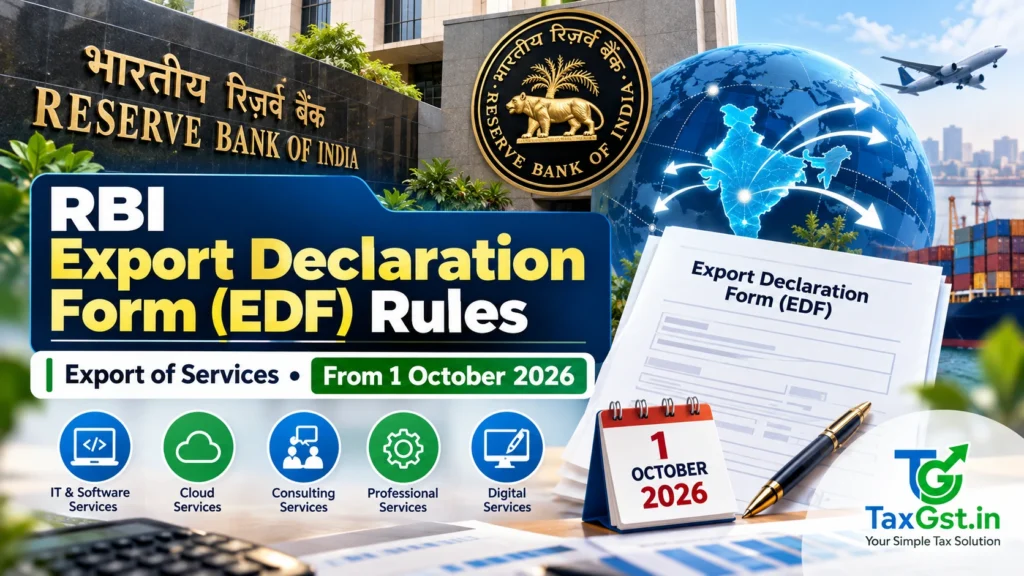
From October 1, 2026, the RBI mandates that exporters of services must furnish the Export Declaration Form (EDF) within 30 days from the end of the month in which the invoice is raised, as per the Foreign Exchange Management (Export and Import of Goods and Services) Regulations, 2026. This overhaul replaces the older Master Directions, introduces a single EDF facility for multiple recipients, and shortens the realisation window for export proceeds to nine months.
Also Read-Lok Sabha Passes Bill To Allow Charges On UPI, Other Digital Payments
Quick Summary
- New principal regulations notified via Notification No. FEMA 23(R)/2026-RB effective October 1, 2026.
- Service exporters must file EDF within 30 days from the end of the invoice month.
- Realisation and repatriation period reduced from fifteen months to nine months.
- Old Master Directions and specific legacy circulars stand superseded by the new principal regulations.
- Authorised Dealers empowered to handle routine transactions and grant EDF filing extensions.
What Are the New EDF Filing Deadlines for Service Exporters?
Under the Foreign Exchange Management (Export and Import of Goods and Services) Regulations, 2026, the timeline for declaring service exports has been strictly defined to align with the invoice cycle. As per Regulation 3(2) of Notification No. FEMA 23(R)/2026-RB, an exporter of services must furnish the EDF to the specified authority within 30 days from the end of the month in which the invoice for the services has been raised.
The regulations offer specific flexibilities within this framework. If an exporter provides services to multiple recipients in a single month, they may submit a single consolidated EDF for all such exports during that month. Furthermore, for exporters of services other than software, the EDF can be submitted on or before the date of receipt of payment, providing a cash-flow aligned alternative. In cases of genuine delay, the Authorised Dealer has the discretion to extend the EDF submission period, provided the exporter cites valid reasons and the dealer satisfies itself about the reasonableness of the request.
How Has the Realisation Period for Export Proceeds Changed?
The timeline for bringing export earnings back to India has been significantly shortened under the 2026 Amendment Regulations. As per Notification No. FEMA 23(R)/(1)/2026-RB dated September 22, 2026, the previous realisation window of fifteen months has been substituted with nine months for both goods and services. Similarly, the alternate timeline mentioned in the proviso has been reduced from eighteen months to twelve months.
This means the full export value must be realised and repatriated by the exporter within nine months from the date of export. For exporters who previously structured their working capital around the fifteen-month window, this reduction necessitates a tighter receivables management strategy. The change applies prospectively, though Authorised Dealers will continue to handle legacy transactions that required prior RBI approval under the now-superseded 2015 Regulations, as per the transitional provisions inserted at Regulation 20.
How Do EDF Declaration Rules Differ for Goods, Software, and Other Services?
The 2026 Regulations create distinct declaration pathways depending on the nature of the export and the port of shipment. For goods exported through Electronic Data Interchange (EDI) ports, the EDF is deemed submitted as part of the shipping bill, eliminating duplicate filing. However, for goods exported through non-EDI ports, or when the specified authority for services is not an Authorised Dealer, the duly authenticated EDF must be explicitly forwarded to the respective Authorised Dealer, as stipulated under Regulation 3(3) of Notification No. FEMA 23(R)/2026-RB.
Software exporters operate under a separate regime using the SOFTEX form, meaning the 30-day invoice-month rule specifically targets non-software service providers. The table below outlines the specific declaration timelines and conditions across these categories.
| Export Category | Declaration Timeline or Condition | Regulatory Reference |
|---|---|---|
| Goods (EDI Port) | Deemed submitted via shipping bill at the time of export | Regulation 3(1) Proviso |
| Goods (Non-EDI Port) | Duly authenticated EDF forwarded to the Authorised Dealer | Regulation 3(3) |
| Services (General) | Within 30 days from the end of the month in which invoice is raised | Regulation 3(2) |
| Services (Non-software) | On or before the date of receipt of payment | Regulation 3(2)(b) |
| Services (Multiple Recipients) | Single consolidated EDF for all exports in a month | Regulation 3(2)(a) |
Practical Impact of the New Timelines
To understand how these rules apply operationally, consider a practical scenario. A management consultancy firm exports services worth ₹25,00,000, raising the invoice on October 15, 2026. Under Regulation 3(2), the standard deadline to furnish the EDF is within 30 days from the end of the invoice month, which falls on November 30, 2026.
However, if the firm receives the ₹25,00,000 payment from the foreign client on December 18, 2026, the non-software flexibility under Regulation 3(2)(b) allows them to submit the EDF on or before the payment receipt date. If the firm had exported to three different clients in October, they could file a single consolidated EDF for the entire ₹25,00,000, leveraging the facility under Regulation 3(2)(a). Missing these windows without requesting an extension from the Authorised Dealer under Regulation 3(2)(c) could disrupt the Export Data Processing and Monitoring System (EDPMS) closure and hold up future export transactions.
Furthermore, the transition is smoothed by Regulation 20, which empowers Authorised Dealers to handle transactions related to exports and imports undertaken prior to October 1, 2026, which previously required explicit RBI approval. This prevents a backlog of legacy cases from stalling current operations. The supersession of the Foreign Exchange Management (Export of Goods & Services) Regulations, 2015, and corresponding Master Directions means exporters must discard old compliance checklists and align entirely with the principle-based framework established by the 2026 Regulations.
Illustrative example only; actual figures, terms and outcomes vary.
How Does the EDF Flow Through EDPMS and the Banking System?
The Export Declaration Form does not operate in isolation — it feeds directly into the Export Data Processing and Monitoring System (EDPMS), which tracks each export transaction from declaration to final realisation. Under the 2026 framework, the Authorised Dealer serves as the primary node in this workflow. When an exporter furnishes the EDF to the AD, the AD uploads the declaration into EDPMS, which then monitors whether the export proceeds are realised and repatriated within the nine-month window mandated by Regulation 5 of the amended regulations.
For goods exported through non-EDI ports, or for service exports where the specified authority is not an AD, Regulation 3(3) of Notification No. FEMA 23(R)/2026-RB mandates that the duly authenticated EDF be forwarded to the respective Authorised Dealer. This ensures that every export declaration, regardless of the port or authority involved, ultimately lands in the AD’s system for EDPMS tracking. The footnote to the regulations clarifies that EDPMS (and IDPMS for imports) shall also refer to any successor platform specified by the RBI, so exporters should verify the current platform name on the RBI portal.
The closure of an export transaction in EDPMS requires matching the EDF declaration with the realisation advice. If the EDF is not filed within the prescribed timeline — 30 days from the end of the invoice month for services — the transaction remains open in EDPMS, which can block the exporter’s ability to file subsequent EDFs or process new export shipments through the same AD. This is why the extension facility under Regulation 3(2)(c) is critical: the AD can grant an extension, but only after satisfying itself about the reasons cited by the exporter.
Who Is Affected by the New EDF Rules and What Are the Transition Provisions?
The 2026 Regulations apply to every exporter of goods or services who ships or invoices on or after October 1, 2026. However, two important qualifications exist that carve out specific categories of exporters.
First, the Caution List carve-out. As per the proviso inserted at the end of Regulation 13 by Notification No. FEMA 23(R)/(1)/2026-RB dated September 22, 2026, exporters who were on the Caution List as of September 30, 2026 — as per orders issued by the RBI under Regulation 16 of the now-superseded Foreign Exchange Management (Export of Goods & Services) Regulations, 2015 — shall continue to be governed by those orders until they are removed from the Caution List. Such exporters cannot automatically claim the relaxed timelines or flexibilities under the 2026 Regulations; they must comply with the specific conditions attached to their Caution List status.
Second, the legacy transaction transition. Regulation 20, inserted after Regulation 19, empowers Authorised Dealers to handle transactions related to exports and imports undertaken prior to October 1, 2026, which previously required explicit RBI approval under the 2015 Regulations and the corresponding Master Directions (FED Master Direction No. 16/2015-16 and FED Master Direction No. 17/2016-17). Exporters with pending legacy cases no longer need to approach the RBI directly; their AD can now process these transactions, reducing delays and administrative burden.
The supersession of the 2015 Regulations and the listed legacy circulars — including A.P. (DIR Series) Circular No. 43 on EDF simplification, Circular No. 53 on EDF waiver for free-of-cost exports, and Circular No. 13 on LIBOR alternatives — means exporters who maintain compliance checklists based on older circulars must update them. The 2026 framework is principle-based, so the compliance focus shifts from checking specific circular provisions to ensuring that the core declaration and realisation obligations under the new regulations are met.
What Are the Key Differences Between the Old and New EDF Framework?
The transition from the Foreign Exchange Management (Export of Goods & Services) Regulations, 2015, to the 2026 framework represents a structural shift from prescriptive Master Directions to principle-based regulations. The table below captures the critical operational changes that exporters must internalize.
| Parameter | Old Framework (FEMA 23(R)/2015-RB) | New Framework (FEMA 23(R)/2026-RB) | Source |
|---|---|---|---|
| Realisation Period | Fifteen months from date of export | Nine months from date of export | Notification No. FEMA 23(R)/(1)/2026-RB |
| Extended Timeline (Proviso) | Eighteen months | Twelve months | Notification No. FEMA 23(R)/(1)/2026-RB |
| EDF for Multiple Service Recipients | Separate EDF for each recipient | Single consolidated EDF for all exports in a month | Regulation 3(2)(a) |
| Non-Software Service Exports | EDF tied to invoice date | EDF permissible on or before payment receipt date | Regulation 3(2)(b) |
| Regulatory Approach | Prescriptive Master Directions (FED Master Direction No. 16/2015-16) | Principle-based regulations empowering Authorised Dealers | RBI/2025-26/194 A.P. (DIR Series) Circular No. 20 |
| Legacy Transactions | Required prior RBI approval | Authorised Dealers empowered to handle pre-October 2026 transactions | Regulation 20 |
Worked Example: Impact of the Shortened Realisation Window
Consider an engineering services firm that exported technical design services worth ₹50,00,000 in November 2025 under the old framework, with the invoice raised on November 20, 2025. Under the superseded 2015 Regulations, the firm had until February 20, 2027 (fifteen months) to realise and repatriate the proceeds. However, for a similar export of ₹50,00,000 with an invoice dated November 15, 2026, under the amended Regulation 5 read with Notification No. FEMA 23(R)/(1)/2026-RB, the realisation deadline compresses to August 15, 2027 (nine months). This six-month reduction directly impacts the firm’s working capital cycle and necessitates renegotiation of credit terms with overseas clients.
Illustrative example only; actual figures, terms and outcomes vary.
What Pitfalls Should Service Exporters Avoid Under the New EDF Rules?
The new framework, while simplifying several procedures, introduces compliance risks that can disrupt EDPMS tracking and future export transactions. One critical pitfall is the misalignment between the 30-day invoice-month deadline and the payment receipt flexibility. While Regulation 3(2)(b) allows non-software exporters to file the EDF on or before the payment receipt date, this does not override the nine-month realisation mandate under Regulation 5. An exporter who delays EDF filing until payment receipt — say, seven months after the invoice — may find the EDPMS reflecting an unrealised export for an extended period, potentially triggering caution listing under Regulation 16 of the 2015 framework, which continues to apply to caution-listed exporters as per the proviso inserted at the end of Regulation 13.
Another edge case involves merchanting trade transactions and set-off provisions under Regulation 7. The 2026 Amendment Regulations insert Regulation 20 to empower Authorised Dealer handling of legacy merchanting trade transactions that previously required RBI approval. However, exporters must verify whether their specific transaction qualifies under the transitional provision or falls under the new principal regulations. The supersession of specific legacy circulars — including A.P. (DIR Series) Circular No. 43 on declaration form simplification and Circular No. 53 on EDF waiver for free-of-cost exports — means that waivers or relaxations previously available under those circulars may no longer apply unless explicitly carried forward into the new framework.
Software exporters must continue using the SOFTEX form and should not conflate the EDF timeline with SOFTEX filing obligations. The 30-day invoice-month rule under Regulation 3(2) explicitly excludes software exports, so IT companies filing SOFTEX must track their separate compliance calendar. Additionally, exporters operating through non-EDI ports must ensure the physical EDF reaches the Authorised Dealer promptly, as Regulation 3(3) places the onus of forwarding the authenticated form on the specified authority, but the exporter bears the ultimate responsibility for EDPMS closure.
What Should You Do Next?
- Map all outstanding service export invoices raised from October 1, 2026, and calculate the 30-day EDF filing deadline from the end of each invoice month.
- Identify whether your exports qualify for the single consolidated EDF facility under Regulation 3(2)(a) if you serve multiple foreign clients in a month.
- Determine if you can use the non-software flexibility under Regulation 3(2)(b) to align EDF submission with payment receipt dates.
- Contact your Authorised Dealer to understand their internal EDF upload process into EDPMS and any documentation requirements.
- Review your receivables management strategy to ensure export proceeds are realised and repatriated within the new nine-month window under Regulation 5 of the amended regulations.
- Check if you have any legacy transactions initiated before October 1, 2026, that previously required RBI approval — these can now be handled by ADs under Regulation 20 of the principal regulations.
- Download the updated EDF form from the RBI portal and discard any old compliance checklists based on the superseded Foreign Exchange Management (Export of Goods & Services) Regulations, 2015, and corresponding Master Directions.
Frequently Asked Questions
Can I file a single EDF if I export services to multiple foreign clients in one month?
Yes. Under Regulation 3(2)(a) of the Foreign Exchange Management (Export and Import of Goods and Services) Regulations, 2026, an exporter of services who has exported services to one or more recipients in a month may submit a single consolidated EDF for all such exports during that month. This facility reduces compliance burden for firms handling multiple foreign clients within the same invoice cycle.
What happens if I miss the 30-day EDF filing deadline for my service exports?
Under Regulation 3(2)(c) of Notification No. FEMA 23(R)/2026-RB, the Authorised Dealer may extend the EDF submission period upon request from the exporter, provided the exporter cites reasons for the delay and the AD satisfies itself about the reasonableness of the request. Without such an extension, the delay could disrupt EDPMS tracking and hold up future export transactions.
Is the nine-month realisation period applicable to exports made before October 1, 2026?
The nine-month realisation window introduced by Notification No. FEMA 23(R)/(1)/2026-RB dated September 22, 2026, applies prospectively. For transactions undertaken prior to October 1, 2026, that previously required RBI approval under the 2015 Regulations, Regulation 20 empowers Authorised Dealers to handle such legacy cases without referring them to the Reserve Bank.
Do software exporters need to file the EDF form under the new 2026 Regulations?
Software exporters operate under a separate regime using the SOFTEX form, as distinct from the EDF. The 30-day invoice-month rule under Regulation 3(2) specifically targets non-software service providers. However, software exporters should verify their specific declaration requirements under the applicable regulations and Master Directions governing software exports.
What happens to exporters already on the Caution List when the new regulations take effect?
As per the proviso inserted at the end of Regulation 13 by Notification No. FEMA 23(R)/(1)/2026-RB dated September 22, 2026, exporters who appear on the Caution List as of September 30, 2026 — as per orders issued by the Reserve Bank under Regulation 16 of the Foreign Exchange Management (Export of Goods & Services) Regulations, 2015 — shall continue to be governed by those existing orders until they are formally removed from the Caution List. This means the stricter conditions imposed under the 2015 framework remain in force for such exporters, even after October 1, 2026, and they cannot automatically claim the relaxed timelines or flexibilities available under the 2026 Regulations.
How does the SOFTEX form requirement differ from the new EDF rules for software exporters?
Software exporters operate under a distinct declaration regime. While the 2026 Regulations mandate the EDF for general service exports within 30 days from the end of the invoice month, software exporters must continue filing the Software Export Declaration (SOFTEX) form in original, duplicate, and triplicate copies as prescribed on the RBI portal. The specific flexibility under Regulation 3(2)(b) — allowing non-software service exporters to file the EDF on or before the payment receipt date — does not extend to software exporters, who must adhere to the SOFTEX filing timelines separately notified. The SOFTEX form is available for download on the RBI website under the FEMA forms section.
Can an Authorised Dealer reject a request for EDF filing extension, and what should the exporter do in that case?
Yes, the Authorised Dealer has full discretion under Regulation 3(2)(c) of Notification No. FEMA 23(R)/2026-RB to accept or reject an extension request. The dealer must satisfy itself about the reasonableness of the exporter’s cited reasons before granting any relief. If the AD rejects the request, the exporter bears the risk of non-compliance, which can disrupt EDPMS tracking and potentially flag the transaction for follow-up. Exporters facing genuine delays — such as client-side payment approvals or documentation gaps — should maintain written correspondence with their AD and submit extension requests well before the 30-day window closes, rather than waiting until after the deadline has passed.
Sources
- RBI — Foreign Exchange Management (Export and Import of Goods and Services) Regulations, 2026 (Principal Regulations)
- RBI — Foreign Exchange Management (Export of Goods and Services) (First Amendment) Regulations, 2026
- RBI — Foreign Exchange Management (Export of Goods & Services) Regulations, 2015 (Superseded)
- RBI — FEMA Forms (EDF and SOFTEX Download)
- RBI — FEMA Notifications Archive
- RBI — Press Release on Export and Import Regulations, 2026
- RBI — Amendment Regulations, 2026 (September 22, 2026)
- RBI — Notification No. FEMA 23(R)/(1)/2026-RB
Review your current export compliance workflow against the timelines outlined above and verify your EDF filing status in EDPMS through your Authorised Dealer to ensure a smooth transition from October 1, 2026.
Article Information
Published: October 6, 2026
Last Reviewed: October 6, 2026
Category: FEMA / RBI
Regulatory Body: Reserve Bank of India (RBI)
Written by C.K. Gupta, M.Com & Tax Editor at TaxGST.in — 18+ years of experience in Indian taxation (in practice since 2007), assisting Indian taxation and regulatory compliance.
Official Resources
Disclaimer: This article is for informational purposes only. Foreign exchange regulations and RBI guidelines change frequently. Always refer to the official RBI notifications and Master Directions for authoritative information. Consult your Authorised Dealer (AD) bank for specific export compliance queries.
Discover more from TaxGst.in
Subscribe to get the latest posts sent to your email.



Never Miss a Tax Deadline Again
Due-date alerts, GST updates and tax tips — free on the app you already use.
event Next: TDS Return (138 / 140) · 31 Oct