
 C.K. Gupta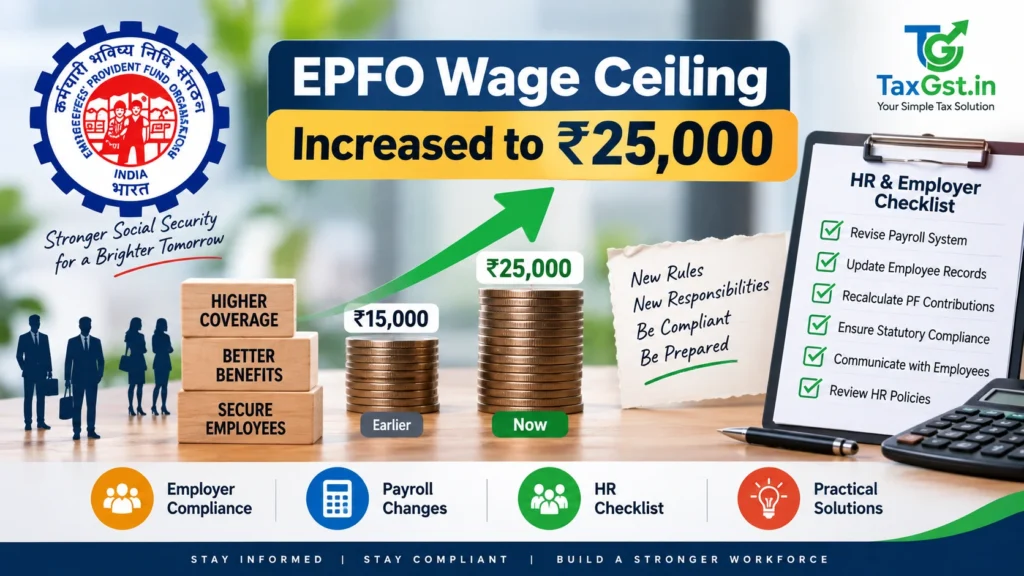
The Union Cabinet approved increasing the wage ceiling for mandatory EPFO coverage from ₹15,000 to ₹25,000 per month. The revised ceiling is scheduled to take effect from 17 September 2026 and is expected to bring more than 51 lakh additional employees under mandatory coverage. Separately, EPFO approved simplified partial-withdrawal reforms under its EPFO 3.0 modernisation programme.
Also Read-UPI Charges Up to ₹2,000: New Government Rules Effective September 2026
Employer-focused update: The revised EPFO wage ceiling is reported as effective from
17 September 2026. The practical challenge is not only changing the figure in payroll software.
Employers must identify affected employees, confirm the applicable wage components, decide the correct contribution
treatment, reconcile employer and employee liabilities, and retain evidence of the implementation decision.
What Technical Problems Can Employers Face After the ₹25,000 Revision?
The change can create operational issues where payroll software, HR records, statutory configuration and the
employer’s existing PF policy are not aligned. The following problems should be reviewed before the next ECR
preparation and salary processing cycle.
| Potential problem | Why it happens | Practical solution |
|---|---|---|
| Incorrect employee identification | Payroll may still use ₹15,000 as the mandatory-coverage threshold or may not distinguish existing EPF members from new employees. | Run an employee master report using joining date, EPF membership status, statutory wage components and establishment coverage. Review every employee in the ₹15,000–₹25,000 band. |
| Wrong wage base | Gross salary, basic wages, DA and other components may be incorrectly treated as interchangeable. | Map the statutory wage definition used for EPF calculations. Do not automatically use CTC or gross salary as the PF wage base. |
| Duplicate or missing enrolment | Employees may already have UANs, previous membership or exemption-related records. | Validate UAN, KYC, date of joining, previous EPF membership and Form 11 declarations before creating or modifying membership records. |
| Employee/employer contribution mismatch | Software may calculate the employee share on one base and the employer share, EPS allocation or EDLI-related amount on another. | Use one approved wage-base configuration, test the EPS/EPF split and reconcile the payroll register with the ECR working sheet. |
| Rounding and penny differences | Separate rounding at employee, component and contribution level can create totals that do not match the ECR or ledger. | Define a single rounding rule, calculate at employee level, and reconcile rounded totals before posting the statutory liability. |
| Arrears and effective-date confusion | Payroll may apply the new ceiling from the wrong month or fail to determine whether an adjustment is required for a partial period. | Document the effective date as 17 September 2026, obtain the official implementation instruction, and separately calculate September transition and subsequent full-month impact. |
| Salary-structure pressure | Where CTC is fixed, the additional employer contribution may reduce the balance available for other salary components. | Prepare an employee-wise CTC impact statement and communicate whether the company will absorb the additional cost or restructure permitted components after legal review. |
| Interface and ECR validation errors | Employer portals and payroll exports may continue to follow earlier validations during the transition. | Keep a test payroll, export a sample ECR, record validation messages and use official EPFO employer support channels for unresolved portal issues. |
Step-by-Step Employer Implementation Checklist
- Freeze the existing baseline: Export the last successfully filed ECR, payroll register, contribution ledger, employee master and current PF configuration before making changes.
- Identify affected employees: Filter employees whose relevant monthly wage is above ₹15,000 and up to ₹25,000, along with employees previously excluded because of the earlier ceiling.
- Check membership history: Review Form 11, UAN, prior EPF membership, date of joining and any applicable exclusion or exemption conditions. Do not enrol an employee solely from gross salary without reviewing the statutory rules.
- Reconfigure payroll: Update the ceiling parameter only after confirming the official notification and the software provider’s implementation note. Test both new joiners and existing employees.
- Recalculate contributions: Compare the old and revised employee share, employer share, EPS allocation and other applicable statutory components. Preserve the employee-wise difference report.
- Review CTC and payslips: Confirm whether the employer contribution is an additional cost or part of a fixed CTC structure. Explain any change in employee deductions before payroll is finalised.
- Validate the ECR: Reconcile the payroll total, ECR total, bank payment, accounting entry and liability payable. Investigate every difference instead of adjusting totals manually.
- Maintain an audit file: Keep the official notification, internal approval, configuration screenshot, test results, employee list, communication copy and reconciliation statement.
September 2026 Transition: What Date Should Payroll Use?
The reported change is effective from 17 September 2026. This creates a transition question for September payroll because the month is not a complete period under the revised ceiling. Employers should not silently assume that every payroll system must apply the new limit to the entire month or that a retrospective adjustment is automatically required.
Before finalising the September 2026 ECR, HR and consultants should verify the formal notification, EPFO implementation instructions, ECR validation behaviour and the treatment prescribed for a mid-month effective date. Maintain two working papers where necessary: (1) the calculation under the earlier rule up to the transition point, and (2) the calculation under the revised rule from the effective date. The final filing treatment should follow the official instruction rather than an assumption.
How to Recalculate PF: Employer Working Method
Use an employee-wise calculation sheet with at least the following fields:
| Field | Purpose |
|---|---|
| Employee ID and UAN | Prevents duplicate or unidentified records. |
| Date of joining and membership status | Supports coverage and enrolment review. |
| Relevant EPF wage | Separates statutory wage from gross salary or CTC. |
| Old wage ceiling and revised ceiling | Shows the change applied by the calculation engine. |
| Employee EPF share | Checks the employee deduction and payslip. |
| Employer EPF/EPS allocation | Checks the employer liability and pension allocation. |
| EDLI and administrative components, where applicable | Ensures all applicable statutory components are reviewed separately. |
| Difference and reason code | Explains whether the difference arises from enrolment, ceiling change, wage revision, rounding or another cause. |
Illustration: If the applicable PF wage is ₹25,000 and the employee and employer rates are each 12%, the nominal contribution at that wage base is ₹3,000 from each side before considering the statutory allocation and applicable limits. This is only a calculation illustration; the actual employer working must separately validate the EPF/EPS split, wage definition, eligibility, rounding and any applicable higher-wage arrangement.
Solutions for HR, Payroll Vendors and Consultants
- Create a rule-version register: Record the old parameter, revised parameter, effective date, approval date, software release and person responsible for implementation.
- Use parallel testing: Run old-rule and revised-rule calculations for a sample of employees and compare the differences before production payroll.
- Separate coverage from contribution: First determine whether the employee is required to be covered. Then determine the permitted wage base and allocation of contributions.
- Introduce four-eye review: Require payroll preparation by one person and statutory review by another for the first two filing cycles after implementation.
- Reconcile at three levels: Employee-wise payroll, statutory ECR and general-ledger/bank payment totals should agree after documented rounding and permitted adjustments.
- Communicate in writing: Issue a short employee note explaining changes in deductions, expected take-home impact and the fact that PF coverage and contribution treatment depend on statutory conditions.
- Do not overwrite historical data: Preserve the earlier payroll and ECR files. Make adjustment entries with a clear period, reason and approval trail.
How EPF, EPS Pension and EDLI Insurance Change After the ₹25,000 Ceiling
The revised ceiling affects three connected social-security components, but the impact is not identical for EPF savings, EPS pension and EDLI insurance. Employers should avoid treating the ₹25,000 figure as an automatic increase in every benefit or as a universal instruction to calculate all contributions on gross salary.
| Component | Earlier position (₹15,000 ceiling) | Position after 17 September 2026 | Employer action and technical check |
|---|---|---|---|
| EPF – Provident Fund | Where contributions were restricted to the statutory ceiling, 12% of ₹15,000 equals ₹1,800 as the employee share. The employer-side 12% allocation is subject to the applicable EPF/EPS split. | On a fully applicable ₹25,000 wage base, 12% equals ₹3,000 as the employee share. The actual amount depends on membership, eligible wage, contribution restriction and applicable rules. | Update the wage-base parameter, test employee deductions, verify the employer share and reconcile the payroll register with the ECR. Do not apply the revised ceiling blindly to employees already contributing on actual higher wages. |
| EPS – Pension | Under the earlier ₹15,000 pensionable-wage ceiling, the employer EPS allocation at 8.33% was commonly calculated up to approximately ₹1,250 per month, subject to the applicable rules and rounding. | At an illustrative ₹25,000 pensionable wage, 8.33% is approximately ₹2,083 per month. This does not mean every employee will automatically receive a pension based on ₹25,000 or that the final pension will increase by the same amount. | Check the employee’s EPS eligibility, pensionable service, date of joining, wage history, contribution allocation and the implementation instructions. Review whether the increased employer EPS allocation changes the amount credited to the employer EPF portion. |
| EDLI – Insurance | EDLI contribution and benefit calculation followed the applicable EDLI scheme provisions and wage ceiling, including existing statutory caps. | The wider coverage may bring more employees within EPFO-linked insurance protection. However, a higher EPF wage ceiling does not by itself guarantee that the maximum EDLI death benefit has increased. The existing benefit cap and formula must be checked against a formal EDLI amendment or clarification. | Continue calculating EDLI using the applicable notified formula and cap. Do not promise employees a ₹10.50 lakh benefit merely because the wage ceiling is ₹25,000. Retain the official EDLI notification or clarification used for payroll configuration. |
Illustrative Employer-Side Contribution Comparison
The following figures are an illustration for a contribution restricted to the relevant ceiling. They are not a substitute for the employer’s exact statutory calculation, because the final result depends on eligible wages, EPS applicability, rounding, exemptions and the official implementation instructions.
| Illustrative item | Earlier ceiling ₹15,000 | Revised ceiling ₹25,000 | Important caution |
|---|---|---|---|
| Employee share at 12% | ₹1,800 | ₹3,000 | Only where the full ceiling is the applicable contribution base. |
| Employer EPS allocation at 8.33% | Approximately ₹1,250 | Approximately ₹2,083 | Subject to EPS eligibility, pensionable wage rules and rounding. |
| Employer EPF balance after EPS allocation | Balance of the employer-side contribution after the applicable EPS allocation | Balance of the employer-side contribution after the applicable EPS allocation | Do not hard-code 3.67% without checking the applicable contribution structure and rounding. |
| EDLI | Calculated under the applicable EDLI rate, wage base and cap | Recalculate under the applicable EDLI rate, wage base and cap | The wage ceiling increase alone does not establish a new maximum insurance payout. |
Important EDLI clarification: Media reports may calculate a potential EDLI amount of ₹10.50 lakh by applying 35 times ₹25,000 plus the permitted additional amount. Employers must not treat that calculation as the operative maximum unless the EDLI scheme and the applicable official notification have formally changed the benefit cap. Verify the latest EPFO/Ministry instruction before changing the insurance-benefit configuration.
How the EPS Change Can Affect Payroll Reconciliation
When an employee is covered under EPS and the employer’s contribution is divided between EPS and EPF, a higher EPS allocation can increase the pension component while reducing the amount credited to the employer-side EPF component. The total employer contribution should therefore not be compared only at the EPF ledger level. HR and consultants should reconcile the combined employer contribution, EPS allocation, EPF allocation, EDLI, administrative charges where applicable, employee deduction and total ECR liability.
Employer Control Checklist for EPF, EPS and EDLI
- Confirm whether the employee is newly covered, an existing member or already contributing on actual higher wages.
- Verify the eligible wage base separately for EPF, EPS and EDLI.
- Check EPS eligibility and pensionable service records before changing the employer allocation.
- Do not assume that the EDLI maximum benefit increased automatically with the EPFO wage ceiling.
- Run employee-wise old-versus-new calculations and preserve the difference report.
- Reconcile payroll, ECR, accounting ledger and bank payment totals after the configuration change.
- Update employee communication so that pension and insurance benefits are described as subject to scheme rules and official implementation instructions.
Official Links and Notification Verification
Employers should rely on the formal government notification and EPFO implementation instructions before making a final production change. The reported effective date is 17 September 2026; however, the exact notification number, Gazette document and ECR implementation circular should be saved in the employer’s compliance file when issued or made available.
- Ministry of Labour and Employment – Official Website
- EPFO – Official Website
- EPFO Important Circulars
- EPFO Employer Portal
Verification note: A news report or press summary should not replace the notification applicable to the employer’s establishment. Record the official PDF, issue date, effective date, applicability, transition instructions and any subsequent clarification before closing the first affected payroll cycle.
EPFO Wage Ceiling Increased from ₹15,000 to ₹25,000: What Employers Must Implement
The Union Cabinet, chaired by the Prime Minister, approved the Ministry of Labour and Employment’s proposal to increase the wage ceiling for mandatory coverage under the Employees’ Provident Fund Organisation (EPFO) from ₹15,000 to ₹25,000 per month.
The decision was announced on 16 September 2026 and is scheduled to become effective from 17 September 2026, according to the Ministry of Labour and Employment. The measure is intended to widen access to formal social security, including provident fund savings, pension-related benefits and insurance protection under the applicable EPFO framework.
Key Highlights for Employers, HR Teams and Payroll Consultants
- Existing ceiling: ₹15,000 per month.
- New ceiling: ₹25,000 per month.
- Effective date: 17 September 2026.
- Expected additional coverage: More than 51 lakh employees.
- Purpose: Expand formal social security and strengthen retirement protection.
- Estimated annual government outgo: Approximately ₹11,339 crore, compared with existing annual budgetary support of about ₹10,250 crore.
- Previous revision: The ceiling was last increased to ₹15,000 in September 2014.
What Is the EPFO Wage Ceiling?
The EPFO wage ceiling is the statutory monthly wage threshold used to determine mandatory coverage under the applicable provident fund framework. It should not be treated as an absolute maximum salary on which every EPF contribution must be calculated.
Actual coverage and contribution treatment may depend on the employee’s joining date, existing EPF membership, establishment coverage, applicable wage definition and whether contributions on higher wages are permitted or already in force. Employers should review the final implementation instructions before updating payroll systems.
Which Employees Must HR and Payroll Teams Review?
The revision is particularly relevant to employees whose applicable monthly wages are above ₹15,000 but do not exceed ₹25,000 and who were previously outside mandatory coverage because of the earlier threshold.
| Illustrative Employee | Monthly Wage | Potential Impact |
|---|---|---|
| Employee below old ceiling | ₹14,000 | Already within the earlier threshold, subject to other conditions. |
| Employee between old and new ceiling | ₹18,000 | May come under mandatory coverage if statutory conditions are satisfied. |
| Employee at new ceiling | ₹25,000 | May be covered under the revised threshold, subject to wage definition and implementation rules. |
| Employee above new ceiling | ₹32,000 | Not automatically covered solely because of the revised threshold; membership and other rules must be examined. |
Important: Coverage is not determined only by gross salary. The statutory wage components, membership status and establishment rules must also be considered.
Does Every Employee Earning ₹15,000 to ₹25,000 Need Immediate Enrolment?
The policy objective is to bring eligible employees within the revised threshold into mandatory EPFO coverage. Practical payroll treatment will depend on statutory implementation and the employee’s circumstances.
- Review basic wages and other relevant wage components.
- Check whether the employee is a new entrant or existing EPF member.
- Confirm that the establishment is covered by EPFO.
- Review statutory or higher-wage contribution arrangements.
- Check whether an exemption or special rule applies.
Payroll Impact: Contribution Recalculation and Take-Home Salary
Some newly covered employees may see lower take-home pay because a portion of eligible wages will be contributed to retirement savings. In return, they may receive stronger long-term social security protection.
| Illustration | Amount |
|---|---|
| Assumed eligible monthly wage | ₹20,000 |
| Employee contribution at 12% | ₹2,400 |
| Employer contribution at 12% | ₹2,400, subject to EPF/EPS allocation rules |
This is only an illustration. Actual contributions depend on eligible wage components, statutory ceilings, pension allocation and the applicable rules.
Why Was the Ceiling Increased?
- To expand formal social security coverage.
- To reflect changes in wages and minimum wage levels.
- To strengthen retirement savings and worker protection.
- To support formalisation of employment.
- To improve workforce stability and employee retention.
The government expects more than 51 lakh additional employees to come under mandatory EPFO coverage.
EPFO 3.0: Simplified and Liberalised Withdrawal Rules
The partial-withdrawal reforms were approved separately by the Central Board of Trustees in October 2025 as part of the broader EPFO 3.0 modernisation programme. Their practical availability should be checked against the latest EPFO notifications and system implementation.
1. Three Broad Withdrawal Categories
- Essential Needs: Specified immediate or essential requirements.
- Housing Needs: Permitted housing-related purposes.
- Special Circumstances: Specified exceptional situations and other permitted purposes.
2. Education Withdrawals Up to 10 Times
The approved measures provide for education-related withdrawals up to 10 times, subject to permitted beneficiaries, purposes and scheme conditions.
3. Marriage Withdrawals Up to 5 Times
Marriage-related withdrawals may be permitted up to five times under the approved reforms, subject to eligibility and applicable conditions.
4. Minimum Service Period of 12 Months
The reforms provide for a uniform minimum continuous service requirement of 12 months for partial withdrawals, subject to implementation and category-specific conditions.
5. 25% Minimum Balance
A provision was approved to earmark 25% of the member’s contributions as a minimum balance. This is intended to preserve part of the retirement corpus. It should not be described as an unconditional right to withdraw exactly 75% of every account balance; the available amount depends on the eligible balance, purpose and applicable limits.
6. Auto-Settlement Limit of ₹5 Lakh
EPFO increased the auto-settlement limit for eligible advance claims from ₹1 lakh to ₹5 lakh in June 2025. Eligible claims may be processed automatically, but approval remains subject to claim conditions, system validation and available records. EPFO stated that eligible claims could be processed within approximately three days.
Withdrawal Reforms at a Glance
| Reform | Change | Caution |
|---|---|---|
| Categories | Essential Needs, Housing Needs and Special Circumstances | Eligibility depends on the category. |
| Education | Up to 10 withdrawals | Subject to conditions. |
| Marriage | Up to 5 withdrawals | Subject to eligibility. |
| Service | 12 months for partial withdrawals | Check implementation. |
| Minimum balance | 25% of contributions | Not an unconditional 75% withdrawal right. |
| Auto-settlement | Up to ₹5 lakh for eligible advances | Validation and claim rules apply. |
Final Settlement Period Changes
- Premature final EPF settlement: Proposed increase from two months to 12 months.
- Final pension withdrawal: Proposed increase from two months to 36 months.
These changes are separate from partial withdrawals. Members should verify the latest operational instructions before relying on a settlement timeline.
Employer Action Plan: What Companies Must Do Now
- Identify employees with applicable wages between ₹15,000 and ₹25,000.
- Verify statutory wage components and membership status.
- Review payroll software and contribution settings.
- Monitor EPFO and Labour Ministry implementation notifications.
- Update employee communication and salary statements where necessary.
- Reconcile employee and employer contributions after implementation.
- Maintain records supporting coverage and contribution calculations.
Practical Employer Payroll Example
Suppose an employee earns ₹22,000 in eligible wages and was previously outside mandatory EPFO coverage solely because the old threshold was ₹15,000. After implementation, the employee may become subject to mandatory coverage if the establishment and individual circumstances satisfy the applicable rules.
The employee may have a monthly PF deduction and the employer may have a corresponding contribution obligation. Take-home pay could reduce, while retirement savings and related social security protection may increase. This example is illustrative and is not a final payroll calculation.
EPFO Wage Ceiling ₹25,000: What Has Changed in 2026?
The most important point is that the government has approved an increase in the wage ceiling used for mandatory EPFO coverage. The earlier threshold of ₹15,000 per month had been in place since September 2014. The revised threshold of ₹25,000 is intended to bring more workers within the formal provident fund and related social-security framework.
This announcement should be read carefully. A wage ceiling is not the same as a universal contribution cap, and the revised threshold does not mean that every employee’s PF contribution will automatically be calculated on ₹25,000. The actual contribution base depends on the statutory definition of wages, the employee’s membership status, the establishment’s coverage and the applicable implementation instructions.
EPFO Wage Ceiling vs PF Contribution Limit
Searches such as “EPFO wage ceiling 25000,” “PF salary limit 2026” and “will PF be deducted on 25000 salary” often mix two separate concepts:
- Mandatory coverage threshold: The salary threshold used to determine whether an employee is required to be covered under the applicable EPF framework.
- Contribution wage base: The wage amount on which employee and employer contributions are calculated under the applicable law and scheme.
- Higher-wage contribution: In some circumstances, contributions may be made on wages above the standard statutory ceiling if the legal and administrative requirements are satisfied.
Accordingly, an employee earning ₹25,000 gross salary should not assume that the employee contribution will always be 12% of ₹25,000. Payroll must identify the eligible wage components before calculating the deduction.
Who Is Covered and Who Needs Further Verification?
The revised ceiling is most relevant to workers who were previously outside mandatory EPFO coverage because their applicable wages exceeded ₹15,000 but did not exceed ₹25,000. However, coverage must be verified individually.
| Situation | What to Check |
|---|---|
| New employee earning ₹18,000 | Whether the establishment is covered and whether the employee satisfies the revised mandatory coverage conditions. |
| Existing EPF member earning ₹28,000 | Existing membership and contribution continuity; the revised threshold does not automatically cancel membership. |
| Employee earning ₹25,000 gross | Basic wages, eligible components and whether gross salary differs from statutory wages. |
| Employee working for an exempted establishment | Applicable exemption, trust arrangements and scheme-specific requirements. |
How Much PF May Be Deducted After the New Ceiling?
For an illustrative calculation only, if ₹20,000 is treated as the eligible monthly contribution wage and a 12% employee rate applies, the employee contribution would be ₹2,400. The employer contribution would also be ₹2,400 before allocation between the relevant EPF and pension components.
Actual payroll may differ because the contribution wage can exclude or include components according to the applicable statutory interpretation. Employers should avoid using gross salary alone and should document the calculation method used in payroll.
Possible Impact on Take-Home Salary
Employees newly brought into mandatory coverage may see a lower monthly take-home salary because the employee share is deducted from eligible wages. The deduction is not simply a fee: it is credited toward the employee’s retirement savings under the EPF framework, with related benefits subject to eligibility.
- Short-term impact: A possible reduction in net salary because of the employee contribution.
- Long-term impact: Increased retirement savings and access to applicable EPFO-linked benefits.
- Employer impact: Possible additional contribution and payroll-compliance responsibilities.
- HR impact: Employee communication, wage mapping, payroll testing and reconciliation.
EPFO 3.0 Withdrawal Rules: What Members Should Know
EPFO 3.0 is commonly used to describe the modernisation and simplification of EPFO services. The withdrawal changes discussed in public reporting include consolidation of withdrawal categories, a 12-month service requirement for partial withdrawals, a 25% minimum balance provision and a higher auto-settlement limit for eligible advance claims.
Members should distinguish between an approved policy change and a feature that is already active in their account. The claim screen, official circulars and EPFO implementation notices should be checked before filing a withdrawal request.
Can Members Withdraw 75% or 100% of PF?
The answer depends on the withdrawal ground and the eligible balance. The 25% retention provision means that members should not treat the rules as an unconditional right to withdraw 75% of the entire account in every situation. Certain permitted circumstances may have different treatment, while final settlement, partial withdrawal and pension withdrawal are separate concepts.
Members should check whether the amount shown in the portal is the eligible amount, whether the retained balance is applied, and whether the claim relates to EPF accumulation or the pension component.
Is UPI-Based PF Withdrawal Available to Everyone?
UPI-based withdrawal has been discussed as part of EPFO’s digital modernisation plans. Public reporting has indicated that testing and proposed integration do not necessarily mean that the feature is available to every member. Do not rely on social-media claims that instant UPI withdrawal is universally live; verify availability through official EPFO communication and the member portal.
Employer, HR and Consultant Documents and Control Checks
- Confirm that the UAN is active and the profile details are correct.
- Check Aadhaar, PAN and bank-account KYC status where applicable.
- Verify that the bank account name and member details match.
- Review the available balance and the eligible withdrawal amount.
- Check service history and previous claims.
- Choose the correct withdrawal category and purpose.
- Keep supporting records where the selected claim type requires them.
- Track the claim through the official EPFO member portal or authorised digital service.
Common Employer and Payroll Mistakes to Avoid
- Assuming that ₹25,000 is the contribution base for every employee.
- Confusing gross salary with basic wages or statutory contribution wages.
- Assuming that every employee above ₹25,000 is excluded from EPFO.
- Believing that all PF claims up to ₹5 lakh are automatically approved.
- Interpreting the 25% retention provision as a universal 75% withdrawal guarantee.
- Relying on unofficial social-media messages instead of EPFO notifications.
- Changing payroll settings before checking the effective date and implementation guidance.
Frequently Asked Questions
1. What is the new EPFO wage ceiling?
The ceiling for mandatory EPFO coverage has increased from ₹15,000 to ₹25,000 per month.
2. When is the revised ceiling effective?
The announced effective date is 17 September 2026.
3. How many additional employees may benefit?
More than 51 lakh additional employees are expected to come under mandatory coverage.
4. Are all employees earning ₹15,000 to ₹25,000 automatically covered?
Eligible employees may come under mandatory coverage, subject to establishment coverage, wage definition, membership status and implementation instructions.
5. Is EPFO 3.0 the same as the wage ceiling revision?
No. The wage ceiling concerns mandatory coverage, while the withdrawal reforms were approved separately.
6. How many education withdrawals are permitted?
The approved measures provide for up to 10 education withdrawals, subject to conditions.
7. How many marriage withdrawals are permitted?
Marriage withdrawals may be permitted up to five times, subject to eligibility.
8. What does the 25% minimum balance mean?
A provision was approved to retain 25% of contributions as a minimum balance. It is not an unconditional right to withdraw 75% of the total account balance.
9. What is the auto-settlement limit?
The limit for eligible advance claims was increased to ₹5 lakh in June 2025.
10. Can take-home salary reduce?
Some newly covered employees may see lower take-home pay because of employee PF contributions.
The increase in the EPFO mandatory coverage wage ceiling from ₹15,000 to ₹25,000 expands the formal social security framework and is expected to cover more than 51 lakh additional employees. EPFO’s separate withdrawal reforms aim to simplify partial withdrawals, standardise service requirements and preserve part of members’ retirement savings.
Employees and employers should distinguish between policy approval, effective implementation and the detailed conditions applicable to each payroll or withdrawal situation. Always check the latest official EPFO instructions before making a compliance or withdrawal decision.
Official Sources
For employer implementation, verify the final notification and EPFO circular directly through the official Ministry and EPFO websites linked above.
- PIB: EPFO wage ceiling increased to ₹25,000
- PIB: Simplified and liberalised partial withdrawals
- PIB: Auto-settlement limit increased to ₹5 lakh
- EPFO: Employees’ Provident Fund Scheme
Editorial Note: This article is for general information. Rules, implementation instructions and claim conditions may change through official notifications. Verify the latest guidance before taking action.
ITR, GST returns, notices and registrations — fixed fees, human support, on-time filing.
Discover more from TaxGst.in
Subscribe to get the latest posts sent to your email.



Never Miss a Tax Deadline Again
Due-date alerts, GST updates and tax tips — free on the app you already use.
event Next: EPF / ESI Payment · 10 Oct