
 C.K. Gupta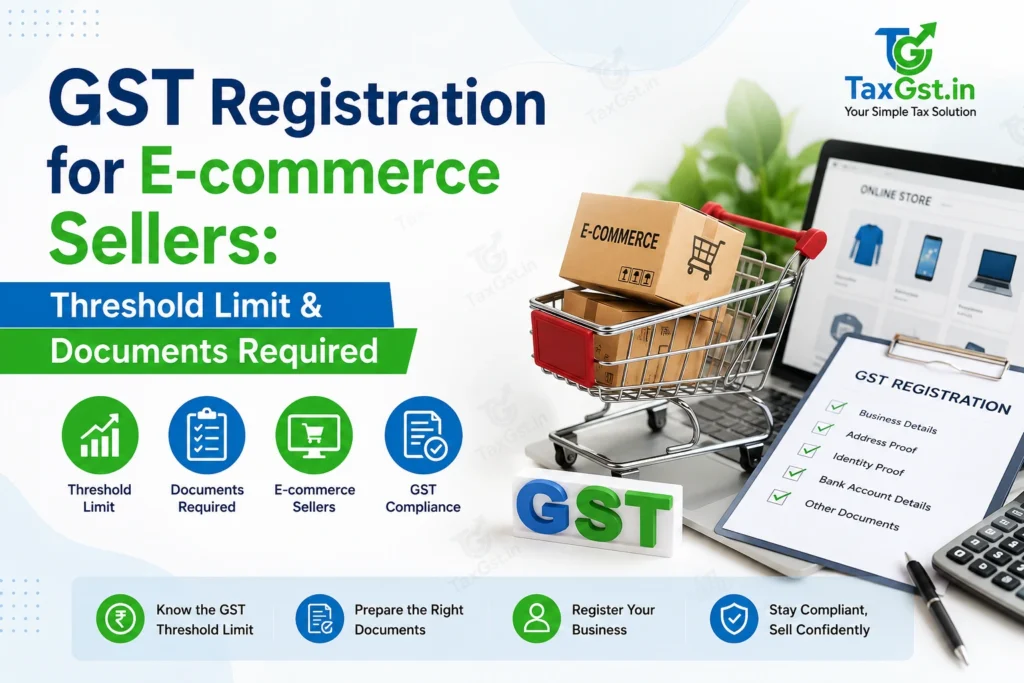
If you are selling goods through an e-commerce operator, the standard GST threshold exemption is generally not available, and you must obtain mandatory registration under Section 24(ix) of the CGST Act, 2017. However, a specific exemption exists for small goods sellers under Notification No. 34/2023-Central Tax if your aggregate turnover remains below the threshold and you supply exclusively within a single state. For service sellers, the standard threshold exemption of ₹20 lakh or ₹10 lakh remains available as per Notification No. 65/2017-Central Tax, unless the operator pays tax on your behalf under Section 9(5).
Also Read-What is GST? CGST, SGST and IGST Explained with Examples (2026)
Quick Summary: E-Commerce GST Registration
- Goods sellers via e-commerce platforms generally lose the threshold exemption and must register mandatorily.
- Notification No. 34/2023-Central Tax provides a conditional exemption for small goods sellers operating intra-state.
- Service sellers can still claim the standard threshold exemption under Notification No. 65/2017-Central Tax.
- E-commerce operators themselves must register mandatorily under Section 24(x) of the CGST Act, 2017.
What is the threshold limit for GST registration for e-commerce sellers?
The threshold limit depends entirely on whether you are selling goods or services. For goods sellers, Section 24(ix) of the CGST Act, 2017 explicitly removes the benefit of the threshold exemption. This means you must register for GST regardless of your turnover if you supply goods through an e-commerce operator who is required to collect tax at source under Section 52 of the CGST Act.
However, Notification No. 34/2023-Central Tax provides a crucial relaxation. If your aggregate turnover in the preceding and current financial year does not exceed the standard threshold limit (₹40 lakh for goods in most states, or ₹20 lakh/₹10 lakh for special category states as per Section 22), you can claim exemption from registration. You must still declare your PAN and business address on the common portal to obtain an enrolment number before making any supply.
For service sellers, the standard threshold limits apply. As per Notification No. 65/2017-Central Tax, service suppliers are entitled to the threshold exemption of ₹20 lakh or ₹10 lakh in special category states. This exemption is only lost if the e-commerce operator is notified to pay tax on your behalf under Section 9(5) of the CGST Act, 2017 (such as ride-hailing or food delivery apps).
Is the threshold exemption available to all e-commerce sellers?
No, the threshold exemption is not universally available. The law creates a strict distinction between goods and services, and imposes severe restrictions even where an exemption is technically granted.
The exemption under Notification No. 34/2023-Central Tax comes with strict conditions. You cannot make any inter-State supply of goods. Furthermore, you cannot supply goods through an e-commerce operator in more than one State or Union territory. You must possess a Permanent Account Number (PAN) and enrol on the common portal to receive a valid enrolment number before starting your supplies.
Service sellers have it comparatively easier. They retain the standard threshold exemption. However, they must carefully check if their specific service category falls under Section 9(5) of the CGST Act. If the operator pays the tax on their behalf for notified services, the supplier loses the threshold benefit and must register mandatorily.
How does the enrolment process work for exempted goods sellers?
Under Notification No. 34/2023-Central Tax, goods sellers who qualify for the threshold exemption must complete a mandatory enrolment process before making any supply through an e-commerce operator. This is not a full GST registration but a simplified compliance requirement designed to track small sellers operating on digital platforms.
You must declare your PAN, address of your place of business, and the State or Union territory where you intend to make supplies on the common portal. The PAN is validated online against the Income Tax database. Upon successful validation, the system generates an enrolment number. No supply of goods can be made through the e-commerce operator until this enrolment number is granted.
You are restricted to supplying in only one State. If you subsequently obtain full GST registration under Section 25 of the CGST Act, 2017 (e.g., because you want to sell inter-state), the enrolment number automatically ceases to be valid from the effective date of your new registration.
Registration Requirements for Different E-Commerce Seller Categories
| Category of Seller | Threshold Exemption Available? | Registration Requirement | Key Conditions |
|---|---|---|---|
| Goods seller (Standard/Inter-state) | No | Mandatory under Sec 24(ix) | Must register regardless of turnover; TCS applies |
| Goods seller (Exempt under Notif 34/2023) | Yes, if turnover below threshold | Enrolment required, not full registration | Intra-state supply only; single state operation |
| Service seller (Standard) | Yes (₹20 lakh or ₹10 lakh) | Required only if turnover exceeds threshold | Standard rules apply as per Notif 65/2017 |
| Service seller (Sec 9(5) notified services) | No | Mandatory | Operator pays tax on behalf of supplier |
| E-commerce operator itself | No | Mandatory under Sec 24(x) | Must register and collect TCS regardless of turnover |
Practical Example: TCS Calculation for a Registered E-Commerce Seller
Consider a goods seller based in Tamil Nadu with an annual turnover of ₹8 lakh who wishes to sell across India. Since inter-state supply is involved, Section 24(ix) mandates GST registration regardless of the turnover being below the ₹20 lakh threshold.
The seller supplies goods worth ₹75,000 through the platform in a month. As per Section 52(1) of the CGST Act, the e-commerce operator collects TCS at 1% of the net taxable value (0.5% CGST and 0.5% SGST). The TCS amounts to ₹750. The operator releases ₹74,250 to the seller and deposits ₹750 as TCS with the government.
This ₹750 is credited to the seller’s electronic cash ledger and can be claimed as credit when filing their monthly GSTR-3B return to offset output liabilities.
What documents are required for GST registration as an e-commerce seller?
The documentation requirement for e-commerce sellers follows the standard registration framework under the CGST Rules, with additional scrutiny on the “place of business” since many sellers operate from shared warehouses or fulfillment centers managed by the operator. You must submit your application in Part B of FORM GST REG-01 along with the specified documents.
For the place of business, you need either an ownership document (property tax receipt, municipal khata, or electricity bill) or a valid rent agreement if the premises are leased. The CBIC clarifies that a premises can be declared as a place of business by multiple suppliers, so a shared e-commerce warehouse is acceptable provided you hold a valid agreement with the operator or owner. For a principal place of business, the PAN-linked address must match the details furnished in Part A of FORM GST REG-01.
Additional documents include identity and address proof of the proprietor, partners, or directors, along with a photograph and bank account details bearing a cancelled cheque or bank statement. Every document must be submitted electronically at the Common Portal.
How to apply for GST registration as an e-commerce seller – Step-by-step process
The registration process for e-commerce sellers is entirely online and follows a two-stage verification mechanism.
Step 1 – Complete Part A of FORM GST REG-01: Visit the Common Portal and declare your PAN, mobile number, email address, and State. The PAN is validated online against the Income Tax database. Your mobile number and email are verified through separate OTPs. On successful verification, a Temporary Reference Number (TRN) is generated.
Step 2 – File Part B of FORM GST REG-01 with documents: Using the TRN, electronically submit Part B of the form along with your place of business proof, identity documents, and bank details. On receipt, the system issues an acknowledgement in FORM GST REG-02. For e-commerce sellers, ensure the place of business details match the warehouse or fulfillment center address you operate from.
Step 3 – Verification and grant of registration: The proper officer examines the application. If satisfied, a certificate of registration in FORM GST REG-06 is made available on the Common Portal, and a GSTIN is assigned. The registration is effective from the date you became liable to registration if the application is filed within 30 days of that date.
What happens if an e-commerce seller fails to register on time?
Operating on an e-commerce platform without mandatory registration attracts severe consequences under the CGST Act. Since Section 24(ix) removes the threshold exemption for inter-state goods sellers, there is no turnover-based defense. The proper officer can determine the tax liability and impose a penalty equal to the tax evaded under Section 73 or Section 74 of the Act.
Beyond penalties, the e-commerce operator is required to collect 1% TCS. If you are unregistered, the operator may still collect and deposit this TCS, but you will be unable to claim credit for it since you have no active GSTIN, creating a permanent cost leak. Additionally, operators will suspend your account upon discovering non-compliance, as Notification No. 37/2023 mandates that operators verify enrolment or registration status before allowing supplies.
What happens if your turnover exceeds the threshold mid-year?
For service sellers and intra-state goods sellers relying on the exemption under Notification No. 34/2023, crossing the threshold limit during the financial year triggers an immediate registration obligation. You must apply for registration within 30 days from the date your aggregate turnover exceeds the prescribed limit.
For goods sellers previously operating under the enrolment mechanism, the moment turnover exceeds the threshold, the enrolment number ceases to be valid. You must immediately apply for full GST registration in FORM GST REG-01. During the processing period, you should not make further supplies through the e-commerce operator until the GSTIN is assigned, as the operator is obligated to block supplies from any person who does not hold a valid enrolment number or registration certificate.
How does TCS mismatch create additional tax liability for sellers?
The matching mechanism under Section 52(8) requires the details of outward supplies declared by the operator in FORM GSTR-8 to be matched with the details declared by the supplier in their GSTR-3B. When a discrepancy is identified, it is communicated to both parties under Section 52(9).
If the supplier fails to rectify the discrepancy, the unmatched amount is automatically added to the supplier’s output tax liability for the succeeding month under Section 52(12). The supplier must then pay the differential tax along with interest.
| Scenario | Operator Reports in GSTR-8 | Supplier Reports in GSTR-3B | Consequence of Non-Rectification |
|---|---|---|---|
| Value understatement by supplier | ₹1,00,000 | ₹80,000 | ₹20,000 added to output liability plus applicable tax and interest |
| Complete omission by supplier | ₹50,000 | Not reported | Full ₹50,000 added to output liability; penalty risk under Section 122 |
| Timing mismatch (different months) | Reported in August | Reported in September | Discrepancy flagged; auto-resolved if matched within permissible window |
| Return goods not adjusted | ₹10,000 return reflected | Return not claimed by supplier | ₹10,000 discrepancy communicated; supplier must adjust in subsequent return |
What are the key steps for e-commerce sellers regarding GST registration?
- Determine whether you are selling goods or services through the e-commerce platform, as the registration requirement differs for each category.
- Calculate your aggregate turnover for the preceding and current financial year to assess whether you fall within the threshold exemption limit (as per Section 22).
- If you are a goods seller with turnover below the threshold, declare your PAN and business address on the common portal to obtain an enrolment number under Notification No. 34/2023-Central Tax before making any supply.
- Gather all required documents including PAN card, Aadhaar, proof of principal place of business, bank account statement, and photographs before initiating the application.
- If registration is mandatory for your category, file Part A of FORM GST REG-01 on the GST portal to obtain a TRN, then complete Part B with the specified documents.
- Verify that your e-commerce operator has correctly reported your supplies in FORM GSTR-8 and that the TCS credited to your electronic cash ledger matches your records.
How does the e-commerce operator file the TCS statement and what are the deadlines?
Every e-commerce operator must file a monthly statement in FORM GSTR-8 electronically on the common portal within 10 days after the end of the month in which tax was collected. As per Section 52(4) of the CGST Act, this statement must contain details of all outward supplies effected through the platform, including supplies returned through it, and the amount collected as TCS.
Additionally, Section 52(5) requires an annual statement to be filed by the 31st day of December following the end of the financial year. Any errors in these statements can be rectified until the 30th day of November following the end of the financial year.
Is TCS applicable when selling through a seller’s own website?
No. The TCS mechanism under Section 52 of the CGST Act applies only when a third-party e-commerce operator collects the consideration from the buyer on behalf of the supplier. If a business sells its own products through its own website or platform without an intermediary operator handling payments, the TCS obligation does not arise. The operator must be a distinct person who owns, operates, or manages the digital facility.
Frequently Asked Questions (FAQs)
Can I make inter-State supplies if I have an enrolment number under Notification No. 34/2023?
No. The exemption conditions under Notification No. 34/2023-Central Tax explicitly prohibit you from making any inter-State supply of goods. You are restricted to making supplies within a single State. If you need to supply across state borders, you must obtain a full GST registration.
Is TCS collected by the e-commerce operator on supplies made by exempted sellers?
No. As per Notification No. 37/2023-Central Tax, the e-commerce operator shall not collect tax at source (TCS) in respect of the supply of goods made by persons exempted from registration. However, the operator must still report these supplies in FORM GSTR-8.
What happens to my enrolment number if I subsequently obtain full GST registration?
The enrolment number automatically ceases to be valid from the effective date of registration under Section 25 of the CGST Act. Once you obtain a full GSTIN, all compliance obligations including return filing and tax payment apply as a regular registered person.
What is the penalty for an e-commerce operator failing to comply with TCS provisions?
If an operator fails to furnish details demanded by an officer not below the rank of Deputy Commissioner within 15 working days, they shall, without prejudice to any action under Section 122, be liable to a penalty which may extend to ₹25,000. The law also specifies severe penalties for ECOs allowing unregistered persons (who are not exempt) to make supplies through their platform.
Sources & References
- Section 24 of CGST Act, 2017 (Compulsory Registration)
- Notification No. 34/2023-Central Tax
- Notification No. 37/2023-Central Tax
- GST Council — TCS Mechanism Guidelines
Article Information
Published: September 3, 2026
Last Reviewed: September 3, 2026
Category: GST Compliance & Registration
Regulatory Body: Central Board of Indirect Taxes and Customs (CBIC)
Written by C.K. Gupta, M.Com & Founder of TaxGST.in — with over 18 years of deep professional experience in Indian accounts, taxation, and finance dating back to 2007.
Official Resources
Disclaimer: This article provides a procedural interpretation of Section 24(ix) and Notification No. 34/2023-Central Tax. E-commerce laws are strictly enforced, and selling without required registration carries severe penalties under Section 122. Always consult a practicing Chartered Accountant to ensure your multi-state fulfillment models are fully compliant.
Related Reading
- New E-Way Bill Rules 2026: Mandatory Ship-To GSTIN & Closure Facility
- Invoice Management System (IMS) Explained: How to Reconcile ITC
- E-Way Bill Rules Amendment 2026 – New Thresholds: What Every Business Must Know
Try the free GST calculator for instant figures.
Discover more from TaxGst.in
Subscribe to get the latest posts sent to your email.
Never Miss a Tax Deadline Again
Due-date alerts, GST updates and tax tips — free on the app you already use.
event Next: GSTR-3B · 20 Oct