
 C.K. Gupta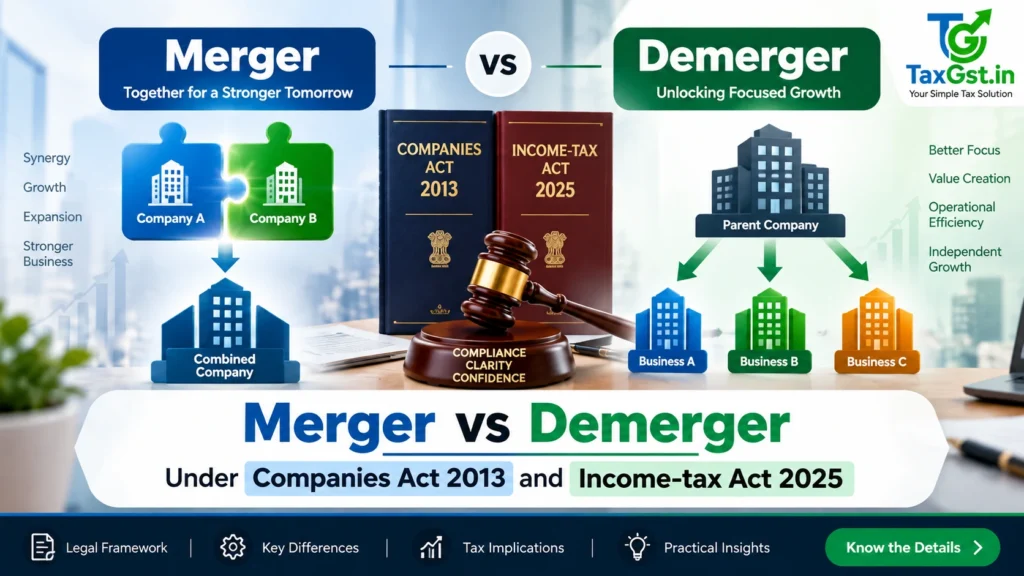
Mergers and demergers serve fundamentally different corporate restructuring and wealth-maximization objectives under Indian law. A Merger (Amalgamation) combines two or more companies into a single entity, strictly defined under Section 2(1B) of the Income-tax Act, 1961. Conversely, a Demerger involves carving out a specific business undertaking and transferring it to a resulting company on a going-concern basis, governed by Section 2(19AA). Both restructuring routes are procedurally executed through the National Company Law Tribunal (NCLT) under Sections 230 to 232 of the Companies Act, 2013. These transactions can achieve “tax-neutral” status—meaning absolute exemption from capital gains tax—provided they strictly satisfy statutory conditions, including a 75% shareholding continuity threshold, asset retention rules, and exact book-value transfer mandates.
Also Read-How to Claim Income Tax Refund for Unfiled ITR: Section 119(2)(b)
Quick Summary: Corporate Restructuring in India
- Mergers (Amalgamations): Pool all assets, liabilities, and reserves of the transferor company into a single amalgamated entity.
- Demergers: Spin off specific business undertakings into separate resulting companies, while the original company continues its remaining core operations.
- The NCLT Route: Sections 230 to 232 of the Companies Act, 2013 govern the comprehensive, court-sanctioned scheme process for large corporate entities.
- The Fast-Track Route: Section 233 provides an expedited, Regional Director (RD) approved route exclusively for small companies, startups, and wholly-owned subsidiary (WOS) combinations.
- Tax Neutrality: Capital gains tax is completely waived under Section 47 if the transaction meets the strict definitions laid out in the Income-tax Act, 1961.
- Loss Carry-Forward: Section 72A allows the amalgamated or resulting company to utilize the accumulated business losses and unabsorbed depreciation of the predecessor, subject to stringent 5-year business continuity conditions.
What is a Merger (Amalgamation) Under Indian Tax Law?
A merger—which is officially termed “amalgamation” within Indian tax legislation—involves the complete combination of one or more companies with another, or the formation of an entirely new company from two or more existing entities. In an amalgamation, the transferor company loses its legal identity and is dissolved without being wound up, merging entirely into the transferee (amalgamated) company.
To ensure the merger does not attract massive capital gains tax liabilities on the transfer of assets, it must satisfy the rigorous definition laid out in Section 2(1B) of the Income-tax Act, 1961. The law stipulates three non-negotiable, mandatory conditions for an amalgamation to be recognized as valid for tax neutrality:
- Global Asset Transfer: All property of the amalgamating company (the transferor) immediately before the amalgamation must seamlessly become the property of the amalgamated company (the transferee). You cannot selectively leave assets behind.
- Global Liability Transfer: All liabilities of the amalgamating company immediately before the amalgamation must become the liabilities of the amalgamated company.
- The 75% Shareholder Continuity Rule: Shareholders holding not less than three-fourths (75%) in value of the shares in the amalgamating company must become shareholders of the amalgamated company by virtue of the amalgamation. This ensures that the original owners retain a substantial economic interest in the newly combined entity.
If even one of these three conditions is breached—for instance, if shareholders holding 30% of the value opt for a cash buyout instead of shares in the new company—the transaction fails the definition of Section 2(1B). It will be treated as an outright sale of assets, triggering severe tax consequences.
What is a Demerger and How Does It Differ?
While a merger is a tool of consolidation, a demerger is the corporate mechanism to spin off, separate, or unbundle a specific business division into a distinct, independent entity. It involves the transfer of an “undertaking” by a demerged company to a resulting company under an NCLT scheme of arrangement.
To qualify for tax-neutral status, the demerger is subject to a far more complex set of conditions under Section 2(19AA) of the Income-tax Act, 1961. A valid demerger must satisfy all of the following six conditions:
- Specific Undertaking Transfer: All property and liabilities relatable exclusively to the transferred undertaking must vest in the resulting company.
- Book Value Requirement: The transfer must occur at exact book values as appearing in the books of the demerged company immediately before the demerger. Revaluations are strictly prohibited, except where mandated by Indian Accounting Standards (Ind AS 103 for common control transactions).
- Proportionate Share Issuance: The resulting company must issue its shares directly to the shareholders of the demerged company on a strictly proportionate basis.
- Shareholder Continuity: Shareholders holding not less than three-fourths (75%) in value of the shares in the demerged company must become shareholders of the resulting company.
- Going Concern Basis: The transfer of the undertaking must be strictly on a “going-concern” basis. You cannot simply transfer a collection of random assets; the transferred unit must be capable of operating as an independent business.
- Section 2(19AAA) Compliance: The demerger must be strictly in accordance with the conditions, if any, notified by the Central Government.
Tax Neutrality: The Capital Gains Exemptions (Section 47)
The primary reason corporations painstakingly structure their transactions to meet the definitions of Section 2(1B) and Section 2(19AA) is to unlock the safe harbor of Section 47 of the Income-tax Act, 1961. Section 47 lists transactions that are explicitly not regarded as a “transfer” for the purpose of capital gains tax.
For the Corporate Entities:
- Section 47(vi): Any transfer of capital assets by an amalgamating company to an Indian amalgamated company is fully exempt from capital gains.
- Section 47(vib): Any transfer of capital assets in a demerger by the demerged company to an Indian resulting company is fully exempt.
For the Shareholders:
- Section 47(vii): When a shareholder gives up their shares in the amalgamating company and receives new shares in the amalgamated company, this exchange is not treated as a taxable transfer.
- Section 47(vid): Any issue of shares by a resulting company to the shareholders of a demerged company, purely in consideration of the demerger, is exempt from capital gains in the hands of the shareholders.
If the scheme fails the definitional tests, Section 47 protections evaporate. The transferor company will pay massive capital gains on the deemed sale of assets, and the shareholders will pay capital gains on the deemed surrender/exchange of their original shares.
Carry Forward of Accumulated Losses (Section 72A)
One of the most powerful financial incentives for M&A activity is the ability to absorb the accumulated business losses and unabsorbed depreciation of a struggling entity to offset the profits of a healthy entity. This is governed by the exceptionally strict Section 72A of the Income-tax Act, 1961.
Conditions for Amalgamations
To carry forward the losses, the transaction must not be a sham designed merely for tax evasion. The law imposes strict qualifying conditions on both companies:
- Amalgamating Company Conditions: The struggling company must have been engaged in the business in which the accumulated loss occurred for at least three years prior to the amalgamation. Furthermore, it must have held continuously, as of the date of amalgamation, at least three-fourths of the book value of its fixed assets held two years prior.
- Amalgamated Company Conditions: The new/acquiring company must hold continuously for a minimum period of five years from the date of amalgamation at least three-fourths of the book value of fixed assets acquired. Crucially, it must continue the business of the amalgamating company for a minimum period of five years.
If the amalgamated company acquires the business, takes the tax benefit in year one, and shuts down the business in year three, the tax authorities will retroactively revoke the loss carry-forward, treat the utilized losses as taxable income of the current year, and levy substantial penalties.
Loss Apportionment in Demergers
In a demerger, accumulated losses and unabsorbed depreciation are treated in two distinct ways:
- Directly Relatable Losses: If the loss or depreciation is directly relatable to the specific undertaking being transferred to the resulting company, it transfers entirely and can be set off in the hands of the resulting company.
- Non-Relatable Losses: Where the loss is general and cannot be directly attributed to the transferred undertaking, it must be mathematically apportioned between the demerged company and the resulting company. The apportionment is done in the exact proportion of the value of the assets retained to the value of the assets transferred.
Comparison: Corporate & GST Compliance Treatments
| Compliance Parameter | Merger (Amalgamation) | Demerger |
|---|---|---|
| Corporate Entity Status | Transferor company ceases to exist and is dissolved without winding up. | Demerged company continues to exist and operate its remaining businesses. |
| GST Input Tax Credit (ITC) Transfer | Full unutilised ITC is transferred entirely via Form GST ITC-02 under Rule 41 of CGST Rules. | ITC is legally apportioned strictly in the ratio of the asset values of the new units. |
| General Borrowings (Loans) | All debts and general borrowings transfer globally to the amalgamated entity. | General borrowings are apportioned based on the ratio of assets transferred vs total assets. |
| Revised Income Tax Returns | Successor company files a modified ITR under Section 170A to absorb financials. | Resulting company files a modified ITR under Section 170A for the carved-out unit. |
Worked Example 1: GST Input Tax Credit (ITC) Apportionment in a Demerger
Consider Demerged Company A, which operates two massive divisions — Division X (a manufacturing arm) with a book value of assets at ₹600 lakh, and Division Y (a software services arm) with a book value of assets at ₹400 lakh. The total asset value of the company is ₹1,000 lakh. The company holds unutilised input tax credit of ₹50 lakh in its GST electronic credit ledger.
Under an NCLT-approved demerger scheme, Division Y is transferred to a newly incorporated Resulting Company B. As per the proviso to Rule 41(1) of the CGST Rules, the input tax credit must be apportioned in the ratio of the value of the assets of the new units as specified in the demerger scheme.
Therefore, Resulting Company B becomes entitled to ₹20 lakh of the ITC (₹50 lakh × [₹400 lakh / ₹1,000 lakh]), while Demerged Company A retains the remaining ₹30 lakh. The transferor must furnish these details in Form GST ITC-02 electronically on the common portal, accompanied by a certificate from a practising Chartered Accountant (CA) or Cost Accountant (CMA) certifying the mathematical accuracy of the apportionment. Upon acceptance by the transferee, the ₹20 lakh is immediately credited to Company B’s electronic ledger.
Worked Example 2: Corporate Tax Loss Apportionment
Using the same companies above, assume Company A has accumulated business losses of ₹100 Lakh. Out of this, ₹40 Lakh is directly relatable to the software services arm (Division Y). The remaining ₹60 Lakh is a general corporate loss resulting from overall headquarters mismanagement.
Upon demerger, Resulting Company B automatically inherits the ₹40 Lakh directly relatable loss under Section 72A. The remaining general loss of ₹60 Lakh must be apportioned based on the asset ratio (40% to Division Y). Therefore, Company B also inherits ₹24 Lakh of the general loss (40% of 60L). Total losses available to Company B to offset future software profits: ₹64 Lakh.
The Tribunal Route vs. Fast-Track Merger Route (Sections 230 to 233)
Companies seeking to merge or demerge must secure rigorous regulatory approval to ensure minority shareholders and creditors are not defrauded. The Companies Act, 2013 provides two primary pathways for sanctioning these schemes.
1. The NCLT Route (Sections 230 to 232)
This is the standard, exhaustive, court-sanctioned route mandatory for all major public and private corporations. The process is lengthy (often taking 8 to 12 months) and involves several critical stages:
- Drafting & Board Approval: A Scheme of Arrangement is drafted, specifying the Appointed Date, the share exchange ratio (backed by a Registered Valuer’s report), and the fate of employees. The Board of Directors of both companies approve it.
- First Motion Application: The companies file an application with the NCLT. The Tribunal directs the convening of formal meetings of shareholders and creditors.
- Voting & Majorities: The scheme must be approved by a majority of persons representing three-fourths (75%) in value of the creditors/shareholders present and voting.
- Regulatory Notices: Notices are statutorily served to the Income-tax Department, the Registrar of Companies (ROC), the Regional Director (RD), the Official Liquidator, and the RBI/CCI if applicable. These authorities have 30 days to file objections.
- Final Sanction: The NCLT hears all parties, clears objections, and issues a final, legally binding sanction order. The order is filed with the ROC via Form INC-28.
2. The Fast-Track Route (Section 233)
To improve the ease of doing business, Section 233 provides a simplified, expedited merger process specifically designed to completely bypass the lengthy NCLT procedures. However, it is an exclusive route available only to:
- Two or more “Small Companies” (as defined under the Companies Act).
- A Holding Company merging with its Wholly Owned Subsidiary (WOS).
- Certain start-ups merging with other start-ups, as prescribed by the MCA.
Under this route, the scheme is approved directly by the Regional Director (RD). The companies send notices to the ROC and Official Liquidator, convene shareholder meetings, and file the scheme with the RD in Form RD-1 along with a declaration of solvency. If there are no objections, the RD confirms the scheme, cutting the timeline down to 90-120 days and significantly reducing legal and tribunal fees.
Appointed Date vs. Effective Date: The Crucial Difference
A frequent point of confusion in corporate restructuring is the distinction between dates. MCA circulars have clarified this extensively to prevent accounting manipulation.
- The Appointed Date: This is the specific calendar date (written into the Scheme of Arrangement) from which the merger or demerger comes into legal force. It serves as the cut-off date for valuation and accounting. It can be retrospective (e.g., April 1st of the previous financial year) to align with audited balance sheets. From this date onward, the transferor company is deemed to be carrying on business “in trust” for the transferee company.
- The Effective Date: This is the procedural date on which the restructuring is legally finalized. It is the date on which the certified copy of the NCLT’s final sanction order is physically filed with the Registrar of Companies (ROC) using Form INC-28.
Key Pitfalls That Destroy Tax Neutrality
Tax neutrality is absolutely not automatic just because the NCLT sanctions your scheme. The Income Tax Department regularly scrutinizes schemes post-approval. If your scheme fails the rigorous definitions of Section 2(1B) or 2(19AA), it will be treated as a taxable transfer, triggering disastrous capital gains tax liabilities and the forfeiture of Section 72A loss carry-forwards.
| Risk Area / Violation | Consequence in a Merger | Consequence in a Demerger |
|---|---|---|
| Breach of 75% Shareholding Threshold | Fails Section 2(1B). Capital gains tax becomes immediately chargeable on the transfer of all corporate assets to the amalgamated company. | Fails Section 2(19AA). The distribution of shares to shareholders becomes a fully taxable dividend or capital gain event. |
| Going-Concern Failure (Cherry Picking) | Not applicable, as all assets and liabilities transfer globally by definition in an amalgamation. | If assets are selectively “cherry-picked” instead of transferring an operational business unit, it is treated as an itemized asset sale (slump sale). |
| Book-Value Deviation (Revaluation) | Revaluing assets during a merger may severely restrict the amalgamated company’s future depreciation claims under the block of assets concept. | Fails Section 2(19AA) entirely unless the fair value recording is strictly and legally mandated by Ind AS 103 (Business Combinations). |
Compliance Checklist: What Should You Do Next?
- Draft the Scheme with Tax Counsel: Ensure the Scheme of Arrangement explicitly mentions that it complies with Section 2(1B) or Section 2(19AA) of the Income-tax Act, 1961, and satisfies the 75% shareholding continuity test.
- Obtain a Registered Valuer Report: The share exchange ratio must be scientifically justified and certified by an IBBI Registered Valuer to prevent objections from minority shareholders and the NCLT.
- File with NCLT or RD: Submit the scheme under Sections 230-232, or deliberately opt for the fast-track route under Section 233 if your corporate structure qualifies as a small company or holding/subsidiary pair.
- Transfer GST Input Tax Credit: Immediately after the Effective Date, file Form GST ITC-02 on the common portal to transfer your unutilised input tax credit. You must obtain and attach the required CA/CMA compliance certificate.
- File a Modified ITR (Section 170A): Inform your Jurisdictional Assessing Officer (JAO) and file a modified return of income under Section 170A within six months of the final NCLT order to absorb the financial impact of the retrospective Appointed Date.
- Protect Your Loss Carry-Forwards: Under Section 72A, institute strict internal controls to ensure the resulting/amalgamated company continues the exact same business for at least five years and does not sell off the acquired fixed assets, avoiding the sudden reversal of your loss set-off benefits.
Frequently Asked Questions (FAQs)
What is the difference between the NCLT route and the Fast-Track merger route?
The NCLT route (Sections 230-232 of the Companies Act, 2013) is a comprehensive judicial process requiring tribunal hearings, extensive creditor meetings, and formal court orders. The fast-track route (Section 233) bypasses the NCLT entirely. It relies on approvals from shareholders, creditors, and the Regional Director (RD), making it much faster and cheaper. However, the fast-track route is legally restricted to small companies, startups, and holding-subsidiary structures.
How are accumulated losses treated in a demerger under Section 72A?
Under Section 72A of the Income-tax Act, 1961, if accumulated business losses or unabsorbed depreciation are directly relatable to the transferred business undertaking, they transfer entirely to the resulting company. If they are general corporate losses (not directly relatable), they are mathematically apportioned between the demerged and resulting companies based strictly on the ratio of the retained and transferred asset values.
What is the GST compliance for transferring input tax credit in a merger?
Under Rule 41 of the CGST Rules, you must file Form GST ITC-02 electronically on the GST common portal, accompanied by a formal certificate from a practicing Chartered Accountant (CA) or Cost Accountant (CMA) confirming the liabilities have been transferred. Upon acceptance by the transferee on the portal, the ITC is permanently credited to the new entity’s electronic credit ledger.
Can a successor company revise its Income Tax Return after a merger order is passed?
Yes. Since the “Appointed Date” is often retrospective, the tax filings of previous years become invalid. Section 170A of the Income-tax Act provides a special window allowing a successor company to file a “modified return of income” to absorb the financial impact of the NCLT order. This modified return must be filed within six months from the end of the month in which the NCLT/RD order is officially issued.
What happens if the 75% shareholding threshold is not met?
If shareholders holding at least 75% in value of the original company do not become shareholders in the new company, the transaction fails the legal definitions under Section 2(1B) or 2(19AA). The restructuring loses its tax-neutral character under Section 47. Capital gains tax becomes aggressively chargeable on the deemed transfer of assets, and accumulated losses under Section 72A cannot be carried forward.
Sources & References
- Companies Act, 2013 — Sections 230 to 233 (Compromises, Arrangements and Amalgamations)
- Income-tax Act, 1961 — Sections 2(1B) and 2(19AA) Definitions
- Income Tax India — Section 72A (Carry forward and set off of accumulated loss)
- CBIC — Rule 41 of CGST Rules (Transfer of Credit on sale, merger, amalgamation, lease or transfer)
Article Information
Published: September 3, 2026
Last Reviewed: September 4, 2026
Category: MCA & Corporate Restructuring
Regulatory Body: Ministry of Corporate Affairs (MCA)
Written by C.K. Gupta, M.Com & Founder of TaxGST.in — with over 18 years of deep professional experience in Indian accounts, taxation, and finance dating back to 2007.
Official Resources
Disclaimer: This article provides an extensive procedural interpretation of the Companies Act, 2013 and the Income-tax Act, 1961 regarding corporate restructuring. NCLT proceedings are highly complex and subject to intense regulatory scrutiny. Always consult a practicing Company Secretary (CS) and Chartered Accountant (CA) to structure your scheme of arrangement to ensure tax neutrality.
Discover more from TaxGst.in
Subscribe to get the latest posts sent to your email.



Never Miss a Tax Deadline Again
Due-date alerts, GST updates and tax tips — free on the app you already use.
event Next: GSTR-3B · 20 Oct