
 C.K. Gupta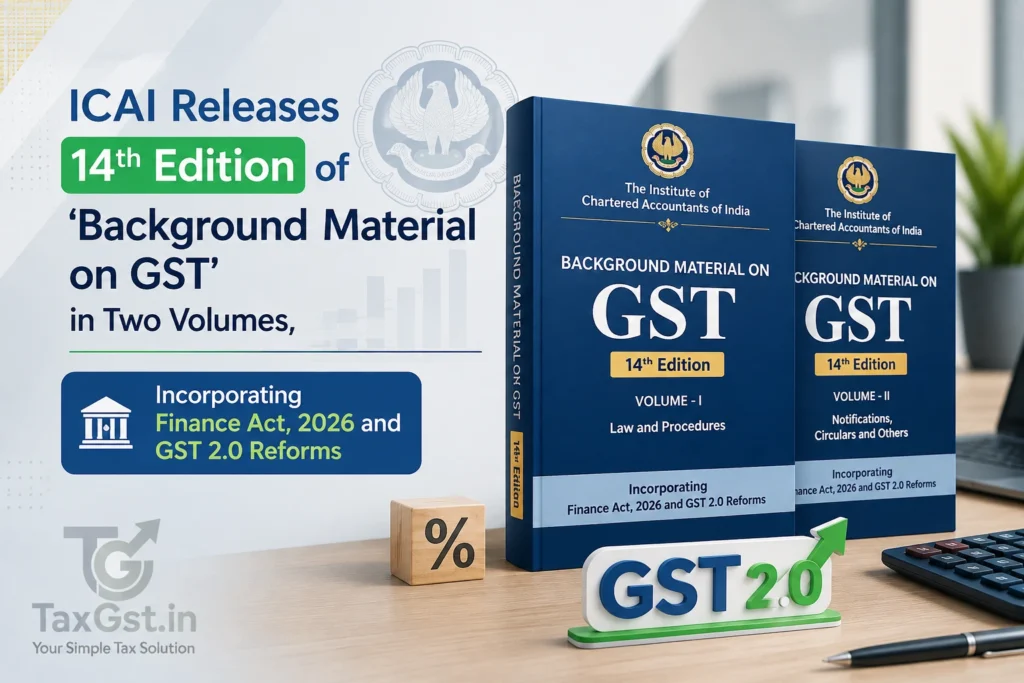
The Institute of Chartered Accountants of India (ICAI) has released the 14th edition of its ‘Background Material on GST’ in two comprehensive volumes, officially incorporating the landmark “GST 2.0” rate rationalisation and all amendments introduced by the Finance Act, 2026. This publication serves as the definitive reference manual for practitioners navigating the simplified two-slab tax structure (5% and 18%), the new 40% de-merit rate, and massive procedural shifts including the Retail Sale Price (RSP) valuation for tobacco, enhanced inverted duty refund mechanisms, and the operationalisation of the GSTAT.
Also Read-What is GST? CGST, SGST and IGST Explained with Examples (2026)
Quick Summary: Key Highlights of the 14th Edition
- GST 2.0 Implementation: Detailed guidance on the 56th GST Council’s transition from a four-tier structure to a simplified two-slab system (5% and 18%), effective from 22nd September 2025.
- Post-Supply Discounts: Finance Act, 2026 amendments to Section 15(3) and Section 34(1) clarifying credit note issuance without mandatory pre-supply agreements.
- Intermediary Services Export: Place of supply aligned with the recipient’s location via the omission of Section 13(8)(b) of the IGST Act, granting major relief to the BPO and agency sectors.
- RSP Valuation (Rule 31D): Tobacco and pan masala valuation shifted to a Retail Sale Price (RSP) basis effective 1st February 2026, accompanied by the withdrawal of the compensation cess.
- Working Capital Relief: Enhanced refund provisions under Section 54(6) allowing a 90% provisional refund on inverted duty structure claims.
The GST 2.0 Structural Reform: The Transition to a Two-Slab System
The 14th edition of the ICAI Background Material exhaustively documents the most significant structural overhaul since the inception of the Goods and Services Tax in 2017—the transition to “GST 2.0”. As recommended by the 56th GST Council and formally implemented from 22nd September 2025, the complex four-tier structure (5%, 12%, 18%, 28%) has been aggressively simplified.
The new framework comprises a 5% Merit Rate for essential goods and services, an 18% Standard Rate covering the vast majority of supplies, and a 40% Special De-merit Rate exclusively reserved for sin goods and ultra-luxury items. This shift drastically reduces classification disputes and inverted duty structures across multiple sectors.
Sectoral Impact of Rate Rationalisation
The rate restructuring has created distinct shifts in tax burdens across various industries. The table below, sourced from the Council’s notifications, illustrates the practical impact of this rationalisation:
| Sector / Category | Pre-Reform Rate | Post-Reform Rate | Effective Date |
|---|---|---|---|
| Household essentials (soaps, toothpaste, UHT milk) | 12% / 18% | 5% / Nil | 22nd Sept 2025 |
| Life-saving drugs and diagnostic kits | 12% | Nil / 5% | 22nd Sept 2025 |
| Automobiles (Two-wheelers, small cars), TVs, Cement | 28% | 18% | 22nd Sept 2025 |
| Hotel accommodation (value ≤ ₹7,500 per day) | 12% | 5% | 22nd Sept 2025 |
| Pan masala, cigarettes, chewing tobacco | 28% + Cess | 40% (Cess Withdrawn) | 1st Feb 2026 |
The rate restructuring for tobacco products is particularly notable. As per Notification No. 19/2025-Central Tax (Rate), pan masala and manufactured tobacco now attract a flat 40% GST under Schedule III. Simultaneously, Notification No. 03/2025-Compensation Cess (Rate) has withdrawn the compensation cess levy entirely from these entries, replacing the opaque dual-tax system with a single high-rate levy.
Deep Dive: The Retail Sale Price (RSP) Valuation Mechanism
To combat rampant tax evasion and under-invoicing in the tobacco sector, the government introduced a special valuation mechanism under Rule 31D of the CGST Rules, 2017 (inserted via Notification No. 20/2025-Central Tax). The ICAI material dedicates extensive coverage to the mechanics of this rule.
Under Rule 31D, the transaction value (Section 15) is overridden. The value of supply for specified goods—such as pan masala, unmanufactured tobacco, cigars, and nicotine-based inhalation products—is now deemed to be the declared Retail Sale Price (RSP) reduced by the applicable tax component.
Worked Example: RSP Valuation in the Supply Chain
Consider a manufacturer selling cigarettes to a distributor. The factory gate price is ₹250, but the printed RSP on the pack is ₹500. The applicable GST rate is 40%.
- Old Valuation Method: GST would be calculated on the transaction value of ₹250. Tax = ₹100.
- New Rule 31D Method: The deemed value is derived from the RSP. Deemed Value = RSP ÷ (1 + [Tax Rate/100]).
- Calculation: ₹500 ÷ 1.40 = ₹357.14 (Deemed Taxable Value).
- GST Component: ₹142.86.
The “Highest Price” Trap: Rule 31D includes strict anti-abuse provisions. Where multiple RSPs are declared on the same package, the highest such price must be adopted for valuation. Furthermore, any increase in the declared RSP at any subsequent stage of the supply chain (e.g., a retailer pasting a higher price sticker) immediately alters the applicable RSP for valuation retrospectively. The exemption from the 99% ITC utilization cap (Rule 86B) ensures downstream traders are not subjected to severe working capital blocks when trading these heavily taxed items.
Finance Act, 2026 Amendments: Credit Notes and Refunds
The Finance Act, 2026, introduced highly anticipated relief measures for corporate taxpayers, heavily focusing on dispute resolution and working capital liquidity.
Post-Supply Discounts (Section 15 & 34)
Historically, post-supply discounts were a massive litigation hotspot. The Department frequently denied the reduction of tax liability via credit notes if the discount was not explicitly documented in a pre-supply agreement. The amendment to Section 15(3) and Section 34(1) of the CGST Act, 2017 fundamentally changes this.
Suppliers can now issue valid GST credit notes for post-supply commercial discounts without the mandatory prerequisite of a prior agreement. The only strict condition is that the recipient must proportionately reverse their Input Tax Credit (ITC) corresponding to the credit note value. This aligns the statute with actual commercial realities.
Inverted Duty Structure Refunds (Section 54)
For manufacturers operating under an Inverted Duty Structure (where the GST on raw materials is higher than the GST on finished goods), blocked working capital has been a perennial issue. The amendment to Section 54(6) now mandates the grant of a 90% provisional refund on inverted duty structure claims within a prescribed timeframe, mirroring the facility previously available only to exporters.
Massive Relief for Exporters: The Omission of Section 13(8)(b)
The 14th Edition of the ICAI material provides an extensive analysis of the omission of Section 13(8)(b) of the IGST Act, 2017, a move that fundamentally alters the “Place of Supply” rules for intermediary services.
Previously, if an Indian agent or BPO facilitated a service for a foreign client, Section 13(8)(b) deemed the “place of supply” to be the location of the supplier (India). This meant the service could not qualify as an “export,” and the Indian intermediary was forced to charge 18% GST to their foreign clients, rendering Indian agencies globally uncompetitive.
With the omission of this clause, intermediary services now fall under the residuary provision of Section 13(2). The place of supply is now the location of the recipient.
| Scenario | Pre-Amendment PoS | Post-Amendment PoS | Export Treatment? |
|---|---|---|---|
| Indian agent facilitating sale for a US client | India (Taxable at 18%) | USA (Location of Recipient) | Yes — Qualifies as Export |
| Indian BPO handling customer support for EU firm | India (Taxable at 18%) | EU (Location of Recipient) | Yes — Qualifies as Export |
| Indian broker connecting two domestic firms | India | India | No — Domestic Supply |
This amendment enables Indian service providers to export under a Letter of Undertaking (LUT) without payment of tax, or pay IGST and claim immediate refunds, drastically improving their global pricing power.
GSTR-3B Enhancements: The New Interest & ITC Logic
Effective from the January 2026 tax period, the GST Network (GSTN) deployed major algorithmic updates to the GSTR-3B filing portal. The ICAI material provides excellent technical commentary on how practitioners must adapt to these changes.
1. Net Cash Interest Computation (Table 5.1)
Previously, the portal aggressively calculated interest under Section 50 on the entire tax liability if a return was filed late, regardless of the funds sitting idle in the taxpayer’s Electronic Cash Ledger. The new algorithmic update to Table 5.1 corrects this injustice.
Worked Example: A taxpayer has a gross liability of ₹10,00,000 for January 2026 but files the return 10 days late. However, they had deposited ₹4,00,000 into their Electronic Cash Ledger before the due date. The new system automatically recognizes this minimum cash balance. The 18% penal interest will now only be calculated on the net cash shortfall of ₹6,00,000, saving the taxpayer significant penal costs.
2. IGST Cross-Utilisation (Table 6.1)
From February 2026 onwards, the portal enables the suggestive cross-utilisation of ITC for the payment of IGST liability. Once the available IGST credit pool is completely exhausted, taxpayers can utilise CGST or SGST ITC to pay off the remaining IGST liability in any order they choose. This flexibility prevents scenarios where a business is forced to make cash payments for IGST while sitting on massive piles of state tax credits.
GSTAT Operationalisation and Rule 14A Withdrawal
The ICAI material dedicates a substantial volume to litigation procedures, specifically the operationalisation of the Goods and Services Tax Appellate Tribunal (GSTAT). With the Principal Bench expected to commence hearings by December 2025, and the limitation date for filing backlog appeals set for 30th June 2026, practitioners must begin auditing their pending High Court writ petitions for transfer.
Furthermore, the GSTN has enabled a direct portal facility (via Form GST REG-32) for taxpayers to withdraw from the restrictive Rule 14A framework. Active taxpayers registered under Rule 14A can navigate to Services → Registration → Application for Withdrawal from Rule 14A. To qualify, the taxpayer must have furnished returns for a minimum of one tax period (post-April 2026) and complete mandatory Aadhaar authentication for the Primary Authorised Signatory within 15 days of draft creation.
Compliance Action Checklist: What Should You Do Next?
📋 Practitioner’s Action Plan
- ERP Updates: Audit your clients’ billing software to ensure the transition to the new 5% and 18% GST 2.0 slabs is mapped correctly to HSN codes effective September 22, 2025.
- RSP Valuation: For clients in the tobacco sector, reprogram invoicing systems to calculate tax backward from the declared RSP (Rule 31D) to prevent underpayment of the 40% liability.
- Credit Note Audits: Review vendor agreements. Ensure clients issuing post-supply discounts obtain written confirmation that the recipient has reversed the corresponding ITC as per the amended Section 15(3).
- Refund Strategies: Re-evaluate blocked capital for clients with Inverted Duty Structures and immediately file for the new 90% provisional refund mechanism under Section 54(6).
- Export Classification: Advise BPO and agency clients that intermediary services to foreign clients are now zero-rated exports. Update their LUT filings accordingly.
Frequently Asked Questions (FAQs)
When do the revised GST rates under GST 2.0 come into effect?
As per the 56th GST Council recommendations, the transition to the 5% and 18% slab structure for standard goods and services is effective from 22nd September 2025. The special 40% rate for tobacco and pan masala takes effect on 1st February 2026.
How does the credit note provision for post-supply discounts work now?
The amendment to Section 15(3) of the CGST Act enables the issuance of credit notes for post-supply commercial discounts without the strict need for pre-supply agreements. However, the recipient must reverse the corresponding Input Tax Credit (ITC) to validate the transaction.
What is the special valuation mechanism for pan masala and tobacco products?
Under Rule 31D of the CGST Rules, the value of supply for specified goods is deemed to be the declared Retail Sale Price (RSP) reduced by the applicable tax component. If multiple RSPs are declared on a package, the highest price must be legally adopted for valuation.
How does the omission of Section 13(8)(b) help intermediary services?
Previously, Indian intermediaries serving foreign clients had to charge 18% GST because the place of supply was deemed to be India. With the omission, the place of supply is now the recipient’s location (overseas), allowing the service to qualify as a zero-rated export.
How does interest computation work in GSTR-3B now?
The automated interest computation in Table 5.1 of GSTR-3B now factors in the minimum cash balance available in your Electronic Cash Ledger from the due date of return filing till the actual date of tax payment. You only pay Section 50 penal interest on the net cash shortfall.
What is the deadline for filing backlog appeals to the GSTAT?
With the GSTAT Principal Bench and State Benches becoming fully operational for hearings by December 2025, the GST Council has recommended 30th June 2026 as the limitation date for filing all backlog appeals.
Sources & References
- Institute of Chartered Accountants of India (ICAI) – GST Publications
- CBIC Official Portal – CGST Rules and Notifications
- GST Council Official Newsletters (Jan-Feb 2026)
- Notification No. 19/2025-Central Tax (Rate) and Notification No. 20/2025-Central Tax
Article Information
Published: September 2, 2026
Last Reviewed: September 2, 2026
Category: GST Compliance & Regulatory Updates
Regulatory Body: Central Board of Indirect Taxes and Customs (CBIC)
Written by C.K. Gupta, M.Com & Tax Editor at TaxGST.in — assisting CAs, CSs, and corporate tax teams with GST compliance, litigation strategies, and ICAI regulatory updates since 2017.
Official Resources
Disclaimer: This article provides a comprehensive summary of the updates highlighted in the ICAI’s 14th edition of the Background Material on GST, including the GST 2.0 rate rationalization. It is intended for informational and educational purposes. Always consult the official CBIC notifications, tariff schedules, and the full ICAI publication before advising clients or executing ERP transitions.
Related Reading
- New E-Way Bill Rules 2026: Mandatory Ship-To GSTIN & Closure Facility
- Invoice Management System (IMS) Explained: How to Reconcile ITC
- E-Way Bill Rules Amendment 2026 – New Thresholds: What Every Business Must Know
Try the free GST calculator for instant figures.
Discover more from TaxGst.in
Subscribe to get the latest posts sent to your email.
Never Miss a Tax Deadline Again
Due-date alerts, GST updates and tax tips — free on the app you already use.
event Next: GSTR-3B · 20 Oct