 C.K. Gupta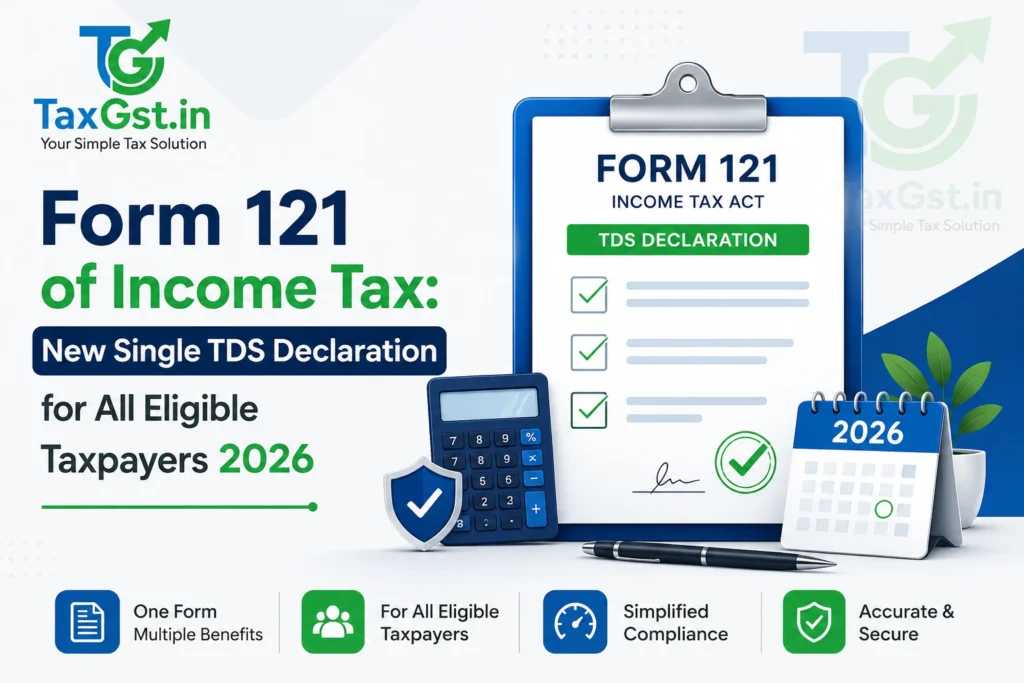
Form No. 121 is the new, consolidated statutory self-declaration form prescribed under the Income-tax Rules, 2026. Effective from Tax Year 2026-27, it officially replaces the legacy Forms 15G and 15H. Under Section 393(6) of the Income-tax Act, 2025, it enables eligible resident individuals and HUFs to declare that their estimated total income tax liability for the Tax Year is nil. By submitting Form 121, taxpayers request payers (such as banks or companies) not to deduct Tax Deducted at Source (TDS) on specified incomes like interest and dividends. Deductors must then generate a Unique Identification Number (UIN) and report the declaration in the new quarterly TDS statement, Form No. 140.
Also Read – How to Claim Income Tax Refund for Unfiled ITR: Section 119(2)(b)
Quick Summary: The Transition to Form 121
- Consolidation: Form 121 unifies and replaces the separate declarations for individuals below 60 (Form 15G) and senior citizens (Form 15H).
- Legal Framework: Governed by Section 393(6) of the Income-tax Act, 2025, and prescribed rules under the Income-tax Rules, 2026.
- Eligible Entities: Strictly limited to resident individuals and Hindu Undivided Families (HUFs). Companies, firms, and Non-Resident Indians (NRIs) are excluded.
- Digital Tracking (UIN): Deductors must allot a Unique Identification Number (UIN) to every Form 121 received.
- New Deductor Reporting: Payers must report all Form 121 UINs in the newly introduced Form No. 140 (which replaces the legacy Form 26Q) under Rule 219 of the Income-tax Rules, 2026.
What is Form 121? Understanding the New Legal Framework
With the implementation of the Income-tax Act, 2025 (which replaces the legacy Income-tax Act, 1961), the terminology and procedural framework of Indian taxation have undergone a massive overhaul. The concepts of “Previous Year” and “Assessment Year” have been streamlined into a unified “Tax Year”.
As part of this modernization, the Central Board of Direct Taxes (CBDT) has eliminated the fragmented system of having separate TDS exemption forms based on age. Form No. 121 is a newly drafted, consolidated statutory declaration prescribed under the Income-tax Rules, 2026.
Operating under Section 393(6) of the Income-tax Act, 2025 (which corresponds to the erstwhile Section 197A), Form 121 allows a taxpayer to formally declare to a deductor that their estimated total income for the relevant Tax Year will fall below the taxable threshold, resulting in a nil tax liability. Based on this legal declaration, the payer (such as a bank) is permitted to credit or pay specified incomes without deducting TDS.
The Transition: Old Regime vs. New Regime (2026)
For taxpayers and tax professionals accustomed to the legacy systems, understanding the structural changes introduced by the Income-tax Rules, 2026 is critical to maintaining compliance.
| Compliance Parameter | Old Regime (Income-tax Act, 1961) | New Regime (Income-tax Act, 2025) |
|---|---|---|
| Applicable Forms | Separate forms: Form 15G (Below 60 years) & Form 15H (60+ years). | Form No. 121 (Single consolidated form for all age groups). |
| Statutory Section | Section 197A | Section 393(6) |
| Time Period Terminology | Financial Year / Assessment Year | Tax Year (e.g., Tax Year 2026-27) |
| Quarterly TDS Return | Form 26Q | Form No. 140 (prescribed under Rule 219) |
| Tracking Mechanism | Deductor assigns a unique reference number locally. | Mandatory systemic allotment of a Unique Identification Number (UIN) by the payer. |
Who is Eligible to Submit Form 121?
Eligibility to submit Form No. 121 depends on the taxpayer’s residential status, entity type, and age. The new unified form preserves the differential eligibility conditions that existed under the old 15G/15H framework.
General Exclusions: Companies, Partnership Firms, LLPs, and Non-Resident Indians (NRIs) are strictly excluded from furnishing this declaration.
1. Individuals Below 60 Years & HUFs
For resident individuals under 60 and HUFs, two cumulative conditions must be strictly satisfied to submit Form 121:
- Condition A: The final estimated tax liability on total income for the Tax Year must be nil.
- Condition B: The aggregate of specified incomes (e.g., total FD interest) for which the declaration is filed must not exceed the maximum amount not chargeable to tax (i.e., the basic exemption limit). If your total interest income alone exceeds the basic exemption limit, you cannot file Form 121, even if your final tax liability after Chapter VI-A deductions is zero.
2. Senior Citizens (60 Years and Above)
For senior citizens, the criteria are significantly relaxed. A senior citizen only needs to satisfy one condition: The estimated tax liability on total income for the Tax Year must be nil.
They are exempt from “Condition B”. Therefore, even if a senior citizen’s total interest income exceeds the basic exemption limit, they can still legally submit Form 121 to avoid TDS, provided their final tax calculation (after accounting for deductions and rebates) results in zero tax payable.
What Types of Income Does Form 121 Cover?
Under the consolidated provisions of the Income-tax Act, 2025, Form No. 121 applies to specific categories of income where tax deduction at source is generally mandated. Covered incomes include:
- Interest on Bank Fixed Deposits (FDs) and Recurring Deposits (RDs).
- Interest on Post Office Deposits (like SCSS and NSC).
- Dividend payouts from domestic companies and mutual funds.
- Rental income (if it exceeds the statutory TDS threshold).
- Early withdrawal of Employee Provident Fund (EPF) balances.
How the UIN Allotment and Reporting Process Works
Form 121 is structured into two parts: Part A (completed by the taxpayer) and Part B (completed by the deductor/payer). The Income-tax Rules, 2026 mandate a strict digital tracking process to prevent the misuse of these declarations.
When the declarant submits Part A, the payer must verify the Permanent Account Number (PAN) according to the provisions of the Income-tax Act, 2025. Once verified, the payer must allot a Unique Identification Number (UIN) to that specific declaration.
Deductor Compliance: Monthly Uploads and Form No. 140
The payer cannot simply file the physical form away. They are required to furnish the details of all Form 121 declarations received on the Income-tax e-filing portal via a consolidated monthly CSV upload. This ensures the government maintains a real-time ledger of taxpayers claiming TDS exemptions.
Furthermore, under Rule 219, the payer must file their quarterly TDS statement using Form No. 140 (the replacement for the old Form 26Q). In the annexures of Form 140, the deductor must explicitly quote the UIN of the Form No. 121 against the specific PAN of the declarant, formally linking the zero-TDS payout to the taxpayer’s declaration.
Worked Example: Form 121 for a Senior Citizen
Consider Mrs. Mehta, aged 68. During Tax Year 2026-27, she earns an interest income of ₹4,20,000 from bank fixed deposits. She has no other source of income.
Because she is a senior citizen, she falls under the relaxed condition framework for Form 121. Even though her total interest (₹4.2 Lakhs) exceeds the basic exemption limit, her final estimated tax liability on her total income will be nil after applying standard rebates.
In April 2026, she furnishes Part A of Form No. 121 to her bank. The bank verifies her PAN, allots a Unique Identification Number (UIN), and reports the declaration on the e-filing portal via their monthly CSV upload. Consequently, the bank does not deduct any TDS on her interest payouts throughout the year. At the end of the quarter, the bank files Form No. 140, quoting Mrs. Mehta’s UIN to justify the nil-TDS transaction to the Income Tax Department.
What Are the Common Pitfalls Taxpayers Should Avoid?
1. Thinking Form 121 Exempts You from Filing an ITR:
A declaration under Form No. 121 is not a blanket exemption from income tax. It merely prevents the payer from deducting tax at source. If your actual total income for the Tax Year exceeds the basic exemption limit, you remain legally obligated to file your income-tax return under Section 139(1) of the Income-tax Act, 2025.
2. Failing to Submit the Form to Every Payer:
If you have fixed deposits in multiple banks (e.g., SBI and HDFC), you must submit a separate Form 121 to each bank independently. A declaration given to one payer does not apply to the others.
3. Missing the PAN Requirement:
Under the provisions of the Income-tax Act, 2025, a valid and operative Permanent Account Number (PAN) is mandatory. Without a valid PAN, the declaration is void, and the payer is obligated to deduct tax at source at the maximum punitive rate.
Compliance Checklist: What Should You Do Next?
📋 Taxpayer Action Plan for Tax Year 2026-27
- Estimate Income: Calculate your estimated total income across all sources for Tax Year 2026-27 to confirm your final tax liability will genuinely be nil.
- Download Form 121: Obtain the new Form 121 from the official Income Tax e-filing portal or your respective bank’s internet banking dashboard. Do not use legacy 15G/15H forms.
- Submit Early: Complete Part A and submit the declaration to each payer separately before the first credit of interest or dividend for the Tax Year to prevent early TDS deductions.
- Verify UIN: Confirm with your bank that they have successfully allotted a UIN to your declaration and will report it in their Form No. 140.
- File ITR on Time: Ensure you file your income-tax return within the due date under Section 139(1) if your gross income exceeds the basic exemption limit, regardless of the Form 121 submission.
Frequently Asked Questions (FAQs)
Is Form 121 valid for multiple Tax Years or must I submit it annually?
The declaration is valid only for the specific Tax Year for which it is furnished. You must submit a fresh Form 121 at the beginning of each Tax Year if you continue to meet the eligibility conditions. The form does not carry forward automatically.
Can a non-resident submit Form 121 to avoid TDS on interest income?
No. Non-residents are expressly excluded from furnishing Form 121. The form is available only to resident individuals and HUFs who meet the stipulated criteria. Non-residents must rely on other provisions under the Income-tax Act, 2025, or the relevant Double Taxation Avoidance Agreement (DTAA) for any TDS relief.
Am I required to submit Form 121 to each payer separately?
Yes. The declaration must be furnished separately to every payer responsible for making payment of the relevant income. A single declaration cannot cover multiple payers. You must submit Part A of Form 121 to each bank or financial institution independently.
What happens if my actual total income exceeds the exemption limit after I submit Form 121?
Form 121 only prevents TDS deduction; it does not exempt the income from tax. If your actual total income for the Tax Year exceeds the maximum amount not chargeable to tax, you are legally required to file an income-tax return under Section 139(1) and pay the due tax as self-assessment tax.
Sources & References
- Income Tax Department E-Filing Portal
- Income-tax Act, 2025 — Provisions relating to PAN, TDS, and Section 393(6)
- Income-tax Rules, 2026 — Rule 219 and prescribing of Form No. 140
Article Information
Published: September 3, 2026
Last Reviewed: September 3, 2026
Category: Income Tax & TDS
Regulatory Body: Central Board of Direct Taxes (CBDT)
Written by C.K. Gupta, M.Com & Tax Editor at TaxGST.in — advising individuals and senior citizens on TDS compliance, the transition to the Income-tax Act 2025, and tax-saving strategies since 2009.
Official Resources
Disclaimer: This article provides general guidance on the transition from Forms 15G/15H to the new Form 121 under the Income-tax Act, 2025. Always compute your estimated tax liability accurately before submission to avoid statutory penalties.
Try the free GST calculator for instant figures.
Discover more from TaxGst.in
Subscribe to get the latest posts sent to your email.

Never Miss a Tax Deadline Again
Due-date alerts, GST updates and tax tips — free on the app you already use.
event Next: TDS Return (138 / 140) · 31 Oct