
 C.K. Gupta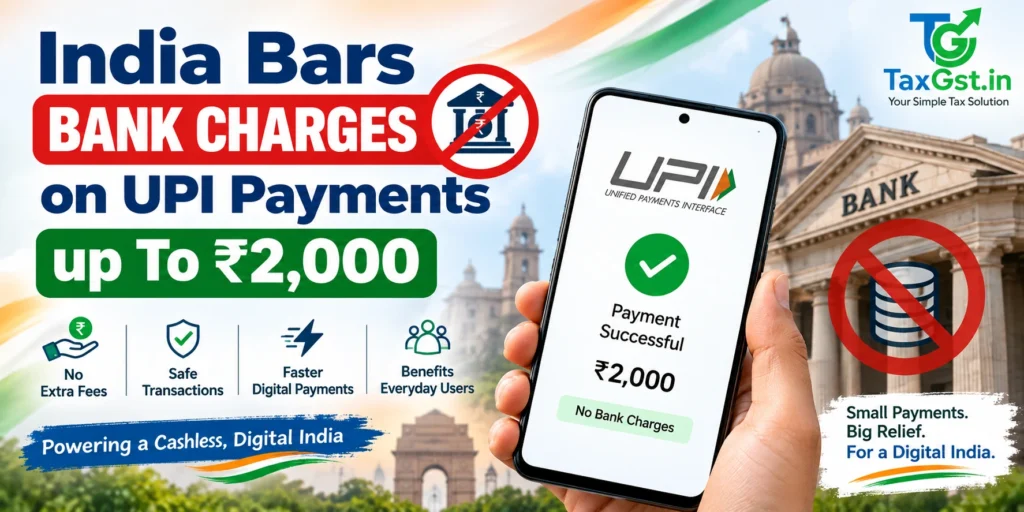
Also Read-Indian Tax Residency After Moving to UAE: Rules, Day Counts & Common Mistakes
The Ministry of Finance notification S.O. 5067(E), dated September 14, 2026, specifies RuPay-powered debit cards and UPI transactions up to ₹2,000 as electronic modes for which a bank or system provider cannot impose a direct or indirect charge on the person making or receiving the payment. The notification does not prescribe an MDR rate for UPI transactions above ₹2,000. Separately, the Ministry of Finance stated on August 8, 2026 that consumers would not face UPI transaction charges and that any future MDR, if introduced, would be limited and merchant-focused.
Quick Summary
- Zero charges on UPI and RuPay up to ₹2,000: No bank or system provider can levy any direct or indirect charge on transactions through these modes within this threshold.
- Consumer payments remain free: All Person-to-Person (P2P) transactions continue to be free of charge.
- Merchant protection: The vast majority of merchant transactions on UPI will remain free; any future MDR will be threshold-based, not blanket.
- Enabling amendment: The recent amendment to the Payment and Settlement Systems Act is designed to ensure UPI’s long-term sustainability, technological advancement, and resilience against emerging risks.
- Future MDR framework: Following enactment of the Taxation and Other Laws (Amendment) Act, 2026, the UPI and Services Steering Committee headed by NPCI will decide on any nominal MDR.
Illustrative example only; actual figures, terms and outcomes vary.
What Does the Government Notification Actually Say?
The government gazette notification, issued under the Payment and Settlement Systems Act, 2007, explicitly specifies that no bank or system provider shall impose any direct or indirect charge on a person making or receiving payments through RuPay-powered debit cards and UPI transactions of up to ₹2,000. This is not a guideline or a recommendation — it is a statutory prohibition enforceable under the Act.
The notification effectively classifies UPI and RuPay debit card transactions up to ₹2,000 as designated electronic modes of payment that must remain free of charge for end users. This means that whether a customer is paying a street vendor ₹50 via UPI or a merchant is receiving ₹1,800 through RuPay, no transaction fee can be passed on to either party by the bank or the payment system provider.
Why Did the Government Issue This Notification Now?
The notification follows a recent amendment to the Payment and Settlement Systems Act that generated significant public debate, with some misinterpreting the amendment as a move to impose charges on ordinary UPI users. The Press Information Bureau, in its press release dated August 8, 2026, clarified that the amendment is an enabling provision — not a charge-imposition measure.
The government’s stated objective is threefold: to ensure UPI’s long-term sustainability, to enable continued technological advancement, and to build resilience against emerging risks in the digital payments ecosystem. The amendment empowers the UPI and Services Steering Committee, headed by the National Payments Corporation of India (NPCI), to determine a nominal MDR framework if and when required — but only for a limited set of merchant transactions above a specified threshold.
The government has been explicit that UPI is a national achievement built by Indians, for Indians, and that it has promoted, funded, and grown the platform for a decade. The notification reinforces that commitment by ring-fencing small-value transactions from any future charge framework that may be designed for larger merchant payments.
How Does the 2026 Zero-Charge Framework Compare to Earlier MDR Structures?
The 2026 notification marks a decisive shift from the earlier regime where small-value digital transactions operated under temporary or capped charge structures. To understand the magnitude of this change, one must examine the trajectory of RBI and government interventions over the past decade.
In December 2016, the RBI issued circular RBI/2016-17/185 under Section 10(2) read with Section 18 of the Payment and Settlement Systems Act, 2007, directing that no charges be levied on customers for UPI, IMPS, and USSD transactions up to ₹1,000. This was a temporary measure effective from January 1, 2017 to March 31, 2017, introduced in the aftermath of the withdrawal of legal tender characteristics of specified bank notes. That ceiling of ₹1,000 left transactions between ₹1,000 and ₹2,000 without explicit statutory protection.
Simultaneously, circular RBI/2016-17/184 capped MDR for debit card transactions at 0.75% for values up to ₹2,000 and 1% for values above ₹2,000. This framework, while providing some merchant relief, still permitted banks to recover a fraction of the transaction value — a cost that could ultimately be passed on to merchants and, indirectly, to consumers.
The 2026 framework eliminates this ambiguity entirely. The table below maps the evolution of charge structures across key digital payment modes.
The critical distinction is that the 2026 notification is not a temporary measure with an expiry date — it is a statutory prohibition embedded in the Payment and Settlement Systems Act itself. This gives it permanence and enforceability that the 2016 circulars, which were explicitly time-bound, did not possess.
Practical Impact: A Worked Example
Consider a neighbourhood kirana store that processes 80 UPI transactions daily, with an average ticket size of ₹1,500. Under the 2016-17 MDR framework for debit cards, had these been RuPay card transactions, the merchant would have faced an MDR of 0.75% — amounting to ₹11.25 per transaction, or ₹900 daily (₹11.25 × 80). Over a 30-day month, this would have totalled ₹27,000 in charges.
Under the 2026 zero-charge notification, the same merchant pays nothing on these transactions. The statutory prohibition applies to both the person making the payment and the person receiving it — meaning the customer is not charged, and the merchant cannot be charged by the bank or payment system provider. For a small business operating on thin margins, this represents a direct improvement to monthly cash flow of ₹27,000 — a figure that scales linearly with transaction volume.
The example underscores why the government has characterised this as a financial inclusion measure: it removes a cost barrier that disproportionately affected small merchants and everyday consumers, while preserving the enabling framework for a nominal, threshold-based MDR on larger merchant transactions in the future.
Illustrative example only; actual figures, terms and outcomes vary.
Who is protected under the zero-charge UPI and RuPay notification?
The notification protects both the person making and the person receiving a payment through the specified modes. For P2P transactions, the Ministry of Finance separately stated on August 8, 2026 that such transactions would continue to be free. That policy clarification should be distinguished from the narrower September 14 Section 10A notification, which specifically protects UPI transactions up to ₹2,000. The ₹2,000 threshold applies specifically to Person-to-Merchant (P2M) transactions and RuPay debit card payments, where both the payer and the payee are shielded from any direct or indirect charge.
The notification’s language — “no bank or system provider shall impose any direct or indirect charge on a person making or receiving payments” — is deliberately broad. It captures not only explicit transaction fees but also any ancillary charges, convenience fees, or surcharges that a bank or payment system provider might attempt to levy on transactions within the threshold. This means that if a customer pays ₹1,800 to a merchant via UPI, neither the customer’s bank nor the merchant’s acquiring bank can deduct any fee from either party. The protection is embedded in the Payment and Settlement Systems Act, 2007, giving it the force of law rather than mere regulatory guidance.
The notification is directed at banks and system providers. Businesses should therefore examine their relevant bank, acquiring-bank, payment-system-provider and merchant-agreement arrangements rather than assuming that every intermediary has identical statutory obligations. The government has explicitly stated that the vast majority of merchant transactions on UPI will remain free, given that the average ticket size for UPI merchant payments continues to fall well below the ₹2,000 threshold for a significant share of daily transactions.
What are the compliance obligations for banks and payment system providers?
Banks and payment system providers must ensure that their systems, processes, and merchant agreements are updated to reflect the zero-charge mandate for transactions up to ₹2,000. The notification operates as a statutory bar — not a discretionary guideline — meaning that a charge contrary to the notification would raise a compliance issue under the Payment and Settlement Systems Act, 2007 and the applicable regulatory framework. The RBI, as the regulator empowered under Sections 10(2) and 18 of the PSS Act, retains supervisory and enforcement authority over payment system providers and participants to ensure compliance.
The prohibition covers both direct charges (explicit fees deducted from the transaction amount or the customer’s account) and indirect charges (costs passed through via reduced settlement amounts, higher interchange fees structured to recover costs, or any other mechanism that effectively imposes a cost on the end user for transactions within the threshold). Banks must audit their UPI and RuPay processing systems to ensure that no charge — however characterised — is applied to transactions of ₹2,000 or below. This includes reviewing merchant agreements to ensure that acquirer-side MDR is not being levied on small-value transactions, even if the merchant has consented to such charges.
For consumers and merchants who encounter charges on transactions within the threshold, the recourse mechanism flows through the RBI’s grievance redressal framework for digital payments. The RBI’s Master Directions and the PSS Act provide for penalties and corrective action against non-compliant payment system providers. The government’s August 8, 2026 press release has also directed citizens to rely only on official information from the Ministry of Finance, the RBI, and the NPCI — signalling that the government views misinformation about UPI charges as a material risk to public confidence in the digital payments ecosystem. Banks are therefore expected not only to comply internally but also to proactively communicate the zero-charge framework to their customers and merchant networks to prevent confusion.
What Happens to Transactions Above the ₹2,000 Threshold?
The zero-charge prohibition applies specifically to transactions up to ₹2,000. For transactions above this threshold, the government has created an enabling framework rather than an immediate charge structure. Once Parliament passes the Taxation and Other Laws (Amendment) Bill, 2026, the UPI and Services Steering Committee, headed by NPCI, will determine whether to impose a nominal MDR on specified merchant transactions.
The government has been explicit that any future MDR will apply only to a limited set of merchant transactions, will be nominal in rate, and will be significantly lower than existing debit or credit card MDRs. The vast majority of merchant transactions on UPI are expected to remain free of charge even after this framework is operationalised. The September 14, 2026 notification does not itself impose a charge on transactions above ₹2,000. It defines the specific UPI category protected under Section 10A; any future merchant-side MDR would require the applicable framework or notification.
How Does the E-Mandate Framework Complement the Zero-Charge Rule?
The RBI’s Digital Payments – E-mandate Framework, 2026 (RBI/DPSS/2026-27/396, dated April 21, 2026) operates alongside the zero-charge notification and provides additional protection for recurring transactions. Under these directions, no charges shall be levied to the customer for availing the e-mandate facility for recurring transactions.
This means that whether a customer sets up a ₹500 monthly mutual fund SIP via UPI e-mandate or a ₹12,000 annual insurance premium payment, the e-mandate facility itself carries no charge. The same framework permits recurring transactions up to ₹15,000 per transaction without additional factor of authentication (AFA); specified categories such as insurance premiums, mutual-fund subscriptions and credit-card bill payments may be processed without AFA up to ₹1,00,000 per transaction, subject to the framework.
The e-mandate framework thus provides a complementary layer of consumer protection: the zero-charge notification protects small one-time transactions, while the e-mandate directions ensure that recurring payment arrangements — which often involve larger amounts — remain free of facility charges.
Practical Impact: Mixed Transaction Profile
Consider a mid-sized electronics retailer that processes 200 UPI transactions daily with the following distribution: 120 transactions below ₹2,000 (average ₹800), 60 transactions between ₹2,000 and ₹10,000 (average ₹5,000), and 20 transactions above ₹10,000 (average ₹15,000).
Under the 2026 zero-charge notification, the 120 transactions below ₹2,000 are statutorily protected — no charges apply to either party. For the remaining 80 transactions, no MDR currently applies until the UPI and Services Steering Committee notifies a framework under the Taxation and Other Laws (Amendment) Bill, 2026. Even when notified, the government has stated that any MDR will be nominal and threshold-based.
If one assumes a hypothetical future MDR of 0.3% on transactions above ₹2,000 (purely illustrative, as no rate has been notified), the merchant would pay: 60 transactions × ₹5,000 × 0.3% = ₹900 daily, plus 20 transactions × ₹15,000 × 0.3% = ₹900 daily — totalling ₹1,800 daily or ₹54,000 monthly. Under the current framework, the merchant pays nothing on any of these 200 transactions. The zero-charge notification thus provides immediate, unambiguous cost relief on at least 60% of this retailer’s transaction volume, with the remaining 40% awaiting the steering committee’s decision.
What Changed in Section 10A of the Payment and Settlement Systems Act?
The legal architecture behind the September 2026 notification is important because the change is not simply a new UPI pricing circular. The 2026 amendment to Section 10A changed the way protected electronic modes of payment could be specified. Instead of relying only on the older reference to electronic modes prescribed under section 269SU of the Income-tax Act, 1961, the amended provision allows the Central Government to specify one or more electronic modes of payment by notification.
That distinction explains why the September 14 notification matters. The amendment created the enabling authority; the subsequent notification identified the modes that receive the statutory charge protection. These are two different legal steps and should not be presented as though the amendment itself created a universal zero-charge rule for every UPI transaction.
Notification S.O. 5067(E), dated September 14, 2026, specifies two categories: debit cards powered by RuPay and UPI transactions up to ₹2,000. It then states that no bank or system provider shall impose, directly or indirectly, a charge upon a person making or receiving a payment using those specified modes. The wording therefore creates a direct statutory basis for the protected categories rather than relying only on a temporary administrative arrangement.
UPI Charges: Statutory Protection vs Government Policy Clarification
Two related but different government statements are relevant. On August 8, 2026, the Ministry of Finance clarified the broader policy position: consumers making UPI payments would not face transaction charges, P2P transactions would continue to be free, and any future MDR, if introduced, would be nominal and limited to specified merchant transactions above a threshold.
The September 14 statutory notification is narrower in its legal wording. It expressly protects UPI transactions up to ₹2,000 and RuPay-powered debit cards. Therefore, an accurate explanation should not turn the September notification into a blanket statement that Section 10A protects every UPI transaction regardless of amount.
This distinction is particularly important for merchants. A merchant may continue to receive UPI payments above ₹2,000 without a charge under the current arrangement, but that current absence of a charge should not be described as a statutory Section 10A prohibition above ₹2,000. The September 14 notification itself does not set an MDR rate, percentage or charge schedule for higher-value UPI transactions.
Is MDR the Same as a UPI Transaction Fee?
No. MDR, or Merchant Discount Rate, is a charge associated with payment acceptance and is generally a merchant-side cost within the applicable payment arrangement. A consumer-facing transaction fee is a different concept. Confusing the two can make an article appear to say that customers will automatically be charged simply because a merchant-side MDR framework exists.
Historically, governments and regulators have used different mechanisms to keep low-value digital payments attractive. These have included temporary customer-charge measures, MDR caps, government reimbursement or incentive schemes, and statutory restrictions. The policy objective may be similar — encourage digital payments — but the legal mechanism and economic incidence are not identical.
For businesses, this means that a merchant should inspect its settlement report and acquiring agreement rather than assuming that a payment is costly or free merely from the payment app displayed on the customer’s phone. If a settlement amount is reduced by a fee, the merchant should identify whether it is an MDR, a payment-aggregation fee, a terminal/service charge, a tax component, or another separately contracted service.
Historical Background: How India Reached the ₹2,000 Threshold
The ₹2,000 figure has appeared repeatedly in India’s digital-payment policy because low-value transactions form an important part of everyday commerce. In the post-demonetisation period, the RBI temporarily waived customer charges for certain UPI, IMPS and USSD transactions up to ₹1,000. That was a time-bound measure, unlike the present Section 10A notification.
The government subsequently used subsidy and incentive mechanisms to support low-value RuPay debit-card and BHIM-UPI transactions. For example, the 2018 Cabinet decision provided for the Government to bear MDR on specified low-value debit-card, BHIM-UPI and AePS transactions for a defined period. Later incentive schemes continued to support RuPay debit-card and low-value BHIM-UPI merchant transactions.
These historical measures are useful context, but they should not be described as if they were the same legal instrument as the September 2026 notification. Earlier arrangements could involve reimbursement, incentives, temporary caps or specific scheme conditions. The September 2026 notification instead operates through Section 10A and expressly specifies protected electronic modes.
What This Means for Consumers
For a consumer making a qualifying UPI payment of ₹2,000 or less, the September 14 notification provides a clear statutory protection against a direct or indirect charge imposed by a bank or system provider. A normal example would be paying ₹250, ₹999 or ₹1,999 to a merchant using UPI. The notification protects the payment from a bank or system-provider charge within the specified category.
Consumers should nevertheless distinguish a transaction charge from a completely separate commercial price. If a merchant chooses to change the price of a product or service, that is not automatically the same thing as a bank or system-provider transaction fee. Similarly, charges on unrelated services, accounts, cards or optional banking facilities should not automatically be treated as UPI transaction charges.
If a customer notices a fee that appears to be connected to a qualifying UPI payment, the safest approach is to preserve the transaction reference, date, amount, bank statement entry and fee description. The customer should first complain to the bank or relevant service provider and request a written explanation. If the issue is not resolved, the customer can use the applicable RBI grievance-redressal route.
What This Means for Merchants and Small Businesses
For a small retailer, the practical benefit is easier cost forecasting on qualifying transactions. If a large share of daily receipts consists of UPI payments at or below ₹2,000, those qualifying transactions fall within the statutory protection. The merchant should still reconcile the actual settlement amount because the notification does not automatically eliminate every possible fee associated with every service supplied by a payment provider.
A merchant should separate three questions: first, whether the payment itself is a protected UPI transaction; second, whether the settlement statement contains an MDR or other transaction-linked deduction; and third, whether a separate contractual service fee is being charged for equipment, software, reconciliation, value-added services or another facility. Only the relevant category should be tested against the statutory prohibition.
For accounting and reconciliation purposes, businesses should maintain transaction-level evidence. Monthly settlement reports can be matched with the sales register, bank credits and payment-provider statements. This becomes particularly useful if a future MDR framework is introduced for selected merchant transactions above a threshold, because the business will then have a reliable baseline against which any new cost can be measured.
What About RuPay Debit Cards?
The September 14 notification separately identifies debit cards powered by RuPay. This wording should not be reduced to “RuPay cards up to ₹2,000” because the notification’s two listed categories are structured differently: one is RuPay-powered debit cards, while the other is UPI transactions up to ₹2,000.
This distinction matters when comparing card payments with UPI payments. A merchant processing a RuPay-powered debit-card payment should examine the transaction type and applicable acquiring arrangement, while a UPI transaction should be tested against the ₹2,000 statutory threshold. RuPay credit cards linked to UPI should not automatically be treated as RuPay debit-card transactions.
UPI Credit Cards Are a Separate Question
The September 14 notification specifically names RuPay-powered debit cards and UPI transactions up to ₹2,000. It does not separately name credit-card transactions routed through UPI as a protected electronic mode under Section 10A. Therefore, a RuPay credit card linked to UPI should not be assumed to receive the same statutory treatment merely because the RuPay brand is involved.
Card-linked UPI payments can involve a different payment chain, card-issuer terms and merchant acceptance arrangements. Consumers using credit cards through UPI should therefore check the applicable card terms and any charges shown by the issuing bank or service provider instead of applying the debit-card rule automatically.
How the 2026 E-Mandate Framework Fits In
The RBI’s Digital Payments – E-mandate Framework, 2026, issued on April 21, 2026, is a separate regulatory framework for recurring transactions using cards, prepaid payment instruments and UPI. It is relevant to subscriptions, insurance premiums, mutual-fund payments, credit-card bill payments and other recurring arrangements.
The framework says that no charge shall be levied to the customer for availing the e-mandate facility. It also provides that recurring transactions may generally be authorised without an additional factor of authentication up to ₹15,000 per transaction. Specified categories — including insurance premiums, mutual-fund subscriptions and credit-card bill payments — may be processed without AFA up to ₹1,00,000 per transaction, subject to the framework’s conditions.
This does not mean that every recurring payment of ₹1,00,000 is automatically free of every possible commercial or service charge. The specific RBI rule concerns the e-mandate facility and authentication framework. Readers should therefore distinguish “no charge for availing the e-mandate facility” from the price of the underlying product, subscription, insurance policy, mutual fund or credit-card service.
A Practical Compliance Checklist for Businesses
- Identify payment type: classify each transaction as UPI, RuPay debit card, another debit card, credit card, wallet/PPI or another payment method.
- Check transaction value: for UPI, identify whether the individual transaction is ₹2,000 or below.
- Review settlement reports: check gross transaction value, settlement value, MDR and other deductions separately.
- Review merchant agreements: identify whether any fee is linked to payment acceptance or to a separate software, terminal or value-added service.
- Keep evidence: retain transaction IDs, settlement statements, invoices and bank entries so a disputed deduction can be traced.
- Escalate correctly: first raise the matter with the relevant bank or payment-system provider and then use the applicable regulatory grievance mechanism if unresolved.
- Monitor future notifications: the September 2026 notification does not establish an MDR rate above ₹2,000, so businesses should watch official Ministry of Finance, RBI and NPCI communications for subsequent changes.
Worked Examples: How to Read the Rule
Example 1 — ₹750 UPI merchant payment: The transaction is within the ₹2,000 statutory threshold. A bank or system provider cannot impose a direct or indirect charge on the payer or recipient under the September 14 notification.
Example 2 — ₹2,000 UPI merchant payment: The threshold includes transactions up to ₹2,000. Therefore, an exactly ₹2,000 UPI transaction falls within the specified protected category.
Example 3 — ₹2,001 UPI merchant payment: This transaction is outside the specific ₹2,000 UPI category in the Section 10A notification. That does not mean the notification automatically imposes a charge. It means the statutory protection described here does not extend to that transaction by virtue of the ₹2,000 UPI threshold.
Example 4 — ₹1,500 RuPay debit-card payment: The notification separately specifies RuPay-powered debit cards and prohibits a bank or system provider from imposing a direct or indirect charge on the person making or receiving the payment through that specified mode.
Example 5 — ₹5,000 recurring insurance payment under an e-mandate: The e-mandate framework can permit recurring processing without AFA within the prescribed limits, and no customer charge may be levied for availing the e-mandate facility. The underlying insurance premium remains a separate commercial payment.
What the September 2026 Notification Does Not Say
- It does not prescribe a percentage MDR rate for UPI transactions above ₹2,000.
- It does not state that every UPI transaction above ₹2,000 is automatically chargeable.
- It does not say that RuPay credit cards are identical to RuPay-powered debit cards for Section 10A purposes.
- It does not turn every fee appearing on a merchant settlement statement into an illegal UPI charge; the nature of the fee must be identified.
- It does not replace the RBI’s separate e-mandate framework for recurring payments.
Bottom Line for Consumers and Businesses
The September 14, 2026 notification provides a clear statutory no-charge protection for UPI transactions up to ₹2,000 and for payments made through RuPay-powered debit cards. It is an important development because the protection is now tied to the notification issued under Section 10A of the Payment and Settlement Systems Act rather than being merely a temporary waiver.
At the same time, readers should avoid the opposite mistake of treating the notification as a new MDR schedule. It is not one. Above ₹2,000, the notification defines the boundary of the specific statutory UPI protection but does not itself prescribe a charge. The broader government policy statement says consumers will not face UPI transaction charges and that any future MDR, if introduced, will be limited and merchant-focused.
For practical compliance, consumers should monitor bank statements and merchants should monitor settlement reports. Any suspected prohibited deduction should be documented and raised through the appropriate grievance channel. For recurring payments, the separate RBI e-mandate framework should be applied. This approach keeps the legal position precise while still explaining the real-world impact of the 2026 changes.
What Should You Do Next?
- Audit your UPI and RuPay transactions for hidden charges: Review bank statements for the past 90 days. If any transaction fee appears on UPI or RuPay debit card payments of ₹2,000 or below, raise a formal grievance with your bank’s nodal officer and cite the Payment and Settlement Systems Act prohibition.
- Merchants should reconcile terminal-level charges: If you operate a POS terminal or QR code setup, verify that your acquiring bank has not levied any MDR on transactions within the ₹2,000 threshold. Seek immediate refunds for any erroneous deductions.
- Update customer-facing signage: Display that UPI and RuPay payments up to ₹2,000 are free of charge. This statutory protection can increase digital payment adoption and reduce cash-handling costs at the store level.
- Map your average transaction size: Calculate your typical UPI ticket size. If the majority of your receipts fall below ₹2,000, your effective cost of acceptance is now zero — a direct margin improvement that should be reflected in your financial projections.
- Track subsequent UPI/MDR notifications under the Taxation and Other Laws (Amendment) Act, 2026: This legislation will determine the future MDR framework for larger merchant transactions. Monitor its progress in Parliament to anticipate any changes to your cost structure on transactions above the threshold.
- Subscribe to official RBI and NPCI circulars: Threshold revisions, clarifications, or new merchant categories may be notified. Rely only on official sources — the Ministry of Finance, RBI, and NPCI — and disregard unverified social media claims about UPI charges.
- Review e-mandate registrations under the 2026 Framework: If you use recurring UPI payments for subscriptions or EMIs, confirm that your bank is not levying any charge for the e-mandate facility itself, as prohibited under RBI/DPSS/2026-27/396.
Discover more from TaxGst.in
Subscribe to get the latest posts sent to your email.



Never Miss a Tax Deadline Again
Due-date alerts, GST updates and tax tips — free on the app you already use.
event Next: TDS / TCS Payment · 07 Oct