
 C.K. Gupta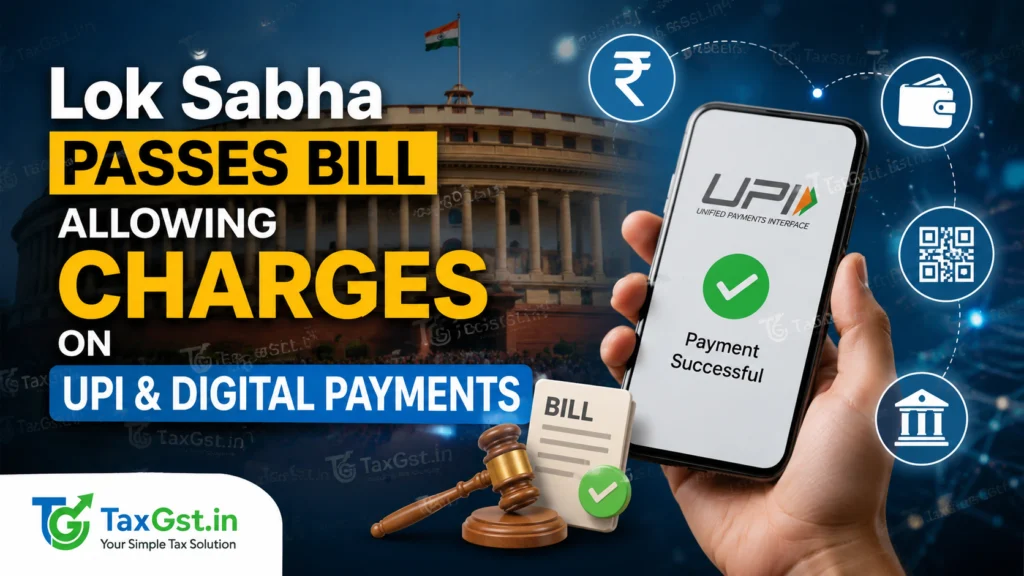
As of August 2026, the Lok Sabha has officially passed the Taxation and Other Laws (Amendment) Bill, 2026 (Bill No. 150 of 2026). This legislation introduces significant amendments to the Payment and Settlement Systems Act, 2007, the Income-tax Act, 2025, and the Finance Act, 2026. The Bill authorises the Central Government to permit banks and service providers to levy charges on payments made through the Unified Payments Interface (UPI) and other notified electronic payment modes by dismantling the statutory “Zero-MDR” mandate.
While the Bill does not immediately impose new charges on standard UPI transactions, it establishes the legal framework to introduce a Merchant Discount Rate (MDR) via a forthcoming official notification. Person-to-person (P2P) UPI transactions are expected to remain entirely exempt, with any potential MDR strictly targeting high-value commercial transactions to ensure the financial sustainability of the digital payments ecosystem.
UPI Charges and Corporate Surcharges: Comprehensive Compliance Guide for FY 2026-27 is essential because businesses, payment aggregators, and tax professionals require a precise understanding of how legislative amendments alter compliance burdens and transaction cost structures. Relying on news headlines regarding “UPI fees” without understanding the underlying statutory shift can lead to premature pricing changes or incorrect tax computations. This guide details the practical effects of the new Bill, the exact mechanics of the Section 10A amendment, the projected MDR thresholds, and the heavily revised corporate surcharge rates that Special Purpose Vehicles (SPVs) must immediately factor into their advance tax computations under the Finance Act, 2026.
What is the Current Status of UPI Transaction Charges in India?
Currently, real-time gross settlement systems like RTGS and NEFT attract standard service charges levied by banks, whereas UPI and RuPay debit card transactions have historically remained strictly exempt from fees for both end-users and merchants. The newly passed Taxation and Other Laws (Amendment) Bill, 2026, does not immediately levy a tax, fee, or cess on your daily UPI transfers. Instead, it restructures the underlying statutory law to grant the Central Government the explicit authority to introduce an MDR on specific digital payment transactions through future, targeted notifications.
The government’s stated intent is to establish a sustainable revenue model for banks, third-party application providers (TPAPs), and payment infrastructure firms. By shifting away from state-subsidized operations, the regulatory framework aligns India with global financial standards, ensuring that the entities bearing the server, cloud, and cybersecurity costs of processing billions of micro-transactions are adequately compensated without burdening the everyday retail consumer.
The End of the Zero-MDR Era: Understanding the Section 10A Amendment
To grasp the magnitude of the new Bill, it is necessary to examine the previous legal framework that governed India’s digital payment revolution. Effective from January 1, 2020, the government introduced Section 269SU of the Income-tax Act, 1961. This section mandated that every business with a total sales turnover exceeding ₹50 crore must provide facilities for accepting payment through specific prescribed electronic modes. Concurrently, Section 10A was inserted into the Payment and Settlement Systems Act, 2007. This section strictly prohibited banks and system providers from levying any charge—directly or indirectly—on a payer or beneficiary for electronic payments made through the modes prescribed under Section 269SU.
Pursuant to these laws, the Central Board of Direct Taxes (CBDT) issued Notification No. 105/2019 dated December 30, 2019, which explicitly listed the Unified Payments Interface (UPI) and RuPay debit cards as the prescribed charge-free modes. This created a strict statutory barrier that prevented any financial institution from generating MDR revenue from the fastest-growing payment networks in the country. To sustain this zero-charge model and compensate banks for the operational costs of the UPI network, the exchequer disbursed approximately ₹8,730 Crores from FY 2021-22 to FY 2024-25 as subsidy support to banks.
The Taxation and Other Laws (Amendment) Bill, 2026 (Bill No. 150 of 2026) severs this statutory linkage. By substituting the text in Section 10A of the Payment and Settlement Systems Act, the new law removes the direct reference to Section 269SU of the Income-tax Act. The amended Section 10A now states that no charge shall be levied on “one or more electronic modes of payment as the Central Government may, by notification, specify.”
The legal takeaway is clear: The power to specify which electronic modes remain charge-free now rests solely with the Central Government via independent notification. The statutory barrier preventing MDR on UPI has been removed. As clarified in a Lok Sabha reply on August 18, 2025, the government had no immediate proposal to levy charges at that time. However, the government can now transition from a taxpayer-subsidized zero-charge model to a “user pays” MDR model through an official gazette notification, bypassing the need for another parliamentary amendment.
The Role of Merchant Category Codes (MCC) in Proposed MDR Thresholds
When the Central Government issues the notification activating MDR on UPI, the fee structure will be highly segmented using Merchant Category Codes (MCC). Every QR code and merchant VPA (Virtual Payment Address) on the UPI network is tagged with a four-digit MCC that identifies the type of business. The primary objective is to monetize corporate and high-value transactions while shielding the common citizen and the unorganized retail sector.
Based on existing frameworks for Prepaid Payment Instruments (PPIs) on UPI, the market anticipates the following structural approach:
- Person-to-Person (P2P) Transactions: Money transfers between individuals (e.g., paying a friend, transferring rent to a landlord’s personal account) will remain 100% free of charge. The policy intent is to maintain UPI as a public good for personal finance.
- Small Merchants (P2PM): Street vendors, local kirana stores, and micro-enterprises with an annual turnover of up to ₹1.5 crore or ₹2 crore are expected to be fully exempt from any MDR, preserving digital inclusion at the grassroots level.
- Large Merchants (P2M): Organized retail chains, e-commerce platforms, large corporate billers, and businesses with an annual turnover exceeding ₹50 crore will likely bear the MDR. The fee is projected to apply exclusively to transaction values above a specific threshold, such as ₹2,000.
- Rate Caps: The proposed MDR for UPI payments accepted by large merchants will be heavily regulated. It is not expected to exceed 0.5% to 0.8% of the transaction value, ensuring it remains significantly cheaper than traditional credit card processing fees.
Worked Example 1: The Accounting and Tax Impact of a 0.5% UPI MDR
To understand the operational impact on corporate accounting, consider a scenario where a large electronics retailer processes a UPI payment of ₹1,00,000 for a laptop sale. Under the anticipated future notification, a 0.5% MDR is applied to this transaction.
- Gross Transaction Value: ₹1,00,000
- MDR Deduction (0.5%): ₹500
- GST on MDR (18% of ₹500): ₹90
- Total Bank Deduction: ₹590
- Net Settlement to Merchant Bank Account: ₹99,410
Behind the scenes, this ₹500 MDR is mathematically distributed among the infrastructure participants. For instance, the Issuer Bank (the customer’s bank) receives a portion, the Acquirer Bank (the merchant’s bank) receives a portion, the UPI Third-Party App (e.g., Google Pay, PhonePe) receives a fraction, and the NPCI network switch retains the remaining fraction.
From a corporate tax compliance perspective, the merchant must ensure that their accounting software records the gross revenue as ₹1,00,000. The ₹590 deduction must be correctly booked as “Bank Charges / Payment Gateway Fees” and the ₹90 GST portion must be claimed as Input Tax Credit (ITC) in their GSTR-3B return. Furthermore, under standard Income-tax provisions, bank charges and MDR withheld by payment gateways are generally exempt from Tax Deducted at Source (TDS) under Section 194H (Commission or Brokerage) of the Income-tax Act. The merchant does not need to withhold 5% TDS on the ₹500 fee. However, clear documentation of the gateway settlement reports and tax invoices from the payment aggregator is mandatory during tax audits.
Why is the Central Government Altering the Digital Payment Cost Structure?
The shift in legislative policy is driven by overwhelming transaction volume, ecosystem sustainability, and the rising costs of fraud prevention. In July 2026 alone, the UPI network processed a record 23 billion transactions, representing a total value of ₹29.9 lakh crore. Managing a network of this scale requires massive investments in server infrastructure, real-time fraud detection algorithms, cloud hosting, and continuous cybersecurity upgrades by the National Payments Corporation of India (NPCI), issuer banks, acquirer banks, and Payment Service Providers (PSPs).
A critical report by the Parliamentary Standing Committee on Finance highlighted that the absence of an MDR makes the UPI ecosystem financially unsustainable in the long run without perpetual and escalating government subsidies. The committee recommended that a balanced, tiered MDR structure would allow infrastructure providers to recover their costs, thereby incentivizing further technological innovation, better grievance redressal mechanisms, and deeper penetration into rural markets where banking infrastructure is still developing.
Furthermore, the policy shift addresses long-standing international trade concerns. Multinational payment networks such as Mastercard and Visa have frequently pointed out the regulatory asymmetry in India’s payment sector. While transactions routed through international card networks attract an MDR, indigenous networks like RuPay and UPI were statutorily insulated from pricing mechanisms. The removal of the rigid zero-MDR provision aligns India’s financial regulatory environment with global norms.
Harmonization with RuPay Credit Cards on UPI
It is also important to note that the UPI ecosystem is no longer strictly a bank-account-to-bank-account transfer system. In 2023, the RBI permitted the linking of RuPay Credit Cards to UPI. These transactions operate on a different cost structure entirely. When a customer uses a RuPay Credit Card via UPI to pay a merchant, an MDR of approximately 1.5% to 2% is generally applicable, with transactions below ₹2,000 often heavily subsidized or exempted for small merchants.
The amendment to Section 10A provides the Central Government and the RBI the legal flexibility to harmonize the pricing structure across the entire UPI framework. Rather than having a confusing system where UPI via a bank account is statutorily zero-cost, but UPI via a credit card incurs an MDR, the government can now publish unified guidelines that regulate MDR based on the merchant category, transaction value, and funding source.
Corporate Tax Amendments: The Revised Surcharge Rates Under the Finance Act, 2026
While the payment infrastructure amendments garnered massive public attention, the Taxation and Other Laws (Amendment) Bill, 2026, simultaneously introduced critical, immediate changes to corporate tax liabilities by amending the Finance Act, 2026. Specifically, the Bill alters the surcharge rates applicable to domestic companies under Schedule IV, sub-section (4)(b) and (12)(b) of the Finance Act, 2026. These revised rates directly impact the calculation of Tax Deducted at Source (TDS) and Tax Collected at Source (TCS) under Sections 200 and 201, as well as the calculation of Corporate Advance Tax.
For standard domestic companies not operating within specialized investment trust frameworks, the surcharge is maintained at 10% (subject to the total income exceeding ₹1 crore but not exceeding ₹10 crore; or 12% if exceeding ₹10 crore, depending on the specific regime opted). However, the new legislation surgically targets domestic companies operating as Special Purpose Vehicles (SPVs) under business trusts—such as Real Estate Investment Trusts (REITs) and Infrastructure Investment Trusts (InvITs)—with a significantly heavier tax burden.
Under the amended Schedule IV of the Finance Act, 2026, a domestic company that qualifies as an SPV referred to in Schedule V faces a baseline surcharge of 25%. This aggressive rate adjustment is a consequential revenue measure designed to offset the pass-through benefits and dividend exemptions historically enjoyed by unit holders of these specific business trusts.
The 15% Penalty Surcharge and the Minimum Alternate Tax (MAT) Arbitrage
The most complex and punitive component of the 2026 amendment is the introduction of an additional conditional surcharge. The Bill explicitly targets SPVs that attempt to transition from the old tax regime to the new, concessional tax regime (such as Section 115BAA). Under existing provisions, unit holders of a business trust enjoy tax exemptions on dividends distributed by the SPV, provided the SPV remains under the old tax regime where it is subject to Minimum Alternate Tax (MAT).
However, a tax arbitrage opportunity arose. Many SPVs began migrating to the new concessional tax regime—which offers lower base corporate tax rates (e.g., 22%) but abolishes MAT and restricts the utility of accumulated MAT credits. Despite the SPV moving to the new regime and enjoying lower corporate tax rates, their unit holders continued to claim dividend exemptions. This resulted in a dual loss of revenue for the exchequer.
To eliminate this loophole, the government amended the law to state that if an SPV moves to the new tax regime, the dividend exemption for the unit holder is revoked. Furthermore, to penalize the SPV for shifting regimes to utilize accumulated MAT credit before transitioning, the Finance Act, 2026 (as amended) imposes an additional 15 percentage point surcharge.
This means an SPV of a business trust that has moved to the new tax regime will face a total surcharge of 40% (the 25% baseline SPV surcharge plus the 15% penalty surcharge).
| Entity Classification | Base Surcharge Rate | Additional Surcharge | Total Effective Surcharge | Legal Reference |
|---|---|---|---|---|
| Standard Domestic Company (Turnover applicable) | 10% / 12% | Nil | 10% / 12% | Finance Act, 2026, Schedule IV, Sub-sec (4)(b) |
| Domestic Company (SPV under Schedule V) – Old Regime | 25% | Nil | 25% | Finance Act, 2026, Schedule IV, Sub-sec (12)(b) |
| Domestic Company (SPV under Schedule V) – New Regime | 25% | 15% | 40% | Taxation and Other Laws (Amendment) Bill, 2026 |
Worked Example 2: Advance Tax and Surcharge Computation for an SPV
To illustrate the severe impact of these amendments on corporate cash flows, consider an Infrastructure Investment Trust (InvIT) operating an SPV that manages a toll road network. The SPV generates a total taxable income of ₹50 Crore for the Financial Year 2026-27.
Scenario A: The SPV remains in the Old Tax Regime.
- Base Tax Rate (assumed at 30%): ₹15,00,00,000
- Surcharge (25% for SPV): ₹3,75,00,000
- Tax + Surcharge: ₹18,75,00,000
- Health & Education Cess (4%): ₹75,00,000
- Total Tax Liability: ₹19,50,00,000 (Effective Tax Rate: 39.00%)
Scenario B: The SPV transitions to the New Concessional Tax Regime (e.g., Section 115BAA equivalent).
- Base Tax Rate (assumed at 22%): ₹11,00,00,000
- Surcharge (25% Base + 15% Penalty = 40%): ₹4,40,00,000
- Tax + Surcharge: ₹15,40,00,000
- Health & Education Cess (4%): ₹61,60,000
- Total Tax Liability: ₹16,01,60,000 (Effective Tax Rate: 32.03%)
While the new regime still results in a lower absolute tax liability due to the drastic drop in the base rate, the 40% combined surcharge heavily dilutes the benefit of the concessional regime. Chief Financial Officers of REITs and InvITs must immediately recalculate their Advance Tax installments (due in September, December, and March) incorporating these aggressive 25% and 40% surcharge multipliers to avoid interest penalties under Sections 234B and 234C of the Income-tax Act.
Compliance Steps for Payment Gateways and Corporate Taxpayers
The intersection of digital payment deregulation and heightened corporate surcharges requires immediate administrative action across finance departments. Start by identifying exactly how these dual updates apply to your enterprise structure and transaction volumes. A failure to update ERP configurations to capture MDR deductions or new surcharge rates will lead to massive reconciliation failures during the financial year-end close.
If your business integrates with Payment Aggregators (PAs) or Payment Gateways (PGs) like Razorpay, BillDesk, or CCAvenue, review your Service Level Agreement (SLA). Demand an addendum that explicitly states how MDR on UPI will be invoiced once the government notification is live. Ensure your accounting software is capable of grossing up daily settlement batches. Booking net receipts under-reports your GST outward liability, triggering automatic notices from the GST network via ASMT-10.
What Documents and Records Should Be Kept Ready for Compliance?
- Identity and Entity Classification Records: PAN, GSTIN, TAN, Corporate Identification Number (CIN), and trust deed documents explicitly proving or disproving your status as a Special Purpose Vehicle under Schedule V.
- Financial and Gateway Records: Payment gateway reconciliation statements, daily settlement reports, bank ledgers, and API logs from your TPAP showing gross vs. net transaction values.
- Tax Computation Sheets: Detailed excel workings or ERP reports demonstrating the application of the 10%, 25%, or 40% surcharge on advance tax payments for the current quarters.
- Source Proof: Retain PDF copies of the Taxation and Other Laws (Amendment) Bill, 2026, alongside any future official gazette notifications issued by the Ministry of Finance regarding MDR thresholds.
What Common Mistakes Should Be Avoided Regarding These Regulations?
The most frequent error observed among corporate taxpayers is acting precipitously on news headlines without reading the operative conditions of the legislative Bill. Assuming that UPI charges apply immediately to regular P2P transfers or small business QR codes is entirely incorrect; the Bill merely creates the enabling framework by amending Section 10A of the Payment and Settlement Systems Act. Adjusting retail prices today for a cost that does not yet exist damages customer trust.
Conversely, on the tax front, a devastating mistake is applying old surcharge rates to current-year corporate tax computations for SPVs. The 25% and 40% surcharge rates mandated under the amended Finance Act, 2026 are highly punitive. Underestimating your advance tax liability by failing to apply the 15% penalty surcharge when transitioning to the new tax regime will result in severe mandatory interest levies under the Income-tax Act. Consult the updated Finance Act schedules, map your exact corporate structure, and document the statutory basis for your tax positions.
What Should You Do Next?
- Monitor official gazette notifications from the Central Government and the Reserve Bank of India (RBI) regarding any specified electronic payment modes that may become subject to MDR charges.
- Review your business’s current digital payment acceptance infrastructure and assess the potential financial impact of a 0.5% to 0.8% charge on your high-ticket UPI sales.
- Ensure your corporate accounting software and ERP parameters are updated to reflect the 10%, 25%, or 40% surcharge rates for domestic companies and SPVs as dictated by the Finance Act, 2026.
- Reconcile your Advance Tax liability immediately. If you are an SPV that shifted to the new concessional tax regime, verify that the additional 15% penalty surcharge has been factored into your upcoming installment calculations.
Frequently Asked Questions
Does the recent Lok Sabha Bill mean UPI transactions will immediately be charged?
No, the Taxation and Other Laws (Amendment) Bill, 2026 does not mandate immediate charges on your daily UPI transactions. It specifically amends Section 10A of the Payment and Settlement Systems Act, 2007, to authorise the Central Government to permit banks and PSPs to levy charges on notified electronic payment modes. The actual imposition of any Merchant Discount Rate (MDR) requires a subsequent, specific notification from the Ministry of Finance.
What was the previous legal position regarding charges on UPI?
Previously, Section 10A of the Payment and Settlement Systems Act explicitly prohibited banks from imposing any charge for electronic payments made through modes prescribed under Section 269SU of the Income-tax Act, 1961. Under this provision, the Central Board of Direct Taxes (CBDT) had notified UPI and RuPay debit cards, ensuring a rigid zero-charge framework since January 1, 2020. The new Bill breaks this linkage, allowing the government to specify exceptions.
Why is the government considering allowing charges on digital payments?
The government’s strategy aims to establish a financially sustainable revenue model for the banking sector, NPCI, and payment infrastructure firms. Processing over 23 billion transactions a month requires immense capital investment in cybersecurity and server capacity. These costs must ultimately be covered either through escalating government subsidies (taxpayer funds) or a “user pays” model, such as an MDR applied to large commercial transactions.
If UPI charges are implemented, will regular consumers pay for transferring money to friends?
It is highly unlikely. Regulatory consensus indicates that any future MDR implementation will strictly exempt Person-to-Person (P2P) transfers. The charges are expected to target Person-to-Merchant (P2M) transactions, specifically focusing on large retail chains and corporate entities with annual turnovers exceeding ₹50 Crore or for single transactions above values like ₹2,000.
What are the new surcharge rates for domestic companies under the Finance Act, 2026?
Under the amendments to the Finance Act, 2026, standard domestic companies face a baseline surcharge of 10%. However, domestic companies operating as Special Purpose Vehicles (SPVs) under business trusts face a punitive 25% surcharge. If an SPV transitions to the new concessional tax regime, an additional 15% penalty surcharge applies, resulting in a staggering total surcharge of 40% on their base corporate tax.
Do I need to deduct TDS on the MDR charged by payment gateways?
Generally, no. Bank charges and Merchant Discount Rates withheld directly by banks or recognized payment aggregators are widely considered exempt from Tax Deducted at Source (TDS) under Section 194H (Commission or Brokerage) of the Income-tax Act. However, merchants must carefully record the gross sales value in their books and book the MDR as an explicit financial expense, ensuring GST input tax credit is claimed correctly on the gateway’s tax invoice.
Are RuPay Credit Cards on UPI currently subject to an MDR?
Yes. Transactions made using a RuPay Credit Card linked to UPI operate on a different framework than standard bank-account-linked UPI transfers. They currently attract an MDR of approximately 1.5% to 2%, though transactions below ₹2,000 are often heavily subsidized for small merchants. The new amendment allows the government to harmonize these rules across all electronic payment methods.
Article Information
Published: August 7, 2026
Last Reviewed: August 7, 2026
Category: Regulatory & Finance Act
Regulatory Bodies: Ministry of Finance & Reserve Bank of India (RBI)
Written by C.K. Gupta, M.Com & Tax Editor at TaxGST.in — delivering expert analysis on legislative amendments, RBI payment frameworks, and corporate taxation compliance since 2009.
Official Resources
- RBI Official Portal
- Ministry of Finance Official Notifications
- National Payments Corporation of India (NPCI)
Disclaimer: This article is for informational and educational purposes only. The implementation of UPI charges and MDR thresholds depends entirely on future notifications published in the Official Gazette. Corporate tax surcharges are subject to final assessments. Always refer to the original legislative Bill, the Finance Act schedules, and subsequent government orders before finalizing your corporate tax provisioning or modifying payment gateway infrastructure.
Discover more from TaxGst.in
Subscribe to get the latest posts sent to your email.



Never Miss a Tax Deadline Again
Due-date alerts, GST updates and tax tips — free on the app you already use.
event Next: GSTR-1 (IFF) · 13 Oct