
 C.K. Gupta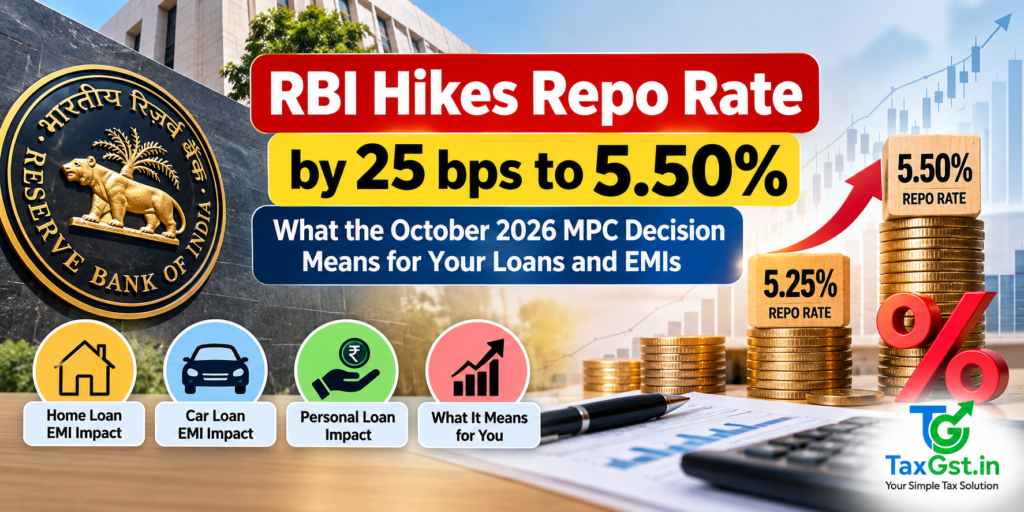
The Reserve Bank of India’s Monetary Policy Committee (MPC) on 7 October 2026 raised the repo rate by 25 basis points to 5.50% — the first rate hike in nearly four years. Announcing the decision at 10 am, RBI Governor Sanjay Malhotra said the six-member committee voted unanimously and also shifted the policy stance from neutral to “calibrated tightening”, a clear signal that rate cuts are off the table and further hikes remain possible.
If you have a home loan, car loan or personal loan on a floating rate, this decision will eventually reach your EMI. Here is a complete breakdown of what RBI announced, why it acted now, and exactly how much more you could end up paying.
Key Highlights of the October 2026 RBI Monetary Policy
- Repo rate: raised from 5.25% to 5.50% (+25 bps), unanimous 6–0 vote
- Policy stance: changed from neutral to calibrated tightening
- MSF rate and Bank Rate: raised to 5.75%
- FY27 real GDP growth forecast: 7.1%
- FY27 CPI inflation forecast: 5.2%
- Market reaction: 10-year G-sec yield rose from 7.21% to 7.24%; banking stocks rebounded after the announcement
Repo Rate Journey: How We Got Here
Today’s hike ends a long phase of stable-to-falling rates. Here is the recent history:
| MPC Meeting | Decision | Repo Rate | Stance |
|---|---|---|---|
| February 2023 | Hike of 25 bps | 6.50% | Withdrawal of accommodation |
| 2023–24 | Held through the year | 6.50% | Withdrawal of accommodation |
| 2025 | Four cuts totalling 125 bps | 5.25% | Neutral |
| February 2026 | No change | 5.25% | Neutral |
| April 2026 | No change | 5.25% | Neutral |
| June 2026 | No change | 5.25% | Neutral |
| August 2026 | No change | 5.25% | Neutral |
| October 2026 | Hike of 25 bps | 5.50% | Calibrated tightening |
Also read: RBI Keeps Repo Rate Unchanged at 5.25% in August 2026 — what the pause meant for borrowers
Why Did RBI Hike the Repo Rate Now?
Three factors forced RBI’s hand:
1. Inflation is climbing again. Headline CPI inflation rose to 4.8% year-on-year in August 2026, up from 4.5% in July — an eight-month high. RBI flagged rising price pressures from food, fuel and fertilisers. Its FY27 inflation forecast of 5.2% sits well above its 4% target.
2. Costly crude and a weak rupee. Elevated crude oil prices and pressure on the rupee from the continuing West Asia conflict are importing inflation into India.
3. Strong growth gives RBI room to act. The economy grew 7.8% in Q1 FY27 (April–June), and RBI now projects 7.1% growth for the full year. With growth resilient, the central bank chose to prioritise price stability over cheaper credit.
How Does a Repo Rate Hike Reach Your EMI?
The repo rate is the rate at which RBI lends to banks. When it rises, banks’ own borrowing costs go up, and they pass it on to you — with a lag.
- EBLR-linked loans (most floating-rate home loans taken after October 2019) reset automatically, usually every 3 months. Your rate = repo rate + bank’s spread.
- MCLR-linked loans (older floating loans) reset on their reset date — typically once a year.
- Fixed-rate loans are not affected at all until you take a fresh loan.
Banks generally take one to two quarters to fully transmit a hike. So expect the impact on your EMI between late 2026 and early 2027.
Impact on Home Loan EMI: Worked Example
Consider a borrower with a ₹50 lakh home loan for 20 years on EBLR, where the bank charges a 3.00% spread over the repo rate:
| Before (repo 5.25%) | After (repo 5.50%) | |
|---|---|---|
| Effective home loan rate | 8.25% | 8.50% |
| Monthly EMI | ~₹42,605 | ~₹43,391 |
| Extra per month | — | ~₹786 |
| Extra interest over 20 years | — | ~₹1.89 lakh |
Your bank may either raise the EMI or extend your tenure and keep the EMI unchanged — check which one applies to you, because a longer tenure quietly adds lakhs in interest. Run your own numbers on our free loan EMI calculator to see the exact impact of a 0.25% or 0.50% rise.
Impact on Car Loan EMI
Car loans in India are mostly fixed-rate, so existing borrowers are safe — but anyone buying a car on finance now will pay more. On an ₹8 lakh car loan for 5 years:
- At 8.50%: EMI ≈ ₹16,417/month
- At 8.75%: EMI ≈ ₹16,510/month
- Difference: ~₹93/month, or about ₹5,600 extra over 5 years
Impact on Personal Loan EMI
Personal loans are unsecured and already carry higher rates (typically 10–14%). A 25 bps hike moves the needle modestly. On a ₹5 lakh personal loan for 3 years:
- At 11.00%: EMI ≈ ₹16,373/month
- At 11.25%: EMI ≈ ₹16,427/month
- Difference: ~₹54/month, or about ₹2,000 extra over 3 years
Impact on Businesses and MSMEs
For businesses, the pain is sharper. MSMEs borrow working capital through cash credit and overdraft facilities at higher spreads. On a ₹25 lakh working capital limit at repo + 4.25% spread:
- At 9.50%: annual interest = ₹2,37,500 (~₹19,792/month)
- At 9.75%: annual interest = ₹2,43,750 (~₹20,313/month)
- Difference: ₹6,250 a year straight out of net profit
Combined with elevated input costs, MSMEs should tighten working-capital cycles and review their debt mix while rates are still near multi-year lows.
The Silver Lining: FD Investors May Gain
It is not all bad news. As banks’ cost of funds rises, they typically raise interest rates on fresh and renewed fixed deposits. If you have an FD maturing in the coming months, wait for revised rate charts before renewing — and senior citizens should compare the extra 0.25–0.50% on offer across banks.
What Experts Are Saying
Market economists read today’s “calibrated tightening” stance as a hawkish signal:
- Emkay Global expects a cumulative 75 bps of hikes in this cycle, preparing markets for a “higher-for-longer” rate environment.
- Kotak Mahindra Bank’s chief economist sees 25–50 bps of additional hikes ahead, with more if global risks persist.
- Karur Vysya Bank’s treasury head sees the terminal repo rate moving towards 6% by March 2027.
The consensus: rate cuts are firmly off the table for the foreseeable future.
What Should Borrowers Do Now?
- Check your loan type. Floating/EBLR-linked loans will reset; fixed-rate loans won’t. Know your next reset date.
- Run the numbers on the EMI calculator for a 0.25–0.50% rise so there are no surprises.
- Consider part-prepayment if you have surplus funds — every prepayment hurts less when rates are rising.
- Don’t extend tenure blindly. Ask your bank whether it is raising EMI or tenure, and compute the total interest difference.
- Compare before a balance transfer. Switching lenders only pays if the effective saving beats the processing charges and the 18% GST on them.
- New borrowers: if a purchase is planned anyway, locking in a loan sooner beats waiting in a rising-rate cycle.
Don’t Forget the Tax Angle on Home Loans
Higher EMIs sting less when you claim every deduction available. On a self-occupied home loan you can claim up to ₹2 lakh per year on interest under Section 24(b) and up to ₹1.5 lakh on principal repayment under Section 80C. Our detailed guide on tax savings on home loans and rental property (Sections 24 & 80C) walks through the full calculation with an example.
What Next? The Road Ahead
The next MPC review is expected in December 2026. Much will depend on how inflation prints over the next two months, the trajectory of crude oil, and the rupee. For now, households and businesses should plan their finances assuming rates stay higher for longer — and borrowers on floating rates should budget for at least one more hike.
FAQs
What is the repo rate after the October 2026 RBI meeting?
The repo rate now stands at 5.50%, raised by 25 basis points from 5.25% on 7 October 2026.
Will my home loan EMI increase after the RBI rate hike?
If your loan is on a floating rate linked to an external benchmark (EBLR), yes — your EMI or tenure will rise at the next reset date, typically within one or two quarters. Fixed-rate loans are unaffected.
Why did RBI increase the repo rate in October 2026?
CPI inflation climbed to 4.8% in August 2026 amid high crude prices, food and fuel pressures, and rupee weakness linked to the West Asia conflict. Strong 7.8% Q1 GDP growth gave RBI the room to prioritise inflation control.
What does “calibrated tightening” mean?
It is RBI’s new stance signalling that policy will lean towards controlling inflation rather than supporting growth — meaning rate cuts are off the table and further hikes are possible if inflation stays elevated.
Will fixed deposit (FD) rates go up now?
Likely, modestly. Banks usually raise FD rates on fresh deposits and renewals when their funding costs rise. Compare rates across banks before renewing a maturing FD.
How much will my EMI rise on a ₹50 lakh home loan?
On a 20-year loan, a 0.25% rate rise (8.25% to 8.50%) adds roughly ₹786 per month — about ₹1.89 lakh in extra interest over the full tenure.
Should I prepay my home loan after the rate hike?
Part-prepayment makes more sense in a rising-rate environment because it cuts the total interest significantly. Just check your lender’s prepayment charges first (nil on floating-rate home loans for individuals, as per RBI norms).
When is the next RBI monetary policy meeting?
The next MPC review is expected in December 2026.
Related Reads
- RBI Keeps Repo Rate Unchanged at 5.25% in August 2026 — how the last policy decision affected borrowers
- Free Loan EMI Calculator — calculate your EMI for home, car, personal and business loans
- Tax Savings on Home Loans: Section 24 & 80C Explained — claim every deduction on your housing loan
Disclaimer: This article is for informational purposes only and is not financial advice. Interest rates, spreads and bank policies change frequently — confirm the latest rates with your lender before making decisions.
Sources: RBI MPC statement dated 7 October 2026, as reported in The Hindu BusinessLine and ET Now live coverage.
Discover more from TaxGst.in
Subscribe to get the latest posts sent to your email.



Never Miss a Tax Deadline Again
Due-date alerts, GST updates and tax tips — free on the app you already use.
event Next: TDS Return (138 / 140) · 31 Oct