
 C.K. Gupta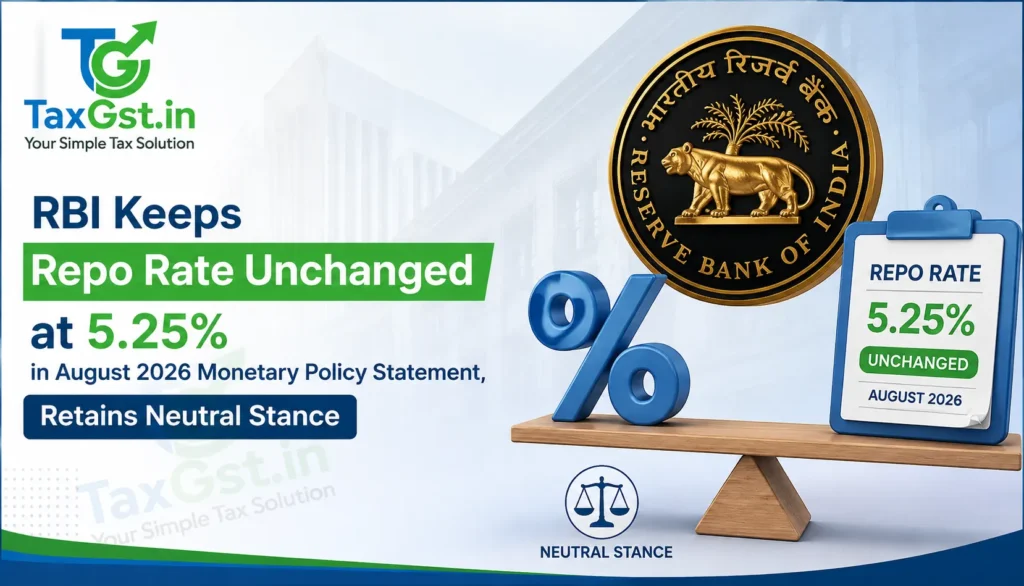
The Reserve Bank of India’s Monetary Policy Committee (MPC) unanimously decided to keep the policy repo rate unchanged at 5.25% on August 5, 2026, retaining a “neutral” stance for the second consecutive review. Despite headline CPI inflation ticking up to 4.4% in June 2026, the MPC views these price pressures as temporary and supply-driven, primarily related to food and fuel. With core inflation steady at 3.9% and real GDP growth projected at 6.7% for FY2026-27, the central bank has opted to monitor incoming data—particularly monsoon distribution and global crude prices—before initiating any rate cuts. For borrowers, this means EMI stability will continue through the upcoming festive season.
Also Read-Form 146 for Foreign Remittances: Who Needs a CA Certificate?
Executive Summary: Key Takeaways from the August 2026 MPC Meet
- Policy Repo Rate: Held steady at 5.25% by a unanimous 6-0 vote.
- Policy Stance: “Neutral” stance retained, keeping the door open for cuts, holds, or hikes based on macroeconomic data.
- GDP Growth Projection: FY2026-27 real GDP growth retained at 6.7% (Q1: 7.0%, Q2: 6.4%, Q3: 6.5%, Q4: 6.8%).
- Inflation Forecast: CPI inflation projected at 5.0% for FY2026-27, with a notable peak expected at 5.9% in Q3 due to base effects and monsoon anomalies.
- Liquidity Operations: RBI continues to absorb surplus liquidity via Variable Rate Reverse Repo (VRRR) auctions.
- Next MPC Meeting: Scheduled for October 5-7, 2026.
Reasons Behind the Status Quo: Analyzing the MPC Decision
The 62nd meeting of the Monetary Policy Committee concluded on August 5, 2026, delivering a policy that was widely anticipated by the markets but contained specific warnings in its underlying commentary. The decision to hold the repo rate at 5.25% marks the second consecutive pause following the aggressive 100 basis points of cumulative rate cuts delivered earlier between February and April 2025.
The unanimous 6-0 vote by the MPC members shows a clear consensus on two critical fronts: the stability of India’s domestic growth engine, and the unpredictable nature of global supply-side inflation.
1. The Inflation Issue: Core vs. Headline Divergence
The MPC’s rationale centers heavily on the divergence between headline inflation and core inflation. Headline Consumer Price Index (CPI) inflation rose to 4.4% in June 2026, crossing the RBI’s official 4% target for the first time in 16 months. However, the committee’s diagnostic revealed that this spike was entirely driven by supply-side shocks — specifically erratic vegetable prices caused by heatwaves and a volatile global crude oil market fueled by the re-escalation of conflict in West Asia.
Conversely, Core Inflation (which strips out volatile food and fuel prices) remained highly stable at 3.9% during May and June. When precious metals (like gold, which saw massive import surges) are excluded, underlying core inflation dropped to a multi-year low of 2.3% to 2.5%. The RBI assessed that hiking interest rates to cure a supply-side vegetable shortage would needlessly choke industrial growth without actually lowering the price of food.
2. Growth Stability as a Policy Cushion
The second pillar supporting the RBI’s “hold” decision is India’s stable GDP growth trend. The economy displayed strong momentum in Q1:2026-27, with the manufacturing Purchasing Managers’ Index (PMI) remaining in expansionary territory and services activity showing steady demand. The RBI projects real GDP growth for FY2026-27 at 6.7%. Because the economy is not showing signs of distress, the RBI is not pressured to provide monetary stimulus (rate cuts) to artificially increase demand.
The Policy Rate Corridor as of August 2026
The RBI manages systemic liquidity and overnight borrowing costs through a defined “corridor” of interest rates. By keeping this corridor unchanged, the central bank ensures that interbank borrowing remains orderly.
| Facility / Rate Type | Current Rate | Function in the Financial System |
|---|---|---|
| Policy Repo Rate | 5.25% | The principal rate at which the RBI lends short-term funds to commercial banks. Acts as the anchor for all floating-rate retail loans. |
| Standing Deposit Facility (SDF) | 5.00% | Acts as the floor of the corridor. The rate at which RBI absorbs surplus liquidity from banks without providing government securities as collateral. |
| Marginal Standing Facility (MSF) | 5.50% | Acts as the ceiling of the corridor. The penal rate at which banks can borrow emergency funds from the RBI when interbank liquidity dries up. |
| Bank Rate | 5.50% | Aligned with the MSF. Used primarily as a penal rate for banks failing to maintain Cash Reserve Ratio (CRR) requirements. |
| Fixed Reverse Repo Rate | 3.35% | Legacy rate kept outside the active corridor; rarely used as the SDF has taken over its primary function. |
What Does the “Neutral” Stance Mean for Borrowers and Investors?
In central banking terminology, the “stance” is just as important as the rate itself, as it provides forward guidance to the markets. By retaining a Neutral Stance, RBI Governor Shaktikanta Das signaled that the central bank is not committed to any predetermined path.
An accommodative stance would have signaled that rate cuts were expected. A withdrawal of accommodation would have signaled impending rate hikes. Neutrality means the RBI has the flexibility to cut, hold, or hike based purely on the data that comes in between now and October. For the markets, this implies that interest rates have peaked, but the descent will be slow, data-dependent, and cautious.
Sector-Specific Impact Analysis
The RBI’s decision to hold rates at 5.25% ripples through the economy differently depending on the sector. Here is a granular look at the market impact.
1. Real Estate and Housing Finance (Positive)
The real estate sector benefits from this decision. With the repo rate held at 5.25%, home loan interest rates (which are legally mandated to be linked to external benchmarks like the repo rate) will remain stable, generally hovering between 8.00% and 8.50%. This stability in Equated Monthly Installments (EMIs) is critical as India approaches the festive season (Q3), which traditionally accounts for over 40% of annual residential sales. Affordable housing developers, in particular, will benefit from sustained buyer sentiment.
2. Banks and NBFCs (Neutral to Positive)
For commercial banks, the status quo protects their Net Interest Margins (NIMs). In a rate-cut cycle, floating-rate loan yields drop immediately, while fixed-deposit costs take time to re-price, squeezing margins. By holding rates, banks can maintain their current profitability. However, Non-Banking Financial Companies (NBFCs) and microfinance institutions face a slight challenge: their cost of borrowing from the bond market remains relatively high, while competitive pressures prevent them from passing these costs onto consumers entirely.
3. Manufacturing and CapEx (Negative to Neutral)
Capital-intensive manufacturing sectors (steel, cement, infrastructure) typically desire lower interest rates to fund capacity expansion. While 5.25% is not exceptionally high, the real interest rate (nominal rate minus inflation) sits at roughly 0.25%. Manufacturers facing elevated global raw material and crude oil costs will experience margin compression until rates are definitively cut later in the fiscal year.
4. Export and IT Services (Neutral)
The export sector’s fortunes are currently tied less to domestic interest rates and more to global trade dynamics. The RBI’s neutral stance supports a stable Indian Rupee (INR). However, the MPC explicitly warned about the US invoking Section 301 tariffs on Indian goods. Stable domestic rates combined with strict US trade policies could create headwinds for merchandise exporters, though IT services remain largely insulated.
Worked Example 1: Impact on a Retail Home Loan EMI
To understand the real-world impact of the RBI’s decision, let us calculate the EMI on a standard home loan. Consider a borrower who has taken a ₹50 Lakh home loan for 20 years.
Under the External Benchmark Lending Rate (EBLR) regime, banks add a “spread” to the repo rate. If a bank’s spread is 3.00%, the effective home loan rate is 8.25% (5.25% Repo + 3.00% Spread).
- Principal: ₹50,00,000
- Interest Rate: 8.25% p.a.
- Tenure: 240 months
- Current EMI: ₹42,605 per month
Because the RBI held rates, this ₹42,605 EMI remains exactly the same. However, if the RBI had cut the repo rate by 25 basis points (to 5.00%), the new interest rate would have dropped to 8.00%. The EMI would have reduced to ₹41,822, saving the borrower roughly ₹783 per month (or ₹1.87 Lakh over the life of the loan). Borrowers must wait until at least Q3 or Q4 of FY27 to see these savings materialize.
Worked Example 2: Working Capital Cost for an MSME Borrower
Micro, Small, and Medium Enterprises (MSMEs) operate on much thinner margins and rely heavily on Cash Credit (CC) and Overdraft (OD) facilities to manage working capital.
Consider an MSME drawing a working capital facility of ₹25,00,000. Due to higher risk profiling, the bank charges a spread of 4.25% over the repo rate, bringing the effective interest rate to 9.50% per annum.
- Annual interest cost: ₹25,00,000 × 9.50% = ₹2,37,500
- Monthly interest outgo: ₹2,37,500 ÷ 12 = ₹19,792
At the unchanged repo rate, this annual interest burden remains stable. However, if headline inflation persists above 5.0% into Q3:2026-27 (peaking at 5.9% as projected) and the MPC is forced to respond with a 25 basis point hike to anchor expectations, the borrowing cost would rise to 9.75%. The new annual interest would be ₹2,43,750 — an additional ₹6,250 straight out of the proprietor’s net profit. The RBI’s decision to hold is therefore a major relief for the MSME segment.
MCLR vs. EBLR: How Different Loans React to the RBI Hold
Not all loans react to the RBI’s policy announcements in the same way. It is vital to know which regime your loan falls under:
- External Benchmark Lending Rate (EBLR): Mandated by the RBI since October 2019 for all retail and MSME loans, these rates are directly linked to an external benchmark (usually the Repo Rate). When the RBI holds the repo rate, EBLR loans see absolutely no change in their interest rate, providing immediate stability.
- Marginal Cost of Funds based Lending Rate (MCLR): Older loans (pre-2019) and large corporate loans are still linked to MCLR. MCLR is determined by the bank’s internal cost of acquiring deposits. Even though the RBI held the repo rate, a bank might still increase its MCLR if it is forced to offer higher interest rates on Fixed Deposits to attract retail money. Corporate borrowers on MCLR must remain vigilant.
Global Headwinds: US Tariffs, Oil, and FCNR(B) Inflows
The MPC does not operate in a vacuum. A significant portion of the August 2026 policy statement addressed global macroeconomic risks.
The US Section 301 Tariff Threat: The United States recently imposed a 10% tariff on top of Most Favored Nation (MFN) tariffs on Indian exports, citing allegations of forced labour, and initiated a Section 301 investigation into India’s trade practices. For domestic loan markets, this creates a dual threat: reduced export demand dampens manufacturing sector growth, while trade uncertainty puts depreciative pressure on the Indian Rupee, which imports inflation (as India pays more for crude oil).
The FCNR(B) Buffer: Fortunately, the RBI has built a strong defense to protect the Rupee. The central bank successfully mobilized $52.3 billion under the Foreign Currency Non-Resident (Bank) swap facility by August 13, 2026. This influx of foreign capital ensures that the RBI has the foreign exchange reserves to intervene in currency markets and keep the Rupee stable, even if global oil prices spike above $90 per barrel.
What Should Depositors and Fixed Income Investors Do?
The RBI’s neutral stance provides a closing window of opportunity for depositors. With CPI inflation projected to peak at 5.9% in Q3:2026-27, retail investors must secure returns that beat inflation to avoid wealth erosion.
- Lock in Fixed Deposits (FDs) Now: Since the RBI has signaled that rates have peaked, banks will not increase FD rates any further. In fact, many banks will start subtly reducing rates on 2-year to 5-year tenures in anticipation of rate cuts next year. Investors should secure current high yields (7.00% to 7.50%) on long-term FDs before the cycle turns.
- Debt Mutual Funds: Investors utilizing long-duration debt mutual funds stand to benefit the most. As interest rates eventually fall in Q4 2026 or Q1 2027, the prices of existing high-yield bonds in these mutual fund portfolios will rise (due to the inverse relationship between bond yields and prices), generating significant capital appreciation.
- Senior Citizens: Maximize allocations to the Senior Citizen Savings Scheme (SCSS) while rates remain highly attractive, as these government-backed schemes will likely see downward revisions once the RBI officially pivots to a rate-cut cycle.
When Can Borrowers Realistically Expect the Next Rate Cut?
The primary question for corporate treasurers and retail borrowers alike is: When will EMIs finally go down?
The MPC’s forward guidance points to the next meeting on October 5-7, 2026 as the earliest mathematical opportunity for policy action. However, a rate cut in October is highly unlikely. The committee explicitly stated it needs greater clarity to emerge regarding inflation before acting.
With the RBI itself projecting CPI inflation to peak at 5.9% in Q3:2026-27 (October to December), the central bank cannot cut rates while inflation is rising toward the upper tolerance limit of 6%. Therefore, the window for an actual rate cut realistically opens only in Q4 (February 2027), assuming winter crop arrivals cool down food inflation and global oil markets remain stable.
Frequently Asked Questions (FAQs)
Will banks reduce lending rates even if the RBI holds the repo rate at 5.25%?
Banks generally will not reduce repo-linked loan rates unless the RBI cuts the repo rate. However, because systemic liquidity is currently in a massive surplus, banks may selectively reduce the “credit risk spread” they charge above the repo rate to attract high-quality retail borrowers (e.g., home loan customers with high CIBIL scores).
What is the “real interest rate” at current levels and why does it matter?
The real policy rate is the nominal repo rate (5.25%) minus the projected inflation (5.0%). This leaves a real interest rate of just 0.25%. This is historically very low, which means monetary policy is still supportive of economic growth and corporate borrowing, despite no rate cuts occurring.
How does the neutral stance differ from an accommodative stance for corporate borrowing?
An accommodative stance signals a bias toward imminent rate cuts, prompting treasurers to delay long-term borrowing. A neutral stance removes that directional bias — the RBI could cut, hold, or hike depending on data. Corporate treasury teams should therefore lock in current rates through fixed-rate instruments or interest rate swaps rather than waiting for near-term cuts.
What impact will the US Section 301 investigation have on India’s monetary policy?
The US Section 301 investigation into India’s trade practices has resulted in retaliatory tariffs. While the RBI cannot fix trade policies using interest rates, it will closely monitor the spillover effects. If tariffs severely damage Indian manufacturing growth, the MPC may consider growth-stimulating rate cuts at future reviews, provided inflation stays under control.
What does the 5.9% Q3 inflation projection mean for fixed deposit investors?
With CPI inflation projected to peak at 5.9% in Q3:2026-27, fixed deposit rates offering returns below 6.0% will deliver negative real returns (loss of purchasing power). Investors must secure high-yield FDs (7.0%+) immediately before banks begin tapering rates in anticipation of the 2027 rate-cut cycle.
When is the next MPC meeting and what data will influence it?
The next MPC meeting is scheduled for October 5 to 7, 2026. The committee will review July and August 2026 CPI inflation data, Q1 GDP actuals, the spatial distribution of the retreating monsoon, and the trajectory of global crude oil prices.
Sources & References
- RBI Monetary Policy Statement, August 5, 2026 — Official Press Release
- RBI Annual Policy and MPC Documentation Portal
- RBI Consumer Education: Understanding EBLR and MCLR
Article Information
Published: August 21, 2026
Last Reviewed: August 21, 2026
Category: Banking & Economy
Regulatory Body: Reserve Bank of India (RBI)
Written by C.K. Gupta, M.Com & Tax Editor at TaxGST.in — translating macroeconomic policy changes into actionable compliance and borrowing strategies for Indian businesses since 2009.
Official Resources
Disclaimer: This article provides an analysis of the August 2026 RBI Monetary Policy Statement. Forward-looking statements regarding lending rates, FCNR(B) impacts, and inflation projections are subject to global macroeconomic shifts. Corporate treasuries and retail borrowers should conduct their own financial assessments before entering into interest rate swaps or long-term loan commitments.
Discover more from TaxGst.in
Subscribe to get the latest posts sent to your email.



Never Miss a Tax Deadline Again
Due-date alerts, GST updates and tax tips — free on the app you already use.
event Next: TDS Return (138 / 140) · 31 Oct