 C.K. Gupta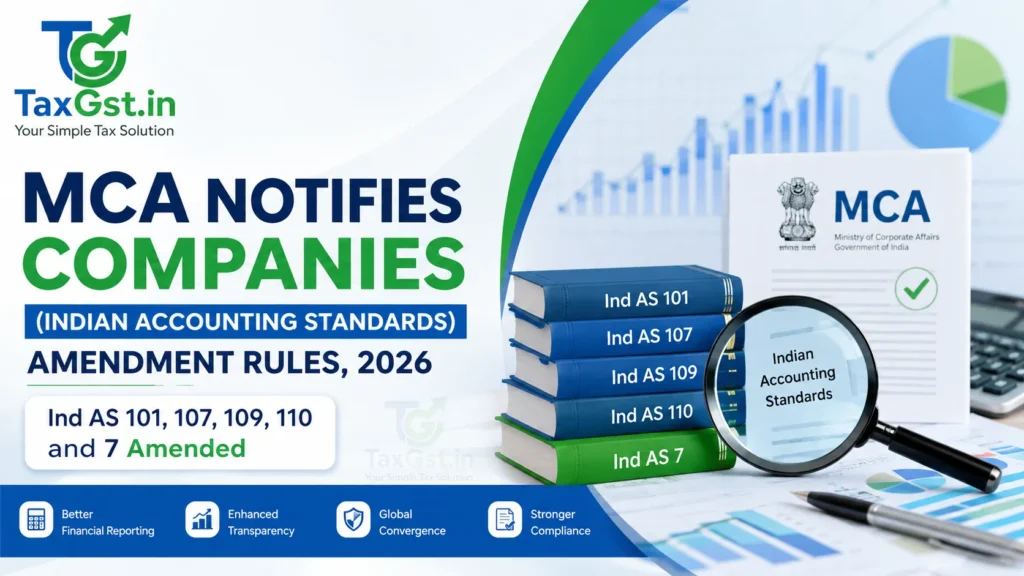
The Ministry of Corporate Affairs (MCA) notified the Companies (Indian Accounting Standards) Amendment Rules, 2026 on 12 August 2026 through G.S.R. 725(E), amending Ind AS 101, 107, 109, 110, and 7. The changes introduce a new accounting framework for green-power contracts (renewable energy PPAs), refine the SPPI assessment for ESG-linked loans, clarify lease liability derecognition, and provide practical relief for electronic payment settlements. Most provisions apply to annual reporting periods beginning on or after 1 April 2026, making FY 2026-27 the first year of implementation.
Quick Summary: Ind AS Amendment Rules, 2026
- Notification: G.S.R. 725(E) dated 12 August 2026, issued under Section 133 of the Companies Act, 2013.
- Standards Amended: Ind AS 101, 107, 109, 110 and 7.
- Key Focus Areas: Renewable energy contract accounting, ESG-linked loan classification, and lease liability derecognition.
- Effective Date: Annual reporting periods beginning on or after 1 April 2026 (FY 2026-27).
- Applicability: Applies to all Ind AS-applicable companies, particularly those with solar/wind PPAs or sustainability-linked borrowings.
What Exactly Did MCA Change in the Ind AS Amendment Rules, 2026?
The Companies (Indian Accounting Standards) Amendment Rules, 2026 represent one of the more technically dense updates MCA has issued in recent years. Rather than tweaking a single standard, the notification rewrites portions of five interconnected standards to align Indian accounting with recent IFRS amendments while addressing domestic implementation gaps.
The heaviest revisions sit inside Ind AS 109 (Financial Instruments). MCA has built an entirely new sub-framework for “contracts referencing nature-dependent electricity” — the formal term for renewable energy Power Purchase Agreements (PPAs) where generation volume depends on weather conditions.
New paragraphs 2.3A–2.3B define the scope, while Appendix B paragraphs B2.7–B2.8 provide the operative test for when these contracts fall outside normal “own-use” treatment. Paragraphs 6.10.1–6.10.2 extend hedge accounting to allow designation of variable nominal amounts of forecast electricity purchases as hedged items, with such forecast transactions presumed “highly probable” for hedge-accounting purposes.
Alongside the green-power framework, Ind AS 109 now contains refined SPPI (Solely Payments of Principal and Interest) guidance. New paragraph B4.1.8A directs entities assessing whether loan cash flows are consistent with a basic lending arrangement to examine what the lender is being compensated for, not merely the quantum. Paragraph B4.1.10A addresses contingent, ESG-linked interest-rate step-ups — a direct response to the growing market in sustainability-linked lending where coupon rates adjust based on ESG target achievement.
A practical fix closes a long-standing ambiguity: lease liabilities recognised by a lessee are now explicitly stated to be subject to the derecognition requirements in Ind AS 109 paragraphs 3.3.1 and 3.3.3. This clarifies that the same derecognition principles applying to other financial liabilities also govern lease liability extinguishment.
Why Should Ind AS-Applicable Companies Care About These Amendments Right Now?
The short answer: FY 2026-27 financial statements must reflect these changes, and the notification is already in force. Even though the rules were published on 12 August 2026, the effective date is annual reporting periods beginning on or after 1 April 2026. That means companies closing their books for FY 2026-27 — starting with the June 2026 quarter — need to apply the amended standards immediately.
For companies with solar or wind power purchase agreements, the impact is direct. Under the new Ind AS 109 framework, contracts referencing nature-dependent electricity are evaluated under the expected-purchase-or-usage lens using the restated paragraph 2.6 and new paragraph 2.8 mechanics.
If a PPA’s volume variability meets the thresholds in paragraphs B2.7–B2.8, the contract may require fair-value-through-profit-or-loss (FVTPL) treatment rather than the “own-use” exemption. This changes both the balance sheet presentation and introduces significant volatility into reported earnings.
Banks and NBFCs with sustainability-linked loan books face a major classification question. The new paragraph B4.1.10A guidance determines whether an ESG-linked interest-rate step-up still permits amortised cost measurement. If the contingency is deemed inconsistent with a basic lending arrangement, the entire instrument may need fair-value accounting.
First-time Ind AS adopters — companies transitioning from AS or IFRS — must apply the amended Ind AS 101 transition paragraphs. The substituted B5 clarifies that a first-time adopter generally cannot reflect a hedging relationship in its opening Ind AS balance sheet unless that relationship qualifies for hedge accounting under Ind AS 109. Paragraph B6 requires the discontinuation of hedge accounting for any pre-transition hedge that fails the qualifying criteria. These are not optional elections — they are mandatory application requirements.
How Should Companies Prepare for the FY 2026-27 Implementation?
Preparation begins with identifying which of the five amended standards affects your financial statements. The table below maps each standard to its core change and the type of company most impacted.
| Ind AS Standard | Key Amendment | Primary Impact | Action Required |
|---|---|---|---|
| Ind AS 109 | New framework for contracts referencing nature-dependent electricity | Companies with solar/wind PPAs | Assess whether PPAs qualify for own-use exemption or require fair-value treatment |
| Ind AS 109 | Refined SPPI guidance for ESG-linked loans | Banks, NBFCs, corporate borrowers | Determine if ESG step-ups permit amortised cost measurement |
| Ind AS 109 | Lease liability derecognition clarified | All lessees with lease liabilities | Align lease extinguishment policy with updated derecognition principles |
| Ind AS 101 | Hedge accounting transition rules for first-time adopters | Companies transitioning to Ind AS | Review pre-transition hedges for qualifying criteria compliance |
| Ind AS 107 | New disclosure requirements for green-power contracts and SPPI assessments | All Ind AS-applicable entities | Update disclosure templates to capture new qualitative and quantitative data |
Consider a practical scenario: a manufacturing company enters into a 15-year solar PPA for ₹50 lakh per annum. Under the amended Ind AS 109 paragraphs 2.3A–2.3B, the company must first assess whether the contract exposes it to variability in electricity volume due to weather-dependent generation. If the PPA meets the scope criteria, the company then applies the own-use test.
If the company’s expected purchase quantity covers 80% of the variable output — this likely qualifies for own-use treatment. However, if the company has a history of selling excess generation back to the grid rather than consuming it, the contract may fail the own-use test. In that case, the PPA must be measured at fair value through profit or loss under Ind AS 109. The company would need to recognise a derivative asset or liability on its balance sheet, with changes flowing through the P&L each quarter.
How Does the SPPI Assessment for ESG-Linked Loans Work in Practice?
The new paragraph B4.1.10A in Ind AS 109 addresses a specific and growing problem: sustainability-linked loans where the interest rate steps up if the borrower misses ESG targets. The question is whether this contingency is consistent with a basic lending arrangement — meaning the lender is compensated for credit risk and time value of money — or whether it functions as an embedded derivative requiring separation and fair-value measurement.
The most common pitfall is treating all ESG-linked step-ups as automatically failing the SPPI test. The amendment does not say that. Instead, paragraph B4.1.10A directs the entity to examine what the lender is being compensated for.
Consider a worked example: An NBFC lends ₹10 crore to a textile manufacturer at 8% interest, with a 50 basis point step-up if the borrower fails to reduce water consumption by 20% within three years. Under the amended Ind AS 109, the NBFC must assess whether the 50 bps compensates for credit risk or for something else.
If the NBFC can demonstrate that water-consumption failure correlates with regulatory shutdown risk and therefore a higher default probability, the SPPI test is likely met. If the step-up is purely a pricing penalty with no credit-risk linkage, the embedded derivative must be separated and measured at fair value through profit or loss.
What Documentation Supports the Green-Power Contract Assessment?
The new paragraphs 2.3A–2.3B and B2.7–B2.8 in Ind AS 109 require a structured assessment of whether a renewable energy contract falls outside own-use treatment. Companies must maintain contemporaneous documentation of this assessment, because statutory auditors will test the judgment at each reporting date.
The core evidence set includes the executed power purchase agreement with volume-flexibility clauses, historical generation data from the solar or wind facility (typically three to five years of actual output records), and the entity’s internal consumption forecasts demonstrating expected purchase or usage quantities.
Companies that fail to maintain this documentation risk two adverse outcomes. First, the contract may be incorrectly classified as own-use when it should be measured at fair value, leading to restatement. Second, hedge accounting for forecast electricity purchases may be disallowed, introducing massive volatility into reported earnings without the offsetting benefit of hedge accounting mechanics.
What Should You Do Next?
With FY 2026-27 already underway and the amendments effective from 1 April 2026, companies need to move from awareness to execution immediately. Here is your action checklist:
- Map your contract portfolio: Identify every power purchase agreement, especially solar and wind contracts, that exposes your company to volume variability from weather-dependent generation.
- Run the own-use test: Apply the expected-purchase-or-usage assessment under restated paragraph 2.6 and new paragraph 2.8. Document whether your historical consumption patterns support the own-use exemption.
- Assess ESG-linked loan terms: For every sustainability-linked borrowing with interest-rate step-ups, determine whether the contingency compensates the lender for genuine ESG performance risk (SPPI compliant) or functions as an embedded derivative requiring separation.
- Update lease liability policies: Align your lease extinguishment accounting with the clarified derecognition requirements in Ind AS 109 paragraphs 3.3.1 and 3.3.3.
- Engage your auditor early: Discuss the amendments with your statutory auditor before the first quarter close to avoid last-minute adjustments regarding own-use test mechanics.
Frequently Asked Questions
What is the effective date of the Companies (Ind AS) Amendment Rules, 2026?
The rules apply to annual reporting periods beginning on or after 1 April 2026. Since the notification was published on 12 August 2026 through G.S.R. 725(E), companies with a 31 March year-end must apply the amended standards for FY 2026-27. This means the June 2026 quarter is the first reporting period where the changes take effect.
Do the 2026 Ind AS amendments apply to FY 2025-26 financial statements?
No. The Companies (Indian Accounting Standards) Amendment Rules, 2026 apply to annual reporting periods beginning on or after 1 April 2026. FY 2025-26 (1 April 2025 to 31 March 2026) falls before this cutoff, so financial statements for that year continue under the previous Ind AS framework.
What is the ‘own-use’ test for renewable energy PPAs under the new Ind AS 109 framework?
Under the amended Ind AS 109 paragraphs 2.3A–2.3B, a contract referencing nature-dependent electricity (such as a solar or wind PPA) is evaluated to determine whether it was entered into for the entity’s expected purchase or usage requirements. If the contract meets the own-use criteria, it is exempt from fair-value-through-profit-or-loss treatment.
How should companies assess ESG-linked interest rate step-ups under the new SPPI guidance?
New paragraph B4.1.10A of Ind AS 109 requires entities to examine whether an ESG-linked interest-rate step-up compensates the lender for a genuine sustainability performance risk or functions as an embedded derivative. If the step-up is consistent with a basic lending arrangement, the instrument may still qualify for amortised cost measurement.
Are first-time Ind AS adopters affected by the 2026 amendments?
Yes. The amended Ind AS 101 paragraphs B5 and B6 impose mandatory requirements on first-time adopters. Paragraph B5 clarifies that a first-time adopter cannot reflect a hedging relationship in its opening Ind AS balance sheet unless that relationship qualifies for hedge accounting under Ind AS 109.
Sources
Article Information
Published: August 21, 2026
Last Reviewed: August 21, 2026
Category: MCA Updates
Regulatory Body: Ministry of Corporate Affairs (MCA)
Written by C.K. Gupta, M.Com & Tax Editor at TaxGST.in — advising companies on MCA compliance, Ind AS implementation, and corporate law since 2009.
Official Resources
Disclaimer: This article is for informational purposes only. The application of Ind AS 109 to complex financial instruments and power purchase agreements requires significant professional judgment. Always consult with your statutory auditor before finalizing the accounting treatment for ESG-linked loans or renewable energy contracts.
Discover more from TaxGst.in
Subscribe to get the latest posts sent to your email.


Never Miss a Tax Deadline Again
Due-date alerts, GST updates and tax tips — free on the app you already use.
event Next: TDS Return (138 / 140) · 31 Oct