
 C.K. Gupta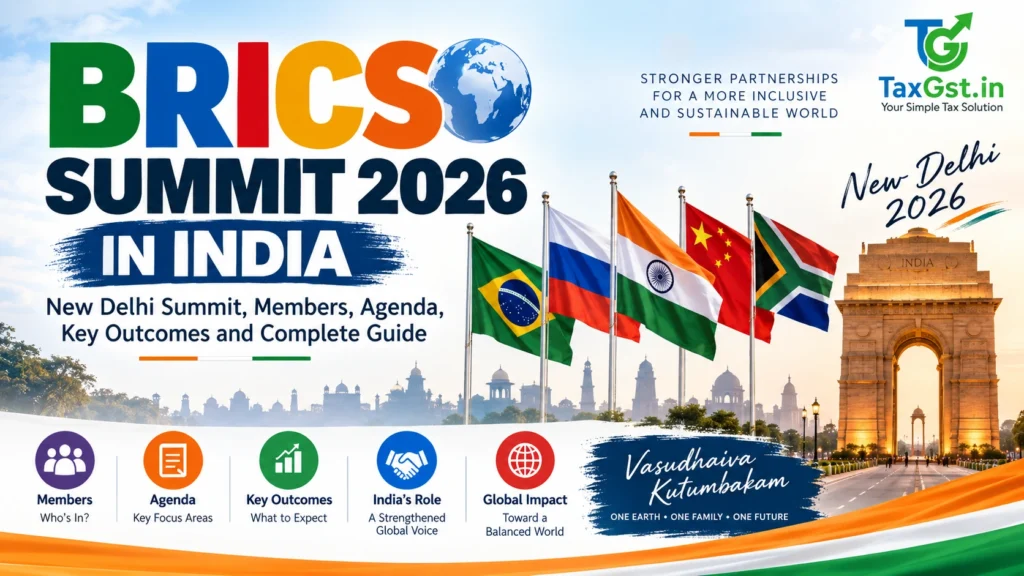
BRICS Summit 2026 in India: Quick Summary
- Summit: 18th BRICS Summit
- Host country: India
- Venue: New Delhi
- Dates: 12–13 September 2026
- India’s BRICS Chairship: 2026
- Theme: “Building for Resilience, Innovation, Cooperation and Sustainability”
- Chairship approach: India described its approach as people-centric and “Humanity First”.
- Major outcome: New Delhi BRICS Leaders’ Declaration
- 2026 membership: BRICS comprises 11 member countries according to Indian government material.
- Next chair: China is to hold the BRICS Chairship in 2027.
Also Read-UPI Charges Up to ₹2,000: New Government Rules Effective September 2026
What Is BRICS and Why Is the 2026 Summit Important?
BRICS is a cooperation platform bringing together major emerging and developing economies. It provides a forum for dialogue and practical cooperation on economic, financial, political, development, cultural and people-to-people issues. The grouping has expanded considerably from its original five-country format, making the 2026 Indian Chairship and New Delhi Summit an important stage in the development of the expanded BRICS framework.
India assumed the BRICS Chairship on 1 January 2026, its fourth time leading the grouping after earlier chairships in 2012, 2016 and 2021. The year 2026 also marked two decades since the establishment of BRICS cooperation. The Indian government said its chairship was designed around resilience, innovation, cooperation and sustainability, with a focus on practical and development-oriented cooperation.
The summit itself took place in New Delhi on 12–13 September 2026. The leaders adopted the New Delhi Declaration, which set out areas of cooperation and shared positions on a broad range of international, economic, development and institutional issues. The declaration also recorded appreciation for the extensive programme conducted under India’s chairship across different cities in India.
What Was the Theme of India’s BRICS Presidency 2026?
India’s BRICS 2026 theme was “Building for Resilience, Innovation, Cooperation and Sustainability.” The four words were used as the central framework for India’s programme during the year.
| Pillar | Broad Focus |
|---|---|
| Resilience | Strengthening economic, social and institutional capacity to respond to global uncertainties, supply-chain disruptions, climate risks and other common challenges. |
| Innovation | Promoting emerging technologies, digital public infrastructure, fintech, artificial intelligence, knowledge sharing and innovation-led growth. |
| Cooperation | Deepening coordination on trade, development finance, policy, institutional reform and people-centred partnerships. |
| Sustainability | Advancing climate action, green finance, energy transition and sustainable development. |
When and Where Was the 18th BRICS Summit Held?
The 18th BRICS Summit was held in New Delhi, India, on 12 and 13 September 2026. It was the principal leaders-level event of India’s 2026 BRICS Chairship. The summit brought together BRICS member-country leaders and representatives in the expanded BRICS framework, alongside partner-country and outreach engagements.
The New Delhi meeting followed a year-long programme of ministerial meetings, official-level discussions, business engagements, youth programmes, academic forums and other activities held in cities across India. The final declaration noted that more than 400 meetings and engagements had taken place in 30 cities under India’s chairship.
Which Countries Are Members of BRICS in 2026?
Indian government information for the 2026 chairship lists 11 BRICS member countries: Brazil, China, Egypt, Ethiopia, India, Indonesia, Iran, Russia, Saudi Arabia, South Africa and the United Arab Emirates.
| No. | BRICS Member |
|---|---|
| 1 | Brazil |
| 2 | China |
| 3 | Egypt |
| 4 | Ethiopia |
| 5 | India |
| 6 | Indonesia |
| 7 | Iran |
| 8 | Russia |
| 9 | Saudi Arabia |
| 10 | South Africa |
| 11 | United Arab Emirates |
Note: BRICS membership and participation categories can be discussed differently in media and secondary sources, particularly in relation to countries that have been invited, joined, or participate through partner arrangements. For the 2026 India Chairship article, the member list above follows current Indian government material.
What Were the Major Agenda Areas at the BRICS Summit 2026?
The New Delhi Summit covered a broad agenda rather than a single economic or geopolitical issue. The New Delhi Declaration grouped BRICS cooperation around political and security cooperation, economic and financial cooperation, and cultural and people-to-people cooperation.
- Global governance and multilateralism: discussion of reform and greater representation for emerging markets and developing countries in international institutions.
- Economic and financial cooperation: strengthening practical economic cooperation, trade and financial coordination among members.
- Innovation and technology: cooperation in digital technologies, artificial intelligence and innovation.
- Sustainable development: climate action, green finance, energy transition and sustainable development.
- Health: cooperation on common health challenges and public-health capacity.
- Food and energy security: strengthening resilience and cooperation in sectors important to economic stability.
- People-to-people cooperation: youth, education, culture, academic and civil-society engagement.
- Business cooperation: continued engagement among businesses, entrepreneurs and BRICS business institutions.
What Is the New Delhi BRICS Leaders’ Declaration?
The New Delhi BRICS Leaders’ Declaration is the principal leaders-level outcome of the 18th BRICS Summit. The declaration reaffirmed the BRICS principles of mutual respect, sovereign equality, solidarity, inclusiveness, cooperation and consensus.
The document states that expanded BRICS cooperation should operate across three broad pillars: political and security cooperation; economic and financial cooperation; and cultural and people-to-people cooperation. It also places emphasis on sustainable development, inclusive growth, innovation and resilience.
The declaration also welcomed partner-country participation and described cooperation with emerging markets and developing countries as an important part of the BRICS partnership. It recorded progress under India’s chairship and expressed support for China taking over the BRICS Chairship in 2027.
Key Things Done at the BRICS Summit 2026
- New Delhi Declaration 2026 adopted: BRICS leaders adopted the New Delhi Declaration, setting out the group’s positions and cooperation priorities for the coming period.
- Strengthened economic cooperation: Members reaffirmed efforts to deepen trade, investment, economic cooperation and the implementation of the BRICS Economic Partnership 2030.
- Cross-border payments discussed: BRICS continued work on making cross-border payments more efficient, including interoperability of payment and messaging systems and greater use of local currencies for trade settlements. This does not mean BRICS launched a common currency.
- Supply-chain cooperation: Leaders supported more resilient and reliable supply chains and greater participation of developing countries in higher-value manufacturing and production.
- Technology and AI cooperation: The declaration strengthened cooperation in science, technology and innovation, including emerging technologies, research collaboration, digital security and responsible use of technology.
- Global governance reform: BRICS reiterated its call for greater representation of emerging markets and developing countries in institutions such as the UN and international financial institutions.
- IMF reform discussed: Members called for reforms to IMF quotas and governance so that representation better reflects the changing global economy.
- Tax cooperation expanded: BRICS welcomed initiatives involving tax authorities, including cooperation on international taxation, transfer pricing, revenue statistics and capacity building for tax professionals.
- Customs cooperation strengthened: Members advanced cooperation on customs matters, including information exchange, Authorized Economic Operators, capacity building and efforts toward joint customs enforcement operations.
- Sustainable development and climate resilience: The summit emphasized sustainable development, resilience, preparedness, early-warning systems and risk-informed planning.
- Urban development cooperation: BRICS welcomed the BRICS Urban Research and Knowledge Network and cooperation on housing, sanitation, mobility, waste management and sustainable cities.
- Youth cooperation: Progress was welcomed on the BRICS Youth Cooperation Framework, aimed at increasing cooperation on common youth priorities.
- Women’s economic participation: BRICS supported initiatives to improve women’s access to finance, markets, technology, skills and digital opportunities.
- Justice and dispute resolution: Members supported greater cooperation between justice institutions and encouraged the use of mediation and arbitration for cross-border commercial disputes.
- BRICS institutional development: The summit welcomed progress toward an online BRICS archival database and continued efforts to strengthen the group’s institutional structure.
- India completed its 2026 Chairship: India conducted more than 400 BRICS-related meetings and engagements across 30 cities during its chairship.
- China to chair BRICS in 2027: BRICS leaders expressed support for China’s 2027 Chairship and the 19th BRICS Summit in China.
What Did India Focus on During Its BRICS Chairship?
India’s programme was not limited to the leaders’ summit. Throughout 2026, India organised meetings across several tracks involving ministers, officials, parliamentarians, businesses, academics, youth representatives and civil-society participants.
Government information states that more than 400 meetings and engagements were conducted in 30 cities. These included meetings connected with energy, youth, finance, business, education, innovation, health, culture and other areas of cooperation.
For example, India hosted the 11th BRICS Energy Ministers’ Meeting in Gurugram in June 2026 under the theme “Energy for All; Powering a Secure, Sustainable and Shared Future.” India also hosted BRICS youth-related meetings in Gandhinagar and Visakhapatnam in August 2026.
What Were the Key Economic and Financial Themes?
Economic and financial cooperation remained one of the central BRICS tracks. The summit declaration continued to emphasise practical cooperation among members and greater participation of emerging markets and developing economies in global economic governance.
The discussions also took place against the background of BRICS expansion and efforts to deepen trade and financial cooperation. Issues involving local-currency settlement, payment connectivity, development finance and the role of institutions such as the New Development Bank have been part of the broader BRICS economic agenda.
These developments should not be interpreted as establishing a single BRICS currency or an immediately operational replacement for existing international payment systems. Proposals and cooperation mechanisms need to be distinguished from arrangements that have actually been implemented.
Did the 2026 BRICS Summit Discuss Artificial Intelligence and Technology?
Yes. Technology and innovation formed part of India’s BRICS 2026 priorities. The broader chairship framework identified emerging technologies, digital public infrastructure, fintech, artificial intelligence and knowledge sharing as areas for cooperation.
The summit also saw proposals and discussions relating to AI cooperation. Such initiatives are part of the broader BRICS effort to increase technological cooperation and knowledge exchange among member countries. Specific programmes should be distinguished from general political commitments or proposals announced during summit discussions.
What Was the Significance of the BRICS Expansion?
The expanded membership has changed the geographic and economic composition of BRICS. Countries from Asia, Africa, the Middle East and Latin America now participate in the grouping, giving the platform a broader representation of emerging and developing economies.
Expansion also makes coordination more complex because members have different economic structures, foreign-policy priorities and regional interests. The New Delhi Declaration therefore places considerable emphasis on consultation, consensus, inclusiveness and practical cooperation.
What Does the BRICS Summit Mean for India?
For India, hosting the summit provided a platform to convene leaders and senior representatives from the expanded BRICS membership and to conduct a year-long programme across multiple Indian cities. India’s stated chairship priorities also connected BRICS cooperation with development, innovation, sustainability and the interests of the Global South.
The New Delhi Declaration records the other BRICS members’ appreciation for India’s chairship and confirms support for China as the 2027 chair. The summit therefore also served as a transition point between India’s 2026 programme and China’s forthcoming chairship.
BRICS Summit 2026: Important Dates and Events
| Date / Period | Event / Development |
|---|---|
| 1 January 2026 | India assumed the BRICS Chairship for 2026. |
| 29 April–31 July 2026 | BRICS-related youth volunteering initiative under MY Bharat. |
| 25–26 June 2026 | 11th BRICS Energy Ministers’ Meeting in Gurugram. |
| 19–20 August 2026 | BRICS Youth Council Meeting and Youth Summit in Gandhinagar. |
| 22 August 2026 | BRICS Youth Ministers’ Meeting in Visakhapatnam. |
| 12–13 September 2026 | 18th BRICS Summit in New Delhi. |
| 12 September 2026 | New Delhi BRICS Leaders’ Declaration adopted during the summit. |
| 2027 | China is scheduled to take over the BRICS Chairship. |
How Did the Summit Address Global Governance?
Global governance reform was a major subject of the New Delhi Summit. The declaration reaffirmed the BRICS position that international institutions should become more representative, effective and responsive to contemporary global realities.
The declaration also referred to the growing weight of emerging markets and developing economies and the importance of strengthening their voice in international economic governance. It reaffirmed BRICS support for multilateral cooperation and reform while emphasising consultation and consensus among members.
What Role Did Youth, Education and People-to-People Cooperation Play?
India’s chairship gave substantial attention to youth engagement, education, entrepreneurship and people-to-people cooperation. The BRICS Youth Council Meeting and Youth Summit were held in Gandhinagar in August, followed by the BRICS Youth Ministers’ Meeting in Visakhapatnam.
The chairship programme also included academic, civil-society, cultural and business engagements. The New Delhi Declaration welcomed the outcomes of forums including the BRICS Think Tank Council, BRICS Academic Forum, BRICS Civil Forum and BRICS Women’s Business Alliance.
What Is the New Development Bank and How Is It Connected to BRICS?
The New Development Bank (NDB) is a multilateral development bank established by the BRICS countries to mobilise resources for infrastructure and sustainable-development projects in emerging markets and developing countries. It is institutionally separate from the annual BRICS summit, although development finance is an important part of the broader BRICS cooperation framework.
The NDB should therefore not be described as a central bank of BRICS or as a replacement for national monetary authorities. Its role is development finance, while the BRICS political and economic cooperation framework covers a much wider range of subjects.
What Happens After the 2026 BRICS Summit?
The summit declaration is not the end of the BRICS process. Its commitments and areas of cooperation are intended to guide continuing ministerial, official-level, business, academic and people-to-people engagement. Implementation of individual initiatives depends on the relevant BRICS mechanisms and participating governments.
China is scheduled to assume the BRICS Chairship in 2027 and host the 19th BRICS Summit. The transition means that some initiatives launched or advanced under India’s chairship can continue into the next chairship through established BRICS mechanisms.
BRICS Summit 2026: Key Facts at a Glance
| Question | Answer |
|---|---|
| Which BRICS summit was held in India? | The 18th BRICS Summit. |
| When was it held? | 12–13 September 2026. |
| Where was it held? | New Delhi, India. |
| What was India’s BRICS theme? | Building for Resilience, Innovation, Cooperation and Sustainability. |
| How many members are listed by India’s 2026 BRICS material? | 11 member countries. |
| What was the main leaders-level document? | The New Delhi BRICS Leaders’ Declaration. |
| Who takes the chair next? | China in 2027. |
Frequently Asked Questions
When was the BRICS Summit 2026 held in India?
The 18th BRICS Summit was held in New Delhi on 12 and 13 September 2026 under India’s BRICS Chairship.
What was the theme of BRICS Summit 2026?
India’s 2026 BRICS Chairship was guided by the theme “Building for Resilience, Innovation, Cooperation and Sustainability”.
How many countries are in BRICS in 2026?
Indian government material for the 2026 chairship lists 11 BRICS members: Brazil, China, Egypt, Ethiopia, India, Indonesia, Iran, Russia, Saudi Arabia, South Africa and the UAE.
What was the main outcome of the 2026 BRICS Summit?
The leaders adopted the New Delhi BRICS Leaders’ Declaration, reaffirming cooperation across political and security, economic and financial, and cultural and people-to-people areas and setting out priorities for continued cooperation.
Did India host BRICS before 2026?
Yes. The 2026 chairship was India’s fourth BRICS Chairship, following earlier chairships in 2012, 2016 and 2021.
What happens to BRICS after India’s 2026 presidency?
China is scheduled to assume the BRICS Chairship in 2027 and host the 19th BRICS Summit. Cooperation on initiatives agreed or advanced under India’s chairship can continue through BRICS mechanisms.
Did BRICS create a common currency at the 2026 summit?
The summit should not be described as having created a common BRICS currency. Discussions about financial cooperation, local-currency settlement and payment connectivity are different from establishing a single common currency.
What is the New Delhi Declaration?
It is the leaders-level declaration adopted at the 18th BRICS Summit in New Delhi. It records shared principles, areas of cooperation and priorities covering governance, economic and financial cooperation, development, sustainability, innovation and people-to-people engagement.
Sources and Official References
- Prime Minister of India — BRICS New Delhi Declaration, 12 September 2026
- MY Bharat — BRICS New Delhi 2026
- MY Bharat — BRICS 2026
- PIB — BRICS Youth Council Meeting, Youth Summit and Youth Ministers’ Meeting
- PIB — BRICS Energy Ministers’ Meeting 2026
- Ministry of External Affairs / High Commission of India — Launch of BRICS India 2026 Logo, Theme and Website
Editorial note: This article covers the BRICS 2026 India Chairship and the 18th BRICS Summit in New Delhi using official Indian government and summit documents available as of September 2026. BRICS membership, partner-country arrangements and implementation of individual initiatives can evolve, so readers should refer to official BRICS and Government of India sources for subsequent changes.
Related Reading
Discover more from TaxGst.in
Subscribe to get the latest posts sent to your email.


Never Miss a Tax Deadline Again
Due-date alerts, GST updates and tax tips — free on the app you already use.
event Next: TDS Return (138 / 140) · 31 Oct