C.K. Gupta
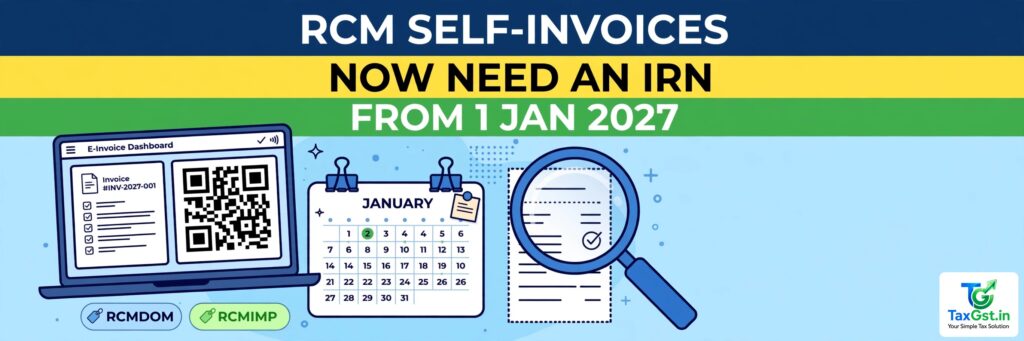
Until now, e-invoicing was a billing-side job: your sales invoices went to the Invoice Registration Portal, got an IRN, and life went on. Your purchase-side self-invoices — the ones you raise yourself when you buy from an unregistered supplier and pay GST under reverse charge — stayed outside the system. From 1 January 2027, that changes. If you are in the e-invoicing net, those self-invoices need an IRN too, and a self-invoice without one will not count as an invoice at all.
The change was notified on 26 October 2026 and follows the 57th GST Council’s recommendations of 8 October 2026. You have about seven weeks from today to get your purchase side ready. Here is what changes, who it catches, and the two 30-day clocks you must not confuse — and for the wider GST picture, the GST hub guides carry the November reform roundup.
What exactly changes on 1 January 2027
Notification No. 04/2026–Central Tax, dated 26 October 2026 (G.S.R. 918(E)), amends Notification No. 13/2020–Central Tax — the notification that identifies who must e-invoice. It adds two new document types to the IRP:
- RCMDOM — self-invoices for supplies received from an unregistered person in India, where you pay the tax under reverse charge.
- RCMIMP — self-invoices for import of services.
Notification No. 05/2026–Central Tax, of the same date, moves the e-invoice schema (FORM GST INV-01) to version 1.2 and adds these two supply-type codes. GSTN opened sandbox testing for RCMDOM and RCMIMP on 16 October 2026; as of writing, the production go-live date has not been separately announced — but the legal effective date of 1 January 2027 stands.
The threshold has not changed. You are in the net only if your aggregate annual turnover exceeded ₹5 crore in any financial year from 2017-18 onwards. If you are already e-invoicing your sales, you are in. If your turnover never crossed ₹5 crore, nothing changes for you — you still raise self-invoices the old way. Our e-invoicing guide for the ₹5 crore threshold explains the IRN mistakes that silently void an invoice, and most of them apply to self-invoices too.
Why this one bites: Rule 48(5)
Here is the part that makes this more than paperwork. Under Rule 48(5) of the CGST Rules, a self-invoice that is not issued through the portal is not to be treated as an invoice. In plain terms: from 1 January 2027, if you are in the e-invoicing net and you raise an RCM self-invoice without an IRN, the document has no legal standing — and the input tax credit on that reverse-charge supply is at risk.
That is a sharp change from today, when a self-invoice raised on your own letterhead or accounting software was perfectly valid. The practical consequence: your purchase and accounts teams — not just your billing team — now need IRP access, and your ERP needs to know about RCMDOM and RCMIMP.
If your business also buys scrap, note that the reverse-charge net widened on the same 1 November 2026 wave — used cooking oil, plastic waste, tyre scrap and e-waste joined metal scrap under RCM. See the GST scrap RCM and 2% TDS guide. Every one of those unregistered-supplier purchases will now also need an IRN-bearing self-invoice from January.
The two 30-day clocks — do not mix them up
There are two different 30-day periods in play, and treating them as one 60-day buffer is the mistake the advisories warn about:
| Clock | What it controls | Who it applies to | Starts from |
|---|---|---|---|
| Rule 47A | Issue the self-invoice within 30 days | Every registered recipient under RCM, any turnover (since 1 Nov 2024) | Date you receive the goods or services |
| IRP reporting window | IRP rejects documents older than 30 days | Taxpayers with turnover of ₹10 crore and above (since 1 Apr 2025) | Date on the invoice |
So if your turnover is ₹10 crore or more, the self-invoice must be both issued within 30 days of receipt and reported to the IRP within 30 days of its date. GSTN has not yet confirmed whether the IRP window applies to RCMDOM and RCMIMP specifically — but the safe internal rule, recommended by practitioners, is simple: self-invoice and generate the IRN within 7 days of receipt. That leaves room for a failed upload, a schema error, or a weekend.
For the full set of 1 November 2026 changes this reform sits inside, see the 1 November GST changes guide, and keep the GST hub guides bookmarked for the January updates as GSTN publishes them.
A 6-week preparation checklist
- Map your RCM vendors. List every unregistered supplier you pay under reverse charge — transporters, security agencies, legal services, scrap dealers, rent from unregistered landlords — plus every import of services (foreign software, consultancy, cloud services).
- Check your ERP/accounting software. Ask your vendor whether it supports schema v1.2 and the RCMDOM/RCMIMP supply types, and when the update ships. If you use the free government IRP portal, test in the sandbox — GSTN opened it on 16 October 2026.
- Fix the process, not just the software. Today the self-invoice is often raised at month-end by one person. From January it needs an IRN within days of receipt. Move the trigger to the goods-receipt or payment-approval step.
- Train the purchase team. The people who raise purchase orders and approve vendor payments are now part of the e-invoicing chain. A missed self-invoice is a lost ITC, not a late filing.
- Watch for the production notice. GSTN has not announced the production go-live date or final technical guidelines yet. Check the GSTN advisory page weekly through December — and watch the compliance calendar hub for the January deadlines.
- Clean up December. Self-invoices for supplies received before 1 January 2027 stay under the old rules. Do not mix December and January supplies in one document.
FAQs
My turnover is ₹4 crore. Does this affect me?
No. The e-invoicing net catches only registered persons whose aggregate turnover exceeded ₹5 crore in any financial year from 2017-18 onwards. You still raise self-invoices within 30 days under Rule 47A, but you do not need an IRN for them.
What if I raise the self-invoice on time but the IRP rejects it?
Fix the schema error and re-report the same document. If your turnover is ₹10 crore or more, remember the IRP will not accept a document more than 30 days old — so do not let a rejected self-invoice sit. A 7-day internal deadline gives you three attempts.
Do RCM self-invoices for imports of goods need an IRN too?
No. The January 2027 extension covers RCM supplies from unregistered persons (RCMDOM) and import of services (RCMIMP). Import of goods is already handled through the customs/Bill of Entry route.
I buy scrap from unregistered dealers. Does the new scrap RCM change interact with this?
Yes — and that is exactly the trap. Scrap categories brought under RCM from 1 November 2026 mean more of your purchases now need self-invoices, and from 1 January 2027 those self-invoices need IRNs too. Map your scrap vendors first.
What happens to my ITC if a self-invoice has no IRN after 1 January 2027?
Under Rule 48(5), a self-invoice not issued through the portal is not treated as an invoice — which puts the ITC on that supply at risk. Treat IRN generation as part of issuing the self-invoice, not an afterthought.
Sources
- Notification No. 04/2026–Central Tax, dated 26 October 2026 (CBIC, G.S.R. 918(E)) — amends Notification No. 13/2020–Central Tax; e-invoicing extended to RCM self-invoices and import of services from 1 January 2027.
- Notification No. 05/2026–Central Tax, dated 26 October 2026 (CBIC) — FORM GST INV-01 schema version 1.2; new supply types RCMDOM and RCMIMP.
- GSTN advisory dated 16 October 2026 — sandbox testing opened for RCMDOM and RCMIMP supply types.
- 57th GST Council meeting decisions, 8 October 2026 (GST Council) — recommendation to extend e-invoicing to reverse-charge supplies and import of services.
Discover more from TaxGst.in
Subscribe to get the latest posts sent to your email.