 C.K. Gupta
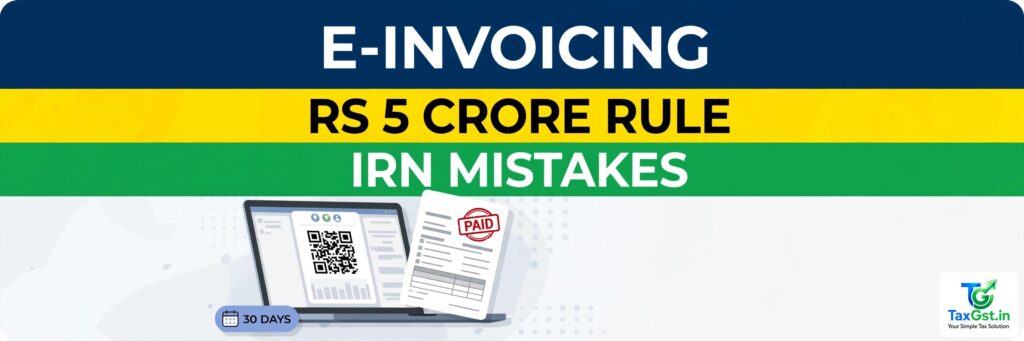
E-invoicing is mandatory if your aggregate turnover crossed ₹5 crore in any financial year from 2017-18 onwards, tested on a PAN basis across all your GSTINs. Every B2B invoice, credit note and debit note must be reported to an Invoice Registration Portal (IRP) and come back with an Invoice Reference Number (IRN) and a signed QR code before you send it to the buyer. If your turnover is ₹10 crore or more, you must report each document within 30 days of its date — after that, the portal simply refuses it. Verified November 2026 · TaxGST.in
Picture this: your accounts team raises a ₹4 lakh invoice on the 2nd of the month, emails the PDF to the buyer, and only remembers the e-invoice step three weeks later. If your turnover is above ₹10 crore, that delay is already dangerous. If it crosses 30 days, the invoice cannot get an IRN at all — and an invoice without an IRN is not a valid e-invoice, however professional the PDF looks. This guide covers who must e-invoice, the two turnover thresholds people keep mixing up, and the IRN mistakes that silently void an invoice. Start with the complete GST compliance guides on the GST hub if e-invoicing is new to your business.
Who must e-invoice — the ₹5 crore test
Under Rule 48(4) of the CGST Rules, the government notifies the class of registered persons who must report specified documents to the IRP. As amended by Notification No. 10/2023-Central Tax dated 10 May 2023, that class is registered persons whose aggregate turnover exceeded ₹5 crore in any preceding financial year from 2017-18 onwards, for supplies to a registered person (B2B) or for exports. The threshold has been ₹5 crore since 1 August 2023.
Three parts of that sentence trip people up. First, “any preceding financial year” means one good year is enough — if you crossed ₹5 crore in 2021-22 and then fell back to ₹3 crore, you are still in the mandate. Second, the test is PAN-wide, not GSTIN-wise: a business with three registrations of ₹2 crore each has aggregate turnover of ₹6 crore and must e-invoice under all of them. Third, e-invoicing applies to B2B supplies and exports — it does not apply to supplies to unregistered consumers (B2C). If you sell only to consumers, the mandate does not bite, however large your turnover.
The second threshold: the 30-day reporting rule at ₹10 crore
Here is the catch: the ₹5 crore figure decides whether you must e-invoice, but a different figure decides how fast you must do it. As per the GSTN advisory dated 5 November 2024, implemented from 1 April 2025, taxpayers with aggregate annual turnover of ₹10 crore or more cannot report an invoice, credit note or debit note to the IRP if it is more than 30 days old. The portal enforces this automatically — an invoice dated 1 April cannot be reported after 30 April, in the portal’s own illustration.
So a business at ₹6 crore of turnover must e-invoice but faces no 30-day portal block today, while a business at ₹12 crore faces both. Confusing the two is the single most common error in e-invoicing advice: “we are below ₹10 crore, so we don’t need e-invoicing” is wrong, and “we report within the month, so we are fine” is wrong if the IRN was never generated at all.
Worked example: the invoice that became invalid
Take a Delhi trader with aggregate turnover of ₹12 crore. On 3 October 2026 it supplies goods worth ₹8,50,000 plus 18% GST (₹1,53,000) to a registered buyer in Haryana and raises invoice INV/1042. The team is busy with festive-season despatches and reports the invoice to the IRP on 5 November — 33 days later. The portal rejects it. There is no “late fee and carry on” option: the document cannot get an IRN, the buyer cannot cleanly claim input tax credit against a valid e-invoice, and the business must sort it out commercially — typically by issuing a fresh, correctly reported document and reconciling the original entry in GSTR-1. The lesson is expensive: e-invoicing must be wired into invoice generation itself, not added as a month-end chore.
The 7 IRN mistakes that silently void an invoice
- Sending the PDF before the IRN exists. The document is not an invoice until the IRP returns it. The signed QR code must be on the copy the buyer receives — a PDF generated first and “e-invoiced later” reverses the legal order.
- Testing turnover GSTIN by GSTIN. As above, the test is PAN-wide. Multi-state businesses fail this one most.
- Missing the 30-day window. At ₹10 crore-plus turnover, a forgotten invoice becomes unreportable after 30 days. Daily or same-day reporting is the only safe routine.
- Reusing or re-casing invoice numbers. Since 1 June 2025 the IRP treats invoice numbers as case-insensitive, converting them to upper case before hashing, as per the GSTN advisory dated 4 April 2025. “inv001” and “INV001” are now the same document — a duplicate will be rejected.
- Wrong buyer GSTIN, document type or date. A mistyped GSTIN blocks generation or strands the credit in the buyer’s books. Validate the buyer’s GSTIN on the portal before billing, not after.
- Wrong HSN digits or stale tax rates. Businesses above ₹5 crore turnover must report 6-digit HSN codes. And rates changed on 22 September 2025, when the 12% and 28% slabs were folded into 5%, 18% and 40% — an item master still carrying old rates will generate wrong e-invoices all month.
- Trying to “edit” an IRN. You cannot. An IRN can be cancelled on the IRP only within 24 hours of generation, and only if no active e-way bill is attached to it. After that, mistakes are fixed by a credit note or debit note, or by amending the entry in GSTR-1 — not by touching the IRP record.
Your e-invoicing checklist
- Confirm applicability once, on a PAN basis, using every year’s turnover since 2017-18
- Generate the IRN before sending any B2B invoice, credit note or debit note to the buyer
- At ₹10 crore-plus turnover, report every document within 30 days of its date — build a daily exception report for unreported invoices
- Keep invoice numbers unique per GSTIN per financial year, and treat upper/lower case as identical
- Reconcile IRP data with GSTR-1 every month; a document in one and not the other is a notice waiting to happen
- Train the team that cancellation is a 24-hour window, not a standing option
If a document is already stuck — an invoice past 30 days, or a wrong GSTIN on a live IRN — do not quietly re-issue a second invoice for the same supply without advice; duplicate billing creates its own mismatch trail. Fix it through a credit/debit note and a clean GSTR-1 amendment, and read why ITC sometimes does not show in GSTR-2B before your buyer starts asking questions. For the payment side, here is how to pay GST online with a PMT-06 challan, and for the monthly calendar, bookmark the compliance calendar hub.
FAQs
Who must issue e-invoices under GST?
Registered persons whose aggregate turnover exceeded ₹5 crore in any financial year from 2017-18 onwards, for B2B supplies and exports, as notified under Rule 48(4) read with Notification No. 10/2023-Central Tax.
What is the 30-day e-invoice rule?
From 1 April 2025, taxpayers with aggregate annual turnover of ₹10 crore or more cannot report an invoice, credit note or debit note to the IRP if it is more than 30 days old. Below ₹10 crore, no such portal block applies today — but the e-invoicing mandate itself still applies above ₹5 crore.
Can I cancel an e-invoice after 24 hours?
No. Cancellation on the IRP is possible only within 24 hours of IRN generation and only when no active e-way bill is attached. Later corrections go through credit notes, debit notes or GSTR-1 amendment.
Is an invoice without an IRN valid?
For a person covered by the mandate, no — a B2B invoice that was never reported to the IRP and never received an IRN and signed QR code is not a valid e-invoice, and the buyer’s ITC claim rests on shaky ground.
Is the ₹5 crore test per GSTIN or per PAN?
Per PAN. Aggregate turnover across all GSTINs under the same PAN is what counts; testing each registration separately understates turnover and is a common cause of non-compliance.
Sources
Notification No. 10/2023-Central Tax, dated 10 May 2023 (Central Board of Indirect Taxes and Customs), reducing the e-invoicing turnover threshold to ₹5 crore with effect from 1 August 2023, under Rule 48(4) of the CGST Rules, 2017 read with Notification No. 13/2020-Central Tax as amended. GSTN advisory dated 5 November 2024, extending the 30-day IRP reporting restriction to taxpayers with aggregate annual turnover of ₹10 crore or more from 1 April 2025. GSTN advisory dated 4 April 2025, on case-insensitive treatment of invoice numbers on the IRP from 1 June 2025. Invoice cancellation within 24 hours and QR-code requirements per the Invoice Registration Portal user manual and GSTN advisories.
Discover more from TaxGst.in
Subscribe to get the latest posts sent to your email.