 C.K. Gupta
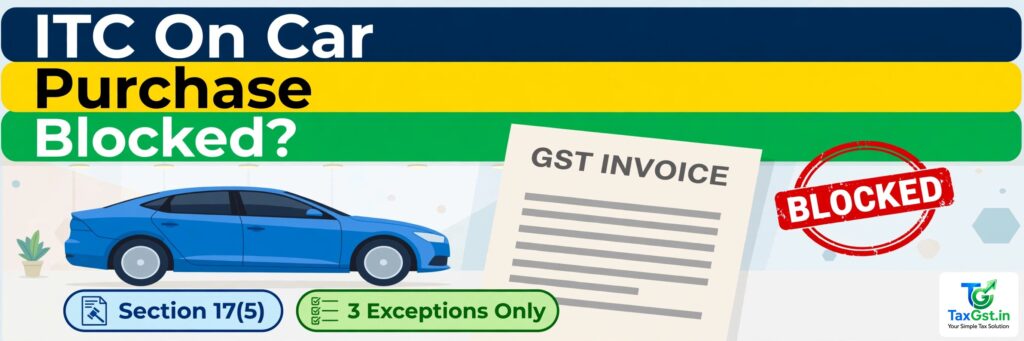
A company buys a car for ₹12 lakh for its directors. The invoice shows ₹3,36,000 of GST on top. The accountant claims the credit in GSTR-3B, because the car is plainly for business use. Six months later a notice arrives: the credit is blocked, interest is due, and the ₹3.36 lakh has to be reversed. This is not a grey area or a disputed interpretation. Section 17(5)(a) of the CGST Act, 2017 blocks input tax credit on motor vehicles for the transportation of persons, and it does so regardless of how genuinely the car is used for business. The only question that matters is what business you are in.
The block, in one paragraph
Section 17(5)(a) denies ITC on motor vehicles for transportation of persons with an approved seating capacity of not more than 13 persons, including the driver — which covers every car, SUV and MUV a business is likely to buy. The section then carves out exactly three exceptions, and the credit is available only when the vehicle is used for making the following taxable supplies: further supply of such motor vehicles, transportation of passengers, or imparting training on driving such motor vehicles. That is the whole list. A car dealer can claim ITC on the cars it buys, including demo cars, because it sells them on. A taxi or cab operator can claim it, because it transports passengers. A driving school can claim it, because it trains drivers. A CA firm, a consultancy, a manufacturer buying a car for its sales team, a startup buying a car for its founder — none of them can, however business-related the travel is. The GST hub carries the full Section 17(5) blocked-credit list, and the blocked ITC guide explains every other item on it, from food and catering to club memberships and employee insurance.
The numbers: what a blocked credit actually costs
Take a petrol car with an ex-showroom price of ₹12,00,000. GST on most cars is 28%, so the invoice carries ₹3,36,000 of GST (plus compensation cess depending on engine size and length, which is also blocked). If the buyer is a dealer, a taxi operator or a driving school, that ₹3,36,000 is credit in GSTR-3B and the car’s real cost is ₹12,00,000. If the buyer is any other business, the credit is blocked and the car’s real cost is ₹15,36,000. The GST simply becomes part of the asset’s cost. An electric car is cheaper on tax — 5% GST, so ₹60,000 on a ₹12 lakh car — but the block works exactly the same way: the rate changes, the rule does not. And the block does not stop at the purchase price. Section 17(5)(ab) blocks ITC on general insurance, servicing, repair and maintenance of the same blocked vehicles, with the same three exceptions. The annual insurance premium, the service bills, the tyre changes — all of it carries GST you cannot claim. Over five years of ownership, the blocked GST on running costs can add another ₹1-2 lakh to the real cost of the car.
What is NOT blocked
The block is narrower than most people think, and the exceptions are where the money is. Trucks, tempos and other goods vehicles are not blocked at all, because Section 17(5)(a) covers only vehicles for the transportation of persons. A logistics company buying a truck claims the full ITC. Buses with seating above 13 are outside the block too, so a company buying a staff bus claims the credit. A car bought to be resold is claimable — which is why dealers claim ITC on their entire stock, including demo cars used for test drives, since the cars are ultimately supplied onward. And here is the catch that trips up leasing: leasing or renting a car for business use is treated the same way as buying one. The monthly lease rental carries GST you cannot claim unless you are in one of the three excepted businesses, so a five-year operating lease on a ₹15 lakh car quietly absorbs lakhs of blocked GST. If you are selling a used car rather than buying one, the margin scheme taxes only the profit, not the full price — the GST on used cars guide explains the 18% margin rule with worked numbers.
The depreciation trap
There is a second consequence that shows up in the income-tax return. Where ITC is claimed on a vehicle — a dealer claiming it, for example — the GST component cannot be added to the asset’s cost for depreciation purposes. Section 16(3) of the CGST Act and the explanation to Section 43(1) of the Income-tax Act, 2025 say the same thing: tax that has been claimed as credit is not part of the cost. So the dealer depreciates the car on ₹12,00,000, not ₹15,36,000. Where ITC is blocked, the opposite applies: the full ₹15,36,000, GST included, is the cost of the asset and depreciation is claimed on the whole amount. In practice this softens the blow slightly for the blocked buyer — they lose the GST credit but gain depreciation on it over the car’s life — while the dealer who claims the credit gets no depreciation on the tax. Neither side gets both. And a final warning: claiming blocked ITC in GSTR-3B is one of the commonest triggers for a mismatch notice, because the department’s systems compare your 3B claim with your GSTR-2B and with the vehicle registration data. The GSTR-2B vs GSTR-3B mismatch guide explains the DRC-01C process and the seven-day reply window when the mismatch is flagged.
What the 57th GST Council did — and did not — change
The 57th GST Council meeting of 8 October 2026 recommended widening ITC to staff life and health insurance and to telecom towers, which would have softened other parts of Section 17(5). But those recommendations are approved, not law — they need amendments to the CGST Act and are expected from 1 April 2027. Nothing in the Council’s recommendations touches the motor-vehicle block. So for tax year 2026-27, the position is unchanged: cars are blocked, the three exceptions are the only way through, and no Council recommendation changes that before April 2027 at the earliest. If your business genuinely needs vehicles, the tax-efficient answer is usually to buy goods vehicles where the use allows it, or to use a taxi operator’s services rather than owning the car — the operator claims the ITC and passes the benefit through in the fare, while you claim ITC on the taxi service itself, which is not blocked.
Frequently asked questions
Can a company claim GST input on a car bought for business use?
No, unless the company is a car dealer, a passenger-transport operator, or a driving school. Section 17(5)(a) blocks the credit for every other business, however genuine the business use.
Can I claim ITC on a car taken on lease for my business?
No, for the same reason. Leasing or renting a car is treated the same way as buying one — the GST on the lease rental is blocked unless you are in one of the three excepted businesses.
Is ITC available on trucks and goods vehicles?
Yes. Section 17(5)(a) covers only motor vehicles for the transportation of persons with seating up to 13. Goods vehicles, and buses seating more than 13, are outside the block.
Can a car dealer claim ITC on demo cars?
Yes. Demo cars are bought for further supply, which is the first of the three exceptions in Section 17(5)(a), so the dealer claims the credit — but then cannot claim depreciation on the GST component.
Is GST on car insurance and servicing claimable?
No, not for a blocked vehicle. Section 17(5)(ab) blocks ITC on general insurance, servicing, repair and maintenance of motor vehicles covered by Section 17(5)(a), with the same three exceptions.
Sources
- Central Goods and Services Tax Act, 2017, Section 17(5)(a) (input tax credit blocked on motor vehicles for transportation of persons with seating capacity of not more than 13 persons, except where used for further supply of such vehicles, transportation of passengers, or imparting training on driving such motor vehicles) and Section 17(5)(ab) (general insurance, servicing, repair and maintenance of such vehicles blocked on the same terms); Section 16(3) (tax claimed as credit excluded from the cost of the asset for depreciation).
- Income-tax Act, 2025, Section 43(1) explanation — the actual cost of an asset excludes any tax for which input tax credit has been claimed.
- 57th GST Council press release, 8 October 2026 — Council recommended widening ITC to staff insurance and telecom towers; approved, not law, expected from 1 April 2027; no change proposed to the motor-vehicle block.
Discover more from TaxGst.in
Subscribe to get the latest posts sent to your email.