 C.K. Gupta
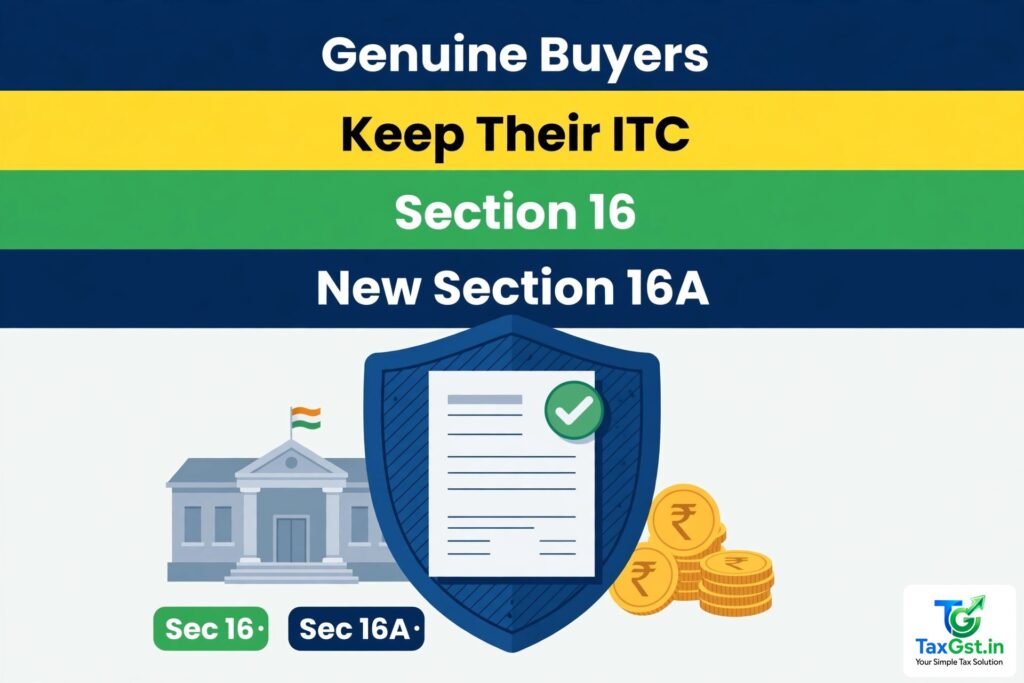
Picture this. You buy raw material worth ₹10 lakh and pay ₹1,80,000 as GST on the invoice. You receive the goods, you pay the supplier in full by bank transfer, and you hold a valid tax invoice. Months later the department tells you your ₹1,80,000 input tax credit is denied. Why? Because your supplier paid its own tax using credit that the department later found inadmissible. You did nothing wrong, and you still lost the money. That exact unfairness is what the CBIC’s new draft proposal tries to fix, and if it becomes law it will change how every genuine buyer defends its credit.
What the CBIC has actually proposed
The Central Board of Indirect Taxes and Customs has prepared a draft agenda note dated 10 November 2026, reviewed by Business Standard and reported on 21 November 2026. The note was prepared by the CBIC’s GST Policy Wing and sent to the GST Council Secretariat for deliberation by the Standing Committee of Officers. It proposes two things: amendments to Section 16 of the CGST Act, and a brand-new Section 16A. This follows the 57th GST Council meeting of 8 October 2026, where the Council asked a Committee of Officers to examine how to protect genuine buyers and report back within three months. Nothing here is law yet. It needs the GST Council’s approval and then an amendment to the CGST Act before any buyer can rely on it. The GST hub’s complete ITC guides explain the current rules that still apply today.
The Section 16(2)(c) fix: you lose credit only if the tax was never paid
Today, Section 16(2)(c) lets the department deny your credit if the tax charged on a supply “has not been paid to the government”. The problem is how that condition is read in practice. If your supplier discharged its liability using input tax credit that was later found inadmissible, the department treats the tax as not paid, and your credit goes with it. The CBIC now proposes to remove the reference to payment of tax “either in cash or through utilisation of admissible ITC” from Section 16(2)(c). The condition that the tax charged must actually be paid to the government stays. The difference is narrower but important: a genuine buyer would no longer lose credit automatically only because the supplier’s credit turned out to be inadmissible.
Here is the catch, and it matters. If your immediate supplier has not paid the tax at all, neither in cash nor through credit, the existing requirement under Section 16(2)(c) continues to apply and your credit is still at risk. The draft note is honest about why the line is drawn here: suppliers do not pay tax invoice by invoice, so a buyer cannot check whether the tax on a particular invoice was paid in cash or through credit, or whether the supplier’s credit was admissible, and the GST portal gives recipients no way to prove it. If your supplier vanishes without paying, the exposure stays with you. That is exactly why the fake-ITC notice protection checklist still matters: payment trail, goods receipt proof and GSTR-2B discipline are your best defence while this proposal works its way through the system.
Section 16(2)(b): goods must come from the supplier who billed you
The second Section 16 change is a single phrase. The CBIC proposes adding the words “from the said supplier” to Section 16(2)(b), so the buyer must receive the goods or services from the same supplier who issued the invoice. This targets a specific arrangement: invoices obtained from one entity while the goods or services actually come from another. If your paperwork and your goods do not trace back to the same supplier, the credit is vulnerable. For honest businesses this is a paperwork discipline point, not a new burden. Keep the e-way bill, transport documents and goods receipt notes tied to the invoicing supplier, and this change works in your favour.
New Section 16A: the crackdown on knowing participants
The protection for genuine buyers comes with a sharper weapon against the others. The proposed new Section 16A would deny input tax credit to a recipient where an investigation establishes that the recipient knowingly assisted in, was involved in, or was a party to issuing invoices without an actual supply of goods or services. The provision would cover fraudulent invoicing in the recipient’s own transaction and at any earlier stage in the supply chain. In plain words, a buyer who knowingly joins a fake-invoicing chain cannot hide behind a genuine-looking immediate supplier.
Two safeguards are built in. First, the burden of proving that involvement sits with the department, through an investigation. Second, the mere cancellation of a supplier’s GST registration, or a default by the supplier, would not by itself establish such involvement. The burden of proving eligibility for credit in general still rests with the taxpayer claiming it, so your documents still have to be in order. The draft also proposes consequential changes to Sections 41 and 155 of the CGST Act. Bimal Jain, founder of A2Z Taxcorp LLP, called the package a balanced reform: genuine buyers would no longer lose credit for defaults deep in the supply chain that they can neither know nor control, while the government gets express power to deny credit to those knowingly involved in fake invoicing. His two asks were that the Council mandate recovery from the defaulting supplier first, and that the benefit extend to past disputes. Nimish Bhatia, partner at PriceWaterhouse, said the ideal end state is a buyer securing credit by reconciling purchase invoices with the Invoice Management System and GSTR-2B, backed by proof of receipt of goods and payment of consideration including taxes.
What the courts have already said
The draft note leans on three rulings. The Gujarat High Court in Maruti Enterprise v. Union of India (1 May 2026) declined to read down Section 16(2)(c) but called for a balanced approach to denying credit. The Punjab and Haryana High Court in Shaurya Alloys Pvt. Ltd. v. State of Punjab (1 October 2026) held that Section 16(2)(c) cannot be invoked routinely or mechanically, and that cancellation of a supplier’s registration by itself cannot justify denying credit without an inquiry into the recipient’s involvement. The Supreme Court’s decision in Shanti Kiran India (P) Ltd. v. Commissioner, Trade and Tax (2025) is also cited. The courts are already pushing back against automatic denial, and the CBIC proposal would put that direction into the statute. Our earlier guide on the Section 17(5) blocked-credit list covers the separate set of credits you can never claim, which this proposal does not change.
What you should do while this is only a proposal
First, do not stop any compliance habit because a draft exists. Until the Council approves and Parliament amends the Act, Section 16(2)(c) works exactly as it does today. Second, tighten the three proofs that every version of this debate rewards: pay suppliers by traceable bank channels, keep goods receipt notes and transport documents that match the invoicing supplier, and reconcile purchases against GSTR-2B every month. The GSTR-2B reconciliation routine shows how to run that check in minutes. Third, if a supplier’s registration is cancelled or a notice arrives, reply on facts and on time; the GST notice survival guide walks through the reply timelines. Fourth, watch the 58th GST Council meeting for whether this agenda note is taken up. If it is approved, the relief will still need a law amendment. And if you have ever wondered why a credit vanished from your return, the guide on why ITC goes missing from GSTR-2B lists the seven real reasons and the fix for each.
Frequently asked questions
Does this proposal mean my ITC is safe even if my supplier never pays tax?
No. The proposal only stops automatic denial when the supplier paid using credit that later turned out inadmissible. If your immediate supplier has not paid the tax at all, Section 16(2)(c) still applies and your credit remains exposed.
When will the Section 16 changes become law?
There is no date yet. The draft is before the Standing Committee of Officers. It then needs GST Council approval and an amendment to the CGST Act, so it is a proposal, not a rule you can rely on today.
Can the department still deny my credit if my supplier’s registration is cancelled?
Not on that fact alone. Under the proposed Section 16A the department would have to establish through investigation that you knowingly took part in fake invoicing. Courts have already said the same thing in the Shaurya Alloys ruling.
What proof should I keep to protect my ITC?
A valid tax invoice, proof the goods or services were received from the same supplier who invoiced you, proof of payment including tax through a traceable channel, and a monthly GSTR-2B reconciliation. Those four records are what every expert quoted in the proposal debate recommends.
Does the proposal change the blocked credits under Section 17(5)?
No. Motor vehicles, food and catering, club memberships and the other Section 17(5) blocks stay exactly as they are. The proposal is about supplier-default denials under Section 16, not about what is inherently ineligible.
Sources
- Business Standard, “CBIC proposes draft GST changes to shield genuine buyers from ITC loss”, 21 November 2026 (updated 22 November 2026) — draft agenda note dated 10 November 2026, CBIC GST Policy Wing, sent to the GST Council Secretariat for the Standing Committee of Officers.
- 57th GST Council meeting, 8 October 2026 — Council asked a Committee of Officers to examine protection of genuine buyers’ ITC and report within three months.
- Gujarat High Court, Maruti Enterprise v. Union of India, (2026) 42 CENTAX 256 (Guj.), decided 1 May 2026; Punjab and Haryana High Court, Shaurya Alloys Pvt. Ltd. v. State of Punjab, CWP-34296-2024, decided 1 October 2026; Supreme Court, Shanti Kiran India (P) Ltd. v. Commissioner, Trade and Tax, (2025) 35 Centax 222 (S.C.).
- CGST Act, 2017, Section 16(2)(b) and 16(2)(c) as in force today; proposed new Section 16A and consequential changes to Sections 41 and 155, per the CBIC draft agenda note.
Discover more from TaxGst.in
Subscribe to get the latest posts sent to your email.