C.K. Gupta
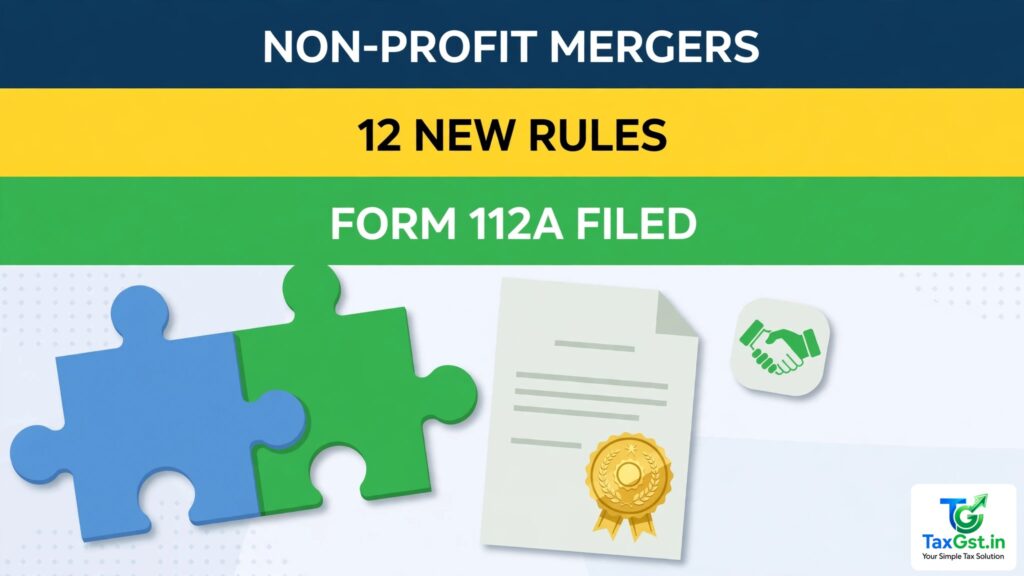
Two trusts doing the same work in the same city, each filing its own returns, each paying its own auditor, each running a half-empty office. Merging them was always possible in company law, but income-tax law never said what happened to the registration, the exemptions, or the accumulated income. On 30 October 2026, CBDT filled that gap with the Income-tax (Eighth Amendment) Rules, 2026. Here is what the new merger rules mean for trusts, societies and Section 8 companies.
What changed on 30 October 2026
Until this notification, the Income-tax Rules, 2026 contained no prescribed conditions for the merger of registered non-profit organisations, and no form for telling the department about one. Notification No. 139/2026, issued as G.S.R. 961(E) on 30 October 2026, inserts new Rule 189A immediately after Rule 189 and introduces Form No. 112A, the intimation for merger of registered non-profit organisations.
The rules are framed under Section 533 read with Sections 352(4) (Table: Sl. No. 8) and 354A of the Income-tax Act, 2025, and they came into force on the date of publication in the Official Gazette, 30 October 2026. The Income-tax Act, 2025 business checklist explains how the new Act’s numbering works for organisations still getting used to it, and the income-tax hub carries the wider set of filing and compliance guides.
The 12 conditions in Rule 189A
Rule 189A(1) lists twelve conditions, clauses (a) to (l). They fall into four groups.
1. Who can merge with whom
A registered non-profit organisation may merge only with another registered non-profit organisation having the same or similar objects. A trust running schools cannot merge with a trust running hospitals and keep the registration. The objects test is the first gate, and it is also the reason the rules exist: the department wants the merged entity to keep doing what both organisations were registered to do.
Registration status must also match. A regularly registered organisation under Section 332 cannot merge with a provisionally registered organisation under the same section, and vice versa. If one side is still provisional, finish that registration first, or the merger fails the conditions.
2. Clean books before the merger
The merging organisation must not have any outstanding tax, interest, penalty, fine or other demand payable under an order, unless that demand is under appeal before an appellate authority. In practice, settle or appeal every demand before the merger date. A demand sitting unpaid and unappealed will block the merger’s tax treatment.
3. Continuity: objects, assets and obligations survive
All assets and liabilities of the merging organisation become part of the merged organisation from the effective date. The merged organisation also assumes the merging organisation’s tax responsibilities, including compliance with the conditions on application of income, accumulated income, investments and payment of additional income tax where applicable.
The sharpest condition is the five-year freeze: the objects of the merged organisation cannot be amended for five years from the end of the financial year in which the merger takes place. Merge in FY 2026-27 and the objects are locked until at least 31 March 2032. Boards that like to tinker with their objects clause every year should think carefully before signing.
4. Tell the department, on time
The merged organisation must intimate the jurisdictional Principal Commissioner or Commissioner of Income-tax in Form No. 112A within one month from the end of the month in which the merger becomes effective. The form is filed electronically, under a digital signature or an electronic verification code.
Worked example: if a merger takes effect on 15 November 2026, the month ends on 30 November, and Form 112A must be filed by 31 December 2026. Miss that window and the merger’s tax treatment is at risk, even if every other condition is met.
What this means for donors and for 80G
Donors give to a registered organisation partly because the donation is deductible. The merger rules protect that chain: because the merged organisation inherits the registration conditions and the objects, a donor’s deduction under the Section 80G donation guide should survive the merger, provided the merged entity stays registered and compliant. But donors should still check the merged organisation’s registration status after the merger, and the merged organisation should update its 80G receipts and website to carry the surviving registration number, not the merged-away one.
A practical checklist for a planned merger
- Compare objects clauses first. If they are not the same or similar, the merger cannot use Rule 189A. Amend objects before the merger, not after, and remember the five-year freeze starts after.
- Match registration status. Both sides must be regularly registered, or both provisionally registered. A mixed pair is barred.
- Clear or appeal every demand. Pull the demand position for both organisations and close out anything unpaid and unappealed.
- Map accumulated income and investments. The merged organisation inherits the conditions on application of income and the investment pattern. An investment that was compliant for one trust may need review in the combined balance sheet.
- Diary the Form 112A date. One month from the end of the merger month. Put it in the calendar the day the merger is approved, and file electronically with DSC or EVC.
- File the return carefully. The first return of the merged organisation is where the department will test the merger. If you are unsure which form applies, the plain-English ITR explainer is a useful starting point before speaking to a tax professional.
Frequently asked questions
Can a trust merge with a Section 8 company?
Rule 189A speaks of registered non-profit organisations generally, so the form of the entity matters less than the registration and the objects. Both sides must be registered non-profits with the same or similar objects and matched registration status. Get advice on the company-law side separately.
What if the two organisations have different objects?
The merger cannot proceed under Rule 189A. The objects must be the same or similar, and the merged organisation’s objects are then frozen for five years.
Is Form 112A filed before or after the merger?
After. It is an intimation, filed within one month from the end of the month in which the merger becomes effective.
Does the merger affect the organisations’ tax exemptions?
The rules are designed so the exemptions continue, provided all twelve conditions are met and the merged organisation honours the inherited conditions on income application, accumulated income and investments. A broken condition can put the registration itself at risk.
Do unregistered non-profits need to worry about this?
No. Rule 189A applies only to registered non-profit organisations under Section 332 of the Income-tax Act, 2025.
Sources
- CBDT Notification No. 139/2026 [F. No. 370142/32/2026-TPL], G.S.R. 961(E), dated 30 October 2026 — Income-tax (Eighth Amendment) Rules, 2026, inserting Rule 189A and Form No. 112A into the Income-tax Rules, 2026.
- Income-tax Act, 2025, Section 533 read with Sections 352(4) [Table: Sl. No. 8] and 354A — enabling provisions for the merger conditions.
- Income-tax Rules, 2026 (principal rules notified vide G.S.R. 198(E), 20 March 2026) — Rule 189A inserted immediately after Rule 189.
Discover more from TaxGst.in
Subscribe to get the latest posts sent to your email.