 C.K. Gupta
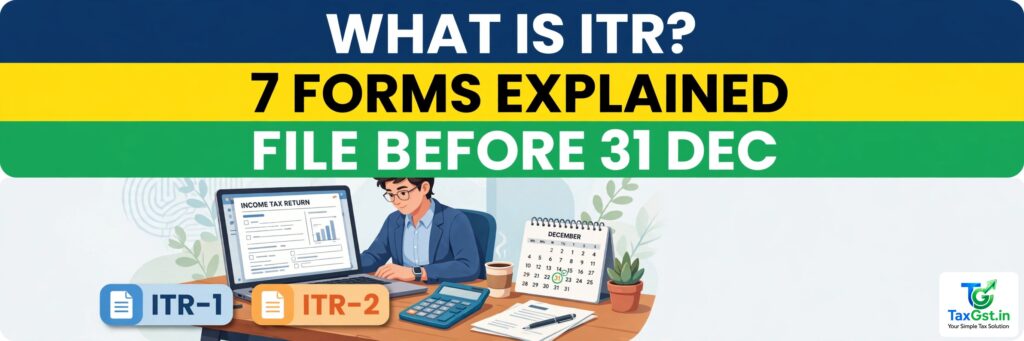
ITR — Income Tax Return — is the form in which you report your year’s income, deductions and taxes paid to the Income Tax Department. Most salaried people file ITR-1 or ITR-2; businesses, firms, companies and trusts each have their own form, seven in all. If you missed your deadline, you can still file a belated return — for this cycle, by 31 December — though a late fee may apply. Verified November 2026 · TaxGST.in
Every July (and every deadline extension season), the same question floods search engines: “What is ITR, and do I actually need to file one?” The honest answer is that ITR is not a tax — it is your annual statement to the government saying: this is what I earned, this is what I already paid, and this is what I still owe or am owed back. If the department owes you, the ITR is also the only way to claim your refund. Start with the Income Tax hub’s filing guides if you are filing for the first time.
This guide covers the seven forms in plain English, who must file, and what happens if you don’t — plus the deadlines that matter right now. If you have already filed and received something back from the department, learn how to read your Section 143(1) intimation before assuming the matter is closed.
The 7 ITR forms, in one table
| Form | Who files it | Typical case |
|---|---|---|
| ITR-1 (Sahaj) | Resident individuals | Salary, one house property, other sources; total income up to ₹50 lakh |
| ITR-2 | Individuals and HUFs | Capital gains, more than one house, foreign assets, income above ₹50 lakh |
| ITR-3 | Individuals and HUFs | Business or professional income (not presumptive) |
| ITR-4 (Sugam) | Individuals, HUFs, firms (other than LLP) | Presumptive taxation — small businesses and professionals |
| ITR-5 | Firms, LLPs, AOPs, BOIs | Partnership firms and associations |
| ITR-6 | Companies | All companies (other than those claiming exemption under Section 11) |
| ITR-7 | Trusts and institutions | Charitable trusts, political parties, institutions claiming exemption |
The most common mistake is filing ITR-1 when you should have filed ITR-2. The trigger is usually capital gains — sell shares or a mutual fund unit during the year and ITR-1 is no longer available to you, even if your salary is your main income. The same applies if you own more than one house property or hold foreign assets. A wrong form can make your return defective, which is why the Income Tax hub’s filing guides stress form selection before anything else.
Who must file — even if no tax is due
You must file if your total income before deductions exceeds the basic exemption limit (₹2.5 lakh under the old regime for most individuals; ₹3 lakh under the new regime for the relevant years — check the regime you are filing under). But filing is also mandatory in several cases even when your income is below the limit:
- You deposited more than ₹1 crore in current accounts during the year
- You spent more than ₹2 lakh on foreign travel for yourself or another person
- Your electricity bill exceeded ₹1 lakh in the year
- You hold foreign assets or are a signatory to a foreign account
- Your TDS or TCS during the year was ₹25,000 or more (₹50,000 for senior citizens)
- You are a company or firm — filing is mandatory regardless of income
And here is the practical point most people miss: even when filing is not compulsory, it is often worth doing. A filed return is your proof of income for a home loan, a visa application or a government tender. It carries forward capital losses that would otherwise lapse. And without it, no refund — however much TDS was cut from your salary or interest.
What happens if you don’t file
Three consequences, in ascending order of pain. First, a late fee under the fee provision for delayed filing: ₹5,000 generally, reduced to ₹1,000 if your total income is up to ₹5 lakh. Second, interest on any tax still payable. Third, and most expensive in the long run: you lose the right to carry forward most losses (capital losses, business losses) to future years, and you cannot revise the return later. A belated return can still be filed — for this cycle, by 31 December — but a belated return cannot carry forward losses (other than house-property loss) and cannot be revised if you spot an error.
If you missed a deadline and are now unsure whether you owe tax or are owed a refund, check your AIS and Form 26AS first, then read what to do if the department raises a demand against you — many “demands” turn out to be TDS mismatches that a rectification fixes.
Deadlines that matter right now
For Assessment Year 2026-27, the CBDT extended the ITR deadline for specified taxpayers whose accounts require audit from 31 October 2026 to 21 November 2026 — but that extension is not general. Salaried individuals filing ITR-1 or ITR-2 are not covered by it; their regular deadline has already passed, and the belated-return window (by 31 December, with late fee where applicable) is what remains. Transfer-pricing cases follow a different calendar again, with 30 November 2026 as the ITR date. If you are an audited taxpayer, use the extra days to reconcile income, deductions and audit information — do not assume the extension covers you without checking the CBDT circular’s specified categories.
A 15-minute filing checklist
- Download your AIS and Form 26AS and reconcile them with your own records
- Pick the right form from the table above — capital gains or foreign assets push you out of ITR-1
- Choose your regime (old vs new) deliberately; the choice changes your deductions, not just your slab
- Verify every TDS entry against your Form 16 — if your Form 16 PDF won’t open, here is the exact Form 16 password format
- File, then e-verify within 30 days — an unverified return is treated as not filed
That last step is the one people forget most. Filing without e-verification leaves the return unprocessed: no refund, no completion. Verify through Aadhaar OTP, net banking or by sending the signed ITR-V to Bengaluru — but do it within 30 days of filing.
FAQs
What is ITR in simple words?
Your annual income tax return: a form reporting your income, deductions, taxes paid and taxes due to the Income Tax Department for a tax year.
Which ITR form should a salaried person file?
ITR-1 if you have salary, one house property and other-source income up to ₹50 lakh with no capital gains; ITR-2 if you have capital gains, more than one house, foreign assets or income above ₹50 lakh.
Can I file ITR after the deadline?
Yes — a belated return can be filed by 31 December of the assessment year, subject to a late fee (₹5,000 generally, ₹1,000 if total income is up to ₹5 lakh), interest where tax is due, and loss of most loss carry-forwards.
Is filing mandatory if my employer already deducted TDS?
Often yes — TDS is not a substitute for filing, and filing is mandatory in the cases listed above (high-value deposits, foreign travel, foreign assets, TDS above ₹25,000/₹50,000) even if income is below the exemption limit.
What if I file but don’t e-verify?
An unverified return is treated as not filed. E-verify within 30 days of filing, or send the signed ITR-V to the CPC, Bengaluru.
Sources
Income Tax Department, e-filing portal — ITR form applicability (ITR-1 to ITR-7) and e-verification window of 30 days. Central Board of Direct Taxes (CBDT) extension of the Assessment Year 2026-27 ITR deadline for specified audit cases from 31 October 2026 to 21 November 2026, as reported by Business Standard and Moneycontrol (November 2026 financial-changes coverage, 30 October–2 November 2026); belated-return deadline of 31 December as reported in the same coverage. Mandatory-filing conditions (Seventh proviso triggers: ₹1 crore current-account deposits, ₹2 lakh foreign travel, ₹1 lakh electricity, TDS thresholds) per the Income-tax Act, 2025 framework carried forward from the Income-tax Act, 1961.
Discover more from TaxGst.in
Subscribe to get the latest posts sent to your email.