 C.K. Gupta
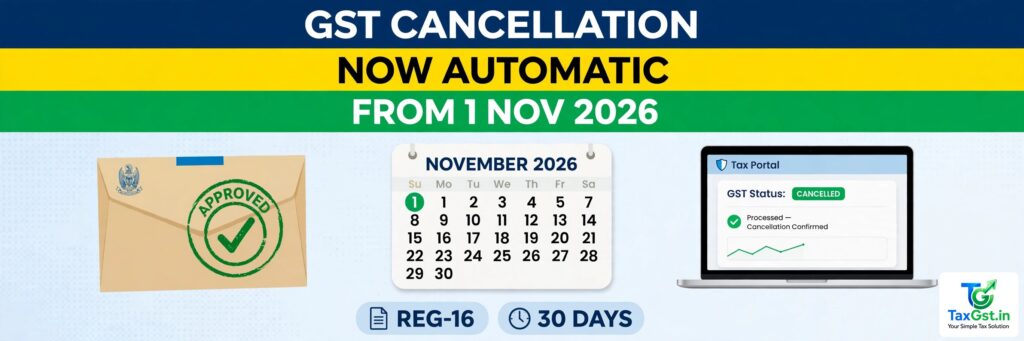
From 1 November 2026, eligible GST-registered persons can get their registration cancelled automatically through the GST portal — no waiting for a tax officer to approve it — provided they meet the conditions in the amended Rule 20, including applying in Form GST REG-16 within 30 days of the event that warrants cancellation. The change, notified by the CBIC on 26 October 2026, is part of the first phase of the 57th GST Council reforms. Verified November 2026 · TaxGST.in
Closing a business is stressful enough without the tax paperwork dragging on for months. Until now, even a straightforward voluntary GST cancellation could sit with the jurisdictional officer while you waited for an order — and meanwhile, return-filing obligations kept ticking. From 1 November 2026, that changes for a defined set of taxpayers: the system itself can cancel your registration, without manual approval.
Here’s the catch: “automatic” does not mean “for everyone, no questions asked”. It means the portal checks a set of conditions, and if you clear them, the cancellation goes through electronically. If you don’t, you stay on the old officer-approved route. This article explains who qualifies, what to file, and the traps to avoid — and if you are still weighing whether to cancel at all, read the full GST registration and cancellation guide on the GST hub first.
What changed on 1 November 2026
As per the CBIC’s Notification No. 05/2026–Central Tax, dated 26 October 2026, Rule 20 of the CGST Rules, 2017 has been substituted with effect from 1 November 2026. The new rule creates a system-enabled mechanism for cancellation of registration under Section 29(1) of the CGST Act, 2017 — the voluntary-cancellation provision. The reform gives effect to the first phase of the registration-cancellation changes recommended at the 57th GST Council meeting on 8 October 2026.
Two things are worth separating straight away. First, this November change covers voluntary cancellation — you asking to exit the GST system. Second, a separate system-based cancellation and revocation mechanism for certain non-compliances is scheduled for 1 April 2027. Don’t confuse the two: the November route is for taxpayers who want out, not for the department cancelling you. If an officer has cancelled your registration instead, the remedy is revocation — see how revocation of a suo-moto GST cancellation works.
Who can use the automatic route
The headline eligibility test reported with the notification is about your recent tax liability. Under the revised Rule 20, automatic cancellation is available where, among other conditions, your monthly output tax liability on specified supplies to registered persons does not exceed ₹2.5 lakh. Note carefully: that ₹2.5 lakh figure is a monthly tax-liability threshold, not a turnover limit — a business with large exempt or zero-rated supplies can look very different on this test than its turnover suggests.
Taxpayers above that threshold are not shut out entirely: under Rule 20(5)(b), they may still qualify for system-based cancellation if they file the final return in Form GSTR-10 within three days of the due date for the residual-period returns referred to in Rule 20(3), and satisfy all other compliance and payment conditions. And if an application is instead forwarded to the proper officer for examination (for example, because returns are pending or dues unpaid), Rule 20(12) provides a safeguard: if the officer fails to act within 15 days, the application is deemed approved. Either way, the principle is the same — the portal will only auto-cancel a file that is clean.
Also note the further simplification coming on 1 December 2026, when amendments to Form GST REG-16 itself take effect. If your cancellation event happens in late November, check which version of the form the portal shows you before filing.
How to apply: REG-16 in 30 days
The procedure is deliberately simple:
- File Form GST REG-16 electronically on the GST portal — Services → Registration → Application for Cancellation of Registration — within 30 days of the event that warrants cancellation (for example, closure of business or discontinuance).
- Clear your dues first. Pay any outstanding tax, interest and late fee, and make sure your returns are filed up to date. Unpaid dues are the most common reason a cancellation stalls.
- File the final return in Form GSTR-10 within three months of the cancellation date (or the date of the cancellation order, whichever is later). This is the return that closes your books with the department.
- Keep the records. Even after cancellation, you must preserve your books and records for the statutory period — cancellation is not deletion.
A worked example makes the 30-day rule concrete. Suppose you shut your shop on 10 November 2026. Your REG-16 is due by 10 December 2026. File on 15 December and you have missed the window — you would then need to explain the delay and may fall back to the officer route. Put the date in your diary the day you close, not the week after.
What the automatic route does not do
- It does not waive your dues. If you owe tax, the system will not auto-cancel around it. Settle first — and if you are paying online, follow the PMT-06 challan guide for paying GST online so the payment actually reflects against your account.
- It does not cancel your other registrations. Each GSTIN is separate. If you hold registrations in multiple states, each needs its own application.
- It does not end your liability for past periods. Notices and demands for earlier periods can still arrive, and past returns can still be scrutinised.
- It does not apply to every cancellation. Death of the proprietor, transfer of business, merger and similar cases have their own procedures and timelines — take advice before assuming the automatic route covers you.
Checklist before you hit submit
- All GSTR-1 and GSTR-3B returns filed up to the cancellation date
- Electronic cash ledger and credit ledger balances checked — claim any refund of excess cash balance due to you (from 1 November 2026, full refunds of excess electronic cash ledger balances are sanctioned automatically by the system)
- ITC on closing stock reversed where required, and the reversal reflected in the final return
- REG-16 filed within 30 days of the closure event
- GSTR-10 diarised for within three months of cancellation
If any item on that list is not clean, fix it before filing — a rejected or stuck application costs more time than a week’s preparation. And if you are cancelling because the business has genuinely stopped, remember the parallel question of whether you even needed registration in the first place: GST registration itself carries no government fee, so a future re-registration, if you restart, costs you effort rather than a fee.
FAQs
Is GST cancellation now fully automatic for everyone?
No. From 1 November 2026, cancellation is system-enabled without officer approval only for taxpayers who meet the Rule 20 conditions, including the ₹2.5 lakh monthly output-tax-liability test or the alternative GSTR-10 condition. Others continue on the officer-approved route.
What is the deadline for filing REG-16?
Within 30 days from the occurrence of the event warranting cancellation, as prescribed in revised Rule 20(1).
Do I still need to file GSTR-10?
Yes. The final return in Form GSTR-10 must be filed within three months of the date of cancellation or the cancellation order, whichever is later.
What changes on 1 December 2026?
Further simplification of the cancellation procedure through amendments to Form GST REG-16 takes effect from 1 December 2026.
Can the department still cancel my registration on its own?
Yes — suo-moto cancellation by officers continues under its own provisions, and a separate system-based cancellation mechanism for certain non-compliances is scheduled from 1 April 2027. This November reform is about voluntary cancellation.
Sources
Central Board of Indirect Taxes and Customs (CBIC), Notification No. 05/2026–Central Tax, dated 26 October 2026 (G.S.R. 919(E)) — substitution of Rule 20 of the CGST Rules, 2017, effective 1 November 2026, giving effect to the first phase of registration-cancellation reforms from the 57th GST Council meeting (8 October 2026). CBIC Member (GST) remarks on the phased rollout from 1 November 2026, as reported by ETGovernment, and CNBC-TV18’s report of the 1 November 2026 GST process changes (simplified registration, faster refunds, streamlined documentation).
Discover more from TaxGst.in
Subscribe to get the latest posts sent to your email.