C.K. Gupta
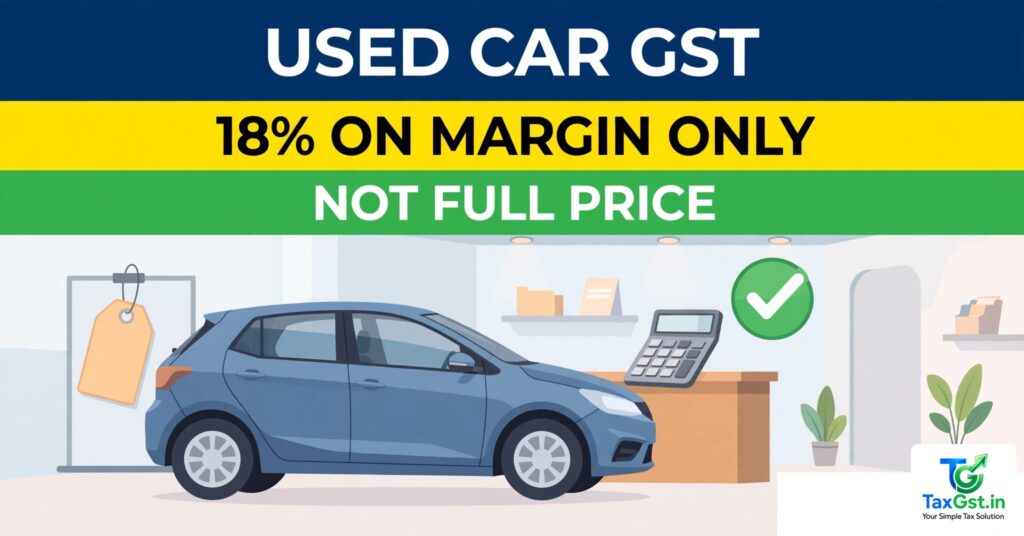
A dealer buys your old Swift for ₹4,00,000, spends ₹15,000 fixing it up, and sells it for ₹4,60,000. What GST does he pay? Not 18% of ₹4,60,000, which would be ₹82,800. He pays 18% of his ₹45,000 margin, which is ₹8,100. That is the whole idea of the margin scheme, and it is also the most misunderstood rule in the used-car market. Buyers assume the dealer pockets the difference. Sellers assume GST applies to their private sale. Both are usually wrong. Here is how the rule actually works in 2026.
The margin scheme in one paragraph
Rule 32(5) of the CGST Rules, 2017 says that a person dealing in second-hand goods, where no input tax credit has been claimed on the purchase, pays GST only on the margin: the selling price minus the purchase price, plus any minor repair cost incurred before the sale. If the margin is negative, it is ignored and no GST is payable. The rate for old and used vehicles comes from Notification No. 8/2018-Central Tax (Rate) dated 25 January 2018. From 16 January 2025, Notification No. 04/2025-Central Tax (Rate), following the 55th GST Council meeting of 21 December 2024, made the rate a uniform 18% on the margin for every old and used vehicle, including electric vehicles. Before that date, small cars and EVs were taxed at 12% on the margin while larger cars paid 18%.
| Vehicle sold under the margin scheme | GST on margin before 16 Jan 2025 | GST on margin from 16 Jan 2025 |
|---|---|---|
| Petrol/LPG/CNG, 1200cc or more, 4000mm or more | 18% | 18% |
| Diesel, 1500cc or more, 4000mm or more | 18% | 18% |
| SUVs above 1500cc | 18% | 18% |
| All other used vehicles, including small cars and EVs | 12% | 18% |
The change hit dealers selling small cars, compact SUVs and electric cars hardest, since their margin tax rose by six percentage points overnight. For buyers, it is usually invisible, because the GST is built into the dealer’s price and the dealer cannot charge it separately as input tax credit to you.
Worked examples: dealer, company car, and loss sale
A dealer sells a used car. Purchase price ₹3,00,000, repair cost ₹10,000, selling price ₹3,50,000. Margin = ₹3,50,000 − (₹3,00,000 + ₹10,000) = ₹40,000. GST at 18% = ₹7,200.
A company sells a car it used in the business. Here the margin is worked out differently. If depreciation was claimed under Section 32 of the Income-tax Act, the margin is the selling price minus the written-down value of the car on the date of sale. A car bought for ₹12,00,000 with a written-down value of ₹5,00,000, sold for ₹6,00,000, gives a margin of ₹1,00,000 and GST of ₹18,000. The Gujarat Authority for Advance Ruling confirmed this treatment in the Dishman Carbogen Amcis ruling. The GST hub carries the full guide to how businesses handle GST on asset sales.
A sale at a loss. A dealer buys at ₹5,00,000 and sells at ₹4,70,000. The margin is negative, so it is ignored. GST is nil. This is the rule’s real purpose: a car was fully taxed when it was first sold new, and the law refuses to tax the same value again every time it changes hands.
When the margin scheme does not apply
The scheme has one hard condition: no input tax credit must have been claimed on the purchase of the vehicle. If the seller claimed ITC when buying the car, the concessional margin treatment is lost, and GST applies at the full rate on the full selling price. That is the trap for businesses that bought a car, claimed ITC, and then sell it as a used vehicle expecting the 18%-on-margin treatment. The same logic applies to the blocked-ITC rules under Section 17(5), which deny credit on most motor vehicles in the first place, so check whether credit was ever actually available before assuming it was claimed.
Two more points buyers and sellers get wrong. First, compensation cess does not apply to old and used vehicles at all: Notification No. 1/2018-Compensation Cess (Rate) sets it at nil, which matters because new large cars carried heavy cess until the September 2025 rate reform. Second, from 22 September 2025 a new small car pays 18% GST and a new large car pays 40%, with no cess, under Notification No. 9/2025-Central Tax (Rate), while electric cars stay at 5%. The used-car margin rate of 18% was not changed by that reform, so a used large car still attracts only 18% on its margin.
Private sales: no GST
If you sell your own car to another individual, and neither of you is a GST-registered dealer, there is no GST on the transaction. GST applies to supplies made in the course of business. A one-off private sale is not a supply by a registered person, and the buyer pays nothing extra in tax. The confusion usually starts when a dealer buys your car: the dealer’s later resale is taxable on his margin, but your sale to him is not. The GST rates and HSN guide explains how the rate notification system works for other goods too.
Checklist before you buy or sell used
- Buyer from a dealer: ask whether the price includes GST. It should, because the dealer cannot pass you ITC on a margin-scheme sale. A dealer quoting GST extra on top of the price is double-charging you.
- Dealer: keep the purchase invoice and repair bills for every car. Without them you cannot prove the margin, and the department will tax the full sale value.
- Business selling its own car: work out the written-down value first. If you claimed depreciation, the margin is sale price minus written-down value, and the 18% applies to that.
- Company cars with ITC claimed: remember the margin scheme is unavailable. Budget for GST on the full sale price, and check the CGST, SGST and IGST split that applies to the sale.
- EV buyers: a used electric car now attracts 18% on the dealer’s margin, the same as a petrol car, since 16 January 2025. The 5% rate applies only to new EVs.
Frequently asked questions
Do I pay GST when I sell my personal car?
No. A private sale between individuals is not a taxable supply under GST. GST applies when a registered dealer or business sells the car.
What GST rate applies to a used car in 2026?
18% on the dealer’s margin, for every category of old and used vehicle, including small cars and EVs, since 16 January 2025.
Can a dealer charge GST on the full price of a used car?
Only if he claimed input tax credit on its purchase, in which case the margin scheme is unavailable. In the normal case the tax is 18% of the margin only.
Is compensation cess charged on used cars?
No. Compensation cess on old and used vehicles is nil under Notification No. 1/2018-Compensation Cess (Rate).
What if the dealer sells the car at a loss?
A negative margin is ignored under Rule 32(5), so no GST is payable on that sale.
Sources
- Rule 32(5), CGST Rules, 2017 — margin scheme for second-hand goods: value of supply is the difference between selling price and purchase price, negative margin ignored; where depreciation was claimed, selling price minus written-down value.
- Notification No. 8/2018-Central Tax (Rate), dated 25 January 2018, as amended by Notification No. 04/2025-Central Tax (Rate), effective 16 January 2025 — uniform 18% GST on the margin for all old and used vehicles, following the 55th GST Council meeting of 21 December 2024.
- Notification No. 1/2018-Compensation Cess (Rate), dated 25 January 2018 — compensation cess on old and used vehicles is nil.
- Notification No. 9/2025-Central Tax (Rate), dated 17 September 2025 — new cars 18% (small) and 40% (other), electric cars 5%, from 22 September 2025; used-car margin rate unchanged.
- Gujarat Authority for Advance Ruling, M/s Dishman Carbogen Amcis Pvt. Ltd. — margin on a depreciated motor vehicle is selling price minus written-down value under the Income-tax Act.
Discover more from TaxGst.in
Subscribe to get the latest posts sent to your email.