C.K. Gupta
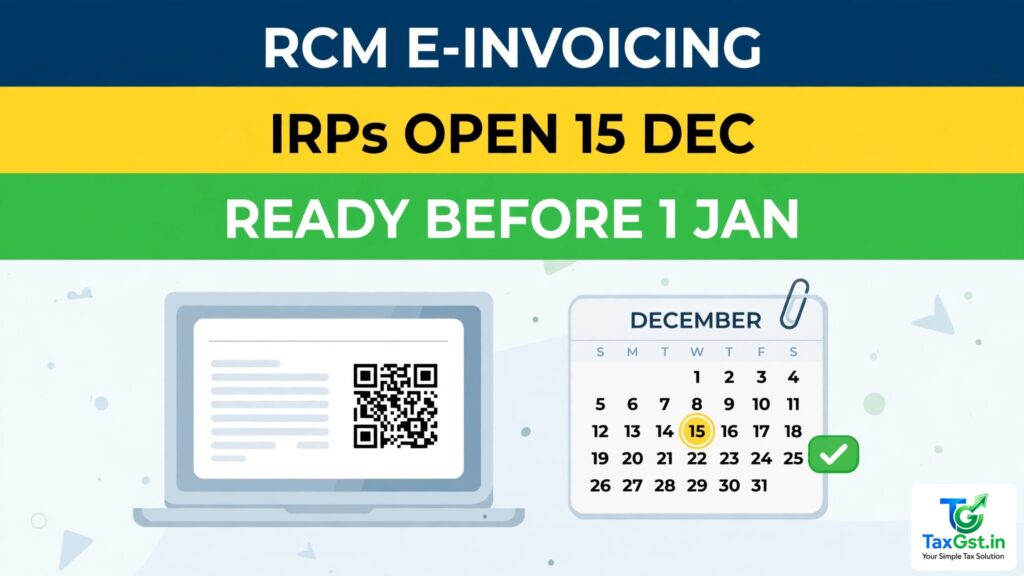
A supplier you never invoiced is about to create paperwork for you. From 1 January 2027, every self-invoice a registered business issues for supplies received from an unregistered person, and for import of services, must carry an Invoice Reference Number. GSTN’s advisory of 17 November 2026 gives businesses a two-week dress rehearsal: the Invoice Registration Portals open for these documents in production from 15 December 2026. Here is what changes, who it catches, and the exact preparation list.
What RCMDOM and RCMIMP actually are
Under the reverse charge mechanism, the buyer, not the seller, pays the GST. Two situations have always needed a self-invoice from the recipient, and both now move into e-invoicing:
- RCMDOM: supplies received from an unregistered person in India, where the registered recipient is liable to pay tax under reverse charge. Think of the small unregistered vendor who supplies packing material, or the local transporter who is not registered.
- RCMIMP: import of services from a supplier located outside India, where the Indian recipient pays GST under reverse charge. Think of the overseas software licence, the foreign consultant, or the cloud subscription billed from abroad.
The legal hook is Notification No. 04/2026-Central Tax, dated 26 October 2026, which extended e-invoicing to these two categories from 1 January 2027, with the schema and rule changes in Notification No. 05/2026-Central Tax of the same date. The 17 November GSTN advisory is the implementation timetable, not a new rule. The full GST guide hub carries the wider picture of the November 2026 GST reforms.
The timeline: three dates that matter
| Date | What happens |
|---|---|
| 16 October 2026 | RCMDOM and RCMIMP made available in the sandbox of all six IRPs (GSTN advisory, 16 October 2026) |
| 15 December 2026 | Production opens on the IRPs; IRN generation voluntary until 31 December 2026 (GSTN advisory, 17 November 2026) |
| 1 January 2027 | E-invoicing for RCMDOM and RCMIMP becomes mandatory (Notification No. 04/2026-Central Tax) |
Two details in the advisory deserve attention. First, production will accept only documents dated 15 December 2026 or later for these supply types, so do not try to push November self-invoices through the IRP. Second, GSTN is explicit that production is for genuine transactions only; all testing belongs in the sandbox. The voluntary window is a chance to find integration bugs with real documents, not a deadline extension. As the advisory puts it, mandatory e-invoicing for these two supply types takes effect from 1 January 2027 only.
Who is covered, and who is not
The turnover threshold is unchanged: e-invoicing applies to registered persons whose aggregate annual turnover is ₹5 crore or more. That threshold was set long ago for B2B e-invoicing, and the e-invoicing guide for the ₹5 crore threshold explains how it is measured. If your turnover is below ₹5 crore, the 1 January 2027 date does not touch you, though the underlying reverse-charge liability still does.
Here is the catch most businesses miss: the threshold is measured on aggregate turnover, not on reverse-charge purchases. A business with ₹6 crore of turnover that buys ₹2 lakh a year from unregistered vendors still has to e-invoice those self-invoices. And the reverse-charge net is widening at the same time: from 1 November 2026, used cooking oil, plastic waste, tyre waste and e-waste joined metal scrap under reverse charge, as covered in the scrap RCM and 2% TDS guide. Every one of those purchases from an unregistered seller will need an IRN from January.
The 30-day clock and the ITC risk
Two existing rules make late e-invoicing expensive. Rule 47A gives you 30 days to issue a self-invoice for a reverse-charge supply, and the IRP reporting window for large taxpayers is also 30 days. Miss the window and the invoice cannot be reported at all. Worse, Rule 48(5) puts input tax credit at risk where an e-invoice was required but not generated. In practice, that means a self-invoice without an IRN after 1 January 2027 is not just a compliance miss, it can cost you the credit on that purchase.
The practical fix is boring but effective: map every reverse-charge purchase in your books today, before December. List the unregistered suppliers, the overseas service vendors, and the scrap dealers. For each one, confirm who in your team raises the self-invoice, which system generates it, and whether that system can call the IRP. If your ERP vendor has not delivered the RCMDOM/RCMIMP update, that conversation needs to happen this week, not in the last week of December.
What to do before 15 December: a checklist
- Test in the sandbox now. All six IRPs (NIC IRP-1 and IRP-2, Cygnet, Clear, EY and IRIS) already carry the functionality. Generate test IRNs for both RCMDOM and RCMIMP with sample data.
- Confirm the document-date rule. Production accepts documents dated 15 December 2026 or later. Backdated self-invoices will be rejected.
- Check the schema. The e-invoice schema INV-01 version 1.2 carries the new supply-type codes. Your GSP or ASP should confirm the field mapping for recipient-generated documents.
- Use the voluntary window. Between 15 and 31 December, generate IRNs for genuine RCM self-invoices in production. A live IRN in December proves the integration works; a failed one in January is a blocked payment.
- Align GSTR-3B. Reverse-charge tax paid on self-invoices feeds your return. Reconcile the IRN list with the RCM table in GSTR-3B so nothing is reported twice or missed.
- Watch the calendar. The compliance calendar hub tracks the December due dates around this change, including the 30 November ITC cut-off that sits just before the voluntary window opens.
Frequently asked questions
Does the 15 December production opening move the mandatory date forward?
No. GSTN’s advisory is clear that mandatory e-invoicing for RCMDOM and RCMIMP takes effect from 1 January 2027 only. The 15 to 31 December window is voluntary early adoption.
My turnover is below ₹5 crore. Do I need to do anything?
No e-invoicing is required, but the reverse-charge liability itself is unchanged. You still issue self-invoices and pay tax under RCM; you simply do not report them to an IRP.
What happens if I issue a self-invoice in January without an IRN?
The document is not a valid e-invoice for a covered taxpayer, and Rule 48(5) puts the input tax credit on that purchase at risk. The invoice also cannot be reported late once the 30-day window closes.
Can I test with real supplier data in the sandbox?
No. GSTN advises that sandbox environments are for sample-data testing only. Use production, from 15 December, for genuine transactions.
Does this cover imports of goods?
No. RCMIMP covers import of services only. Imports of goods continue under the existing bill-of-entry route.
Sources
- GSTN Advisory on Implementation of e-Invoicing for RCM Domestic Supplies (RCMDOM) and Import of Services (RCMIMP) with effect from 1 January 2027, dated 17 November 2026 (production from 15 December 2026; voluntary IRN generation 15–31 December 2026; sandbox available since 16 October 2026).
- CBIC Notification No. 04/2026-Central Tax, dated 26 October 2026 — e-invoicing extended to RCMDOM and RCMIMP from 1 January 2027.
- CBIC Notification No. 05/2026-Central Tax, dated 26 October 2026 — CGST Rules and e-invoice schema (INV-01 v1.2) amendments.
- CBIC Notification No. 06/2026-Central Tax and No. 07/2026-Central Tax, October 2026 — reverse charge and TDS extended to specified waste and scrap categories from 1 November 2026.
Discover more from TaxGst.in
Subscribe to get the latest posts sent to your email.