C.K. Gupta
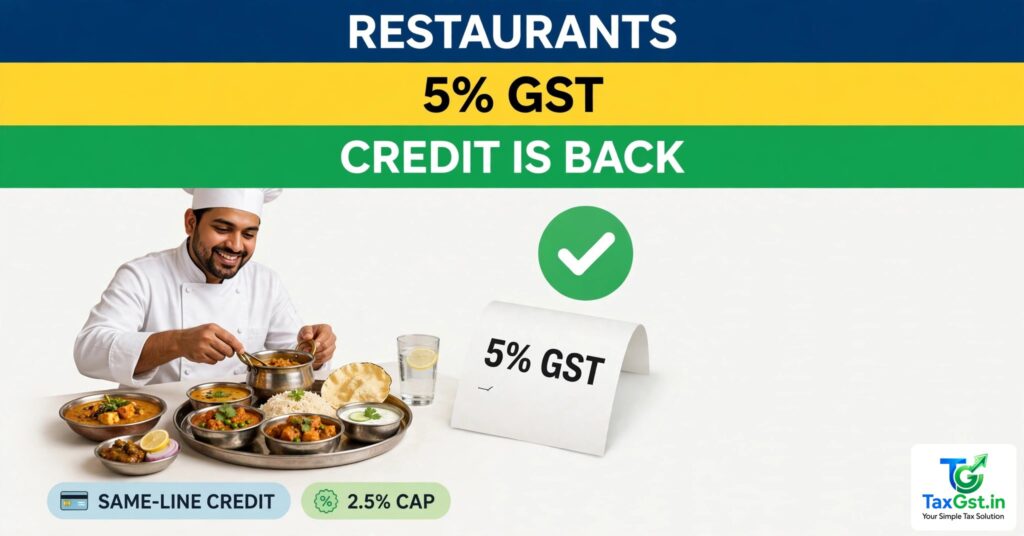
A restaurant owner in Indore has paid 5% GST on every bill since 2017 and claimed zero input tax credit on anything — not on the catering services she buys for a wedding order, not on the banquet hall she hires from another hotel. On 1 November 2026 that changed. She can now claim credit on input services of the same kind — but only the same kind, only from 1 November, and for hotels and caterers the credit stops at 2.5% even if the supplier charged more.
This is the practical guide to that one change. For the full November rate package it sits inside, see the item-wise GST rate changes guide for 1 November 2026; for the wider GST framework, keep the GST hub — rates, registration and returns in one place open alongside.
What exactly changed on 1 November
Notification 6/2026-Central Tax (Rate), dated 27 October 2026, added same-line input tax credit to five entries — 7(i) to 7(v) — covering hotel rooms up to ₹7,500 a day, restaurants, railway catering and outdoor catering. The rate stays at 5%; what changed is the credit side, from “5% without credit” to “5% with credit on same-line input services”. Electric-vehicle passenger transport and EV rentals got parallel 5%/18% entries with the same treatment.
| Service | Rate before 1 Nov 2026 | Rate from 1 Nov 2026 |
|---|---|---|
| Hotel rooms up to ₹7,500/day | 5% without credit | 5% with same-line credit* |
| Restaurants | 5% without credit | 5% with same-line credit |
| Railway catering | 5% without credit | 5% with same-line credit |
| Outdoor catering | 5% without credit | 5% with same-line credit* |
| EV passenger transport / EV rental | No separate entry | 5% with same-line credit* or 18% |
*The asterisk matters: for hotels, outdoor catering and electric vehicles, if the other supplier charged central tax above 2.5%, your credit stops at 2.5%. Restaurants and railway catering have no such cap. The next section works through the numbers.
“Same-line” — the phrase to get right
At the 5% rate, credit is only on services bought from another supplier of the same service: a hotel on a room from another hotel, a restaurant on catering from another restaurant or caterer, an outdoor caterer on catering from another caterer.
What does not count? Almost everything else: ingredients (goods, not services), rent, electricity, laundry, housekeeping, pest control, marketing, staff transport. None is the same service as accommodation or restaurant service, so no credit arises on them at 5% — exactly as before.
Three worked examples make the boundary concrete:
- Restaurant hires another caterer for a wedding: a restaurant charges a client ₹5,00,000 for a wedding dinner and sub-contracts part of the cooking to another caterer for ₹1,00,000 plus 5% GST (₹5,000). The restaurant can claim the full ₹5,000 as credit against its own output tax — catering is the same line, and restaurants have no 2.5% cap.
- Hotel buys rooms from another hotel: a hotel books 20 rooms from another hotel for a conference group at ₹10,000 per room, and the other hotel charges 9% CGST (₹900 per room). The buying hotel may take only ₹250 per room as credit — the 2.5% cap binds, because the supplier charged more than 2.5% central tax. The other ₹650 per room is a cost, not a credit.
- Outdoor caterer, same cap: the same 2.5% ceiling applies to outdoor catering and to electric-vehicle services. A caterer buying catering services charged at 9% CGST likewise stops at 2.5%.
What this is worth in a month
Take a mid-sized restaurant doing ₹20 lakh of taxable sales a month at 5% — output tax ₹1,00,000. Suppose it buys ₹3,00,000 a month of catering services from other caterers for large orders, charged at 5% — ₹15,000 of input tax. That ₹15,000 is now creditable, cutting the cash tax to ₹85,000. Over a year, that is ₹1,80,000 of working capital that stops leaking out as unrecoverable tax — provided the purchases are genuinely same-line services, properly invoiced, and reflected in GSTR-2B.
For hotels the maths is thinner because of the cap. A hotel buying ₹5,00,000 of rooms from another hotel at 9% CGST pays ₹45,000 of tax on that purchase but can claim only 2.5% — ₹12,500. The remaining ₹32,500 stays a cost. The fix is to renegotiate: a supplier charging 5% instead of 9% makes the full credit available, since the cap only bites above 2.5%.
Five things to fix in your billing and books now
- Split same-line inputs in your books: tag catering/accommodation purchases from same-line suppliers separately from rent, utilities and ingredients, so credit is claimed only on the qualifying line.
- Check GSTR-2B before claiming: credit flows only where the supplier has reported the invoice. A same-line service from a supplier who has not filed is not creditable yet — reconcile 2B before filing GSTR-3B.
- Do not claim credit on pre-1-November supplies: the rule applies from 1 November 2026. Section 14 of the CGST Act — not the invoice date alone — decides the rate and credit for supplies straddling the date. An October service invoiced in November does not magically gain credit.
- Renegotiate with high-rate suppliers: a same-line supplier at 5% instead of 9% makes the whole credit usable under the cap.
- Do not confuse this with the composition scheme: restaurants under composition pay 5% on turnover with no credit at all — this change does not apply to them. If your turnover and input pattern now favour the regular scheme, the composition scheme guide works through the comparison with real numbers.
Two related points. If your restaurant or hotel operates from rented premises, the rent itself carries a separate GST question — the renting guide covers the residential/commercial split and the reverse-charge trap when a company rents from an unregistered landlord. And the credit you claim still has to be paid through the return — the GST payment guide covers the PMT-06 challan and what to do when a payment does not reflect.
Frequently asked questions
Can my restaurant now claim GST credit on vegetables and ingredients?
No. The new credit is only on same-line services — catering services bought from another caterer, for example. Purchases of goods such as ingredients do not qualify under this rule.
What is the 2.5% cap, and does it apply to restaurants?
For hotels, outdoor catering and electric-vehicle services, credit on same-line inputs is capped at 2.5% central tax where the supplier charged more. Restaurants and railway catering have no cap — a restaurant can claim the full 5% charged by another caterer.
Does the credit apply to services received before 1 November 2026?
No. The change is effective from 1 November 2026. Section 14 of the CGST Act decides the treatment of supplies straddling the date, based on when the supply was made and when payment was received — not on the invoice date alone.
Can composition-scheme restaurants claim this credit?
No. Composition taxpayers pay tax on turnover and cannot claim input tax credit at all. This change is only for regular-scheme taxpayers charging 5% under entries 7(i) to 7(v).
Does the same-line rule apply to hotel rooms above ₹7,500 a day?
No. Rooms above ₹7,500 a day are taxed at 18% with full input tax credit under the normal rules — the 5% same-line regime covers rooms up to ₹7,500 a day.
Sources
CBIC Notification No. 6/2026-Central Tax (Rate), dated 27 October 2026 — entries 7(i) to 7(v) (hotels up to ₹7,500, restaurants, railway and outdoor catering at 5% with same-line input tax credit); entries 8(vib), 10(ib) and 10(ic) (electric-vehicle transport and rental); 2.5% cap on central tax credit for hotels, outdoor catering and electric vehicles. 57th GST Council press release, 8 October 2026 — Council recommendations implemented by the notification package. Section 14 of the Central Goods and Services Tax Act, 2017 — time of supply rules for rate changes. For the full November rate package, see the GST rate changes guide.
Discover more from TaxGst.in
Subscribe to get the latest posts sent to your email.