 C.K. Gupta
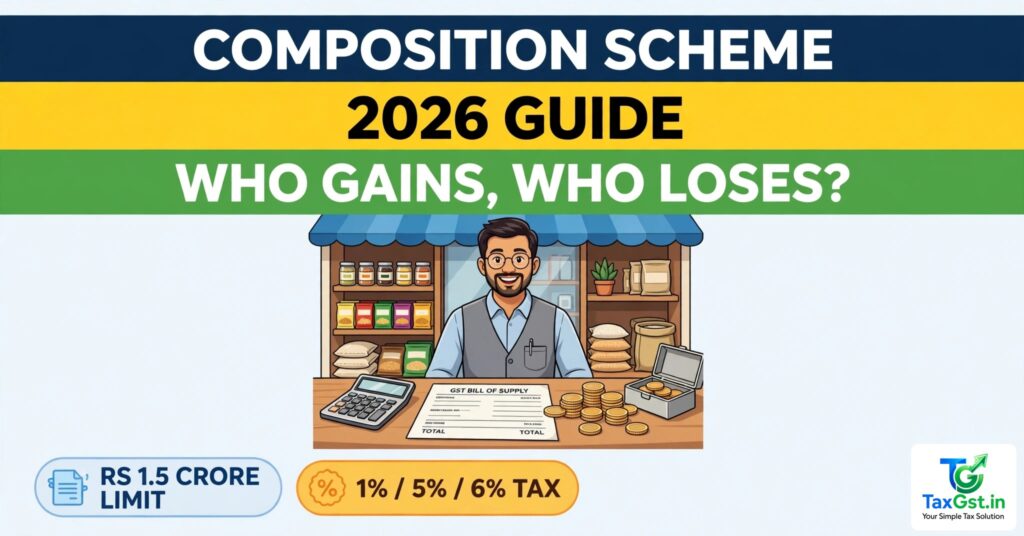
The composition scheme lets small businesses pay GST at 1% (traders and manufacturers), 5% (restaurants) or 6% (small service providers) of turnover instead of filing monthly returns — but you give up input tax credit, cannot sell inter-state, and cannot collect GST from customers. The turnover limits are ₹1.5 crore for goods and ₹50 lakh for services under Section 10(2A). From 1 November 2026 the GST portal has a separate category for Section 10(2A) service providers, and existing composition taxpayers can switch categories through Form REG-14. Verified November 2026 · TaxGST.in
A trader in Jaipur does ₹1.1 crore of turnover a year selling hardware to local shops and walk-in customers. His accountant files GSTR-1 and GSTR-3B every month, reconciles GSTR-2B, and charges him ₹4,000 a month for the privilege. One day he asks the obvious question: is there a simpler way? There is — the composition scheme — but it is a trade, not a free lunch. The scheme swaps monthly returns for a quarterly statement and a flat tax on turnover, and in exchange it takes away your input tax credit and your right to sell outside your state. Whether that trade makes you money depends entirely on your margins and your customers.
For the full GST picture, start with the complete GST hub guides, which cover registration, returns and rates in one place. This article works through the composition numbers so you can decide with a calculator, not a hunch.
Who can opt in — and the two limits that matter
Composition is open to registered persons whose aggregate turnover in the preceding financial year stayed within the limit. There are two separate tracks under Section 10 of the CGST Act, 2017, and mixing them up is the most common mistake:
| Track | Who it covers | Turnover limit (preceding FY) | Tax rate |
|---|---|---|---|
| Section 10(1) | Manufacturers and traders of goods; restaurants not serving alcohol | ₹1.5 crore (₹75 lakh in special-category states) | 1% for manufacturers and traders; 5% for restaurants |
| Section 10(2A) | Service providers not eligible under Section 10(1) | ₹50 lakh | 6% |
The special-category states with the ₹75 lakh limit are Arunachal Pradesh, Manipur, Meghalaya, Mizoram, Nagaland, Sikkim, Tripura and Uttarakhand. The 6% rate for Section 10(2A) services — 3% CGST plus 3% SGST — comes from Notification No. 02/2019-Central Tax (Rate) dated 7 March 2019. The 1% and 5% rates are 0.5% CGST plus 0.5% SGST, and 2.5% plus 2.5% respectively.
Certain businesses are barred outright: anyone making inter-state outward supplies, anyone supplying goods through an e-commerce operator that collects TCS under Section 52, manufacturers of ice cream, pan masala, tobacco and aerated waters, and casual taxable persons and non-resident taxable persons. If any of these apply to you, composition is not on the table at all.
What changed on 1 November 2026
As part of the GST process reforms rolling out from 1 November 2026, GSTN issued an advisory on enhancements to the composition levy functionality. The portal now separately identifies a “Person eligible for composition levy under Section 10(2A)” — earlier, service providers under 10(2A) had no distinct category of their own, which caused confusion at registration. Existing composition taxpayers can now change or update their selected category by filing an amendment in Form GST REG-14. The revised functionality applies to applications through REG-01, CMP-02, CMP-04 and REG-14.
Here is the catch, and it matters: the advisory changes portal functionality only. It does not amend the statutory eligibility conditions, the turnover limits or the tax rates. If you were not eligible for composition on 31 October, the new category does not make you eligible on 1 November. Treat the change as a cleaner form, not a wider door.
The worked numbers: who gains, who loses
Take the Jaipur trader: turnover ₹1.1 crore, purchases ₹95 lakh, gross margin roughly ₹15 lakh. Under the regular scheme he collects GST from customers and claims input tax credit on his purchases, so his net GST cost is roughly the tax on his ₹15 lakh value addition — at 18%, about ₹2.7 lakh, but that is money his customers paid him, not money out of his pocket. Under composition he pays 1% of ₹1.1 crore — ₹1.1 lakh — out of his own pocket, with no credit for the GST embedded in his ₹95 lakh of purchases. That ₹1.1 lakh is about 7% of his ₹15 lakh margin. If his margin were thinner, say 8%, the same ₹1.1 lakh would eat nearly 13% of his profit.
Now take a neighbourhood restaurant doing ₹70 lakh a year. Under the regular scheme a restaurant pays 5% GST without input tax credit anyway, so composition at 5% costs the same tax — but replaces monthly GSTR-1 and GSTR-3B with a quarterly CMP-08 statement and one annual GSTR-4. For the restaurant, composition is nearly pure gain on compliance cost. For a B2B trader whose customers claim input tax credit, composition is usually a loss: your buyers cannot claim any credit on purchases from you, because you do not charge GST at all, so they will quietly move to a regular dealer who gives them credit.
The rule of thumb: composition pays when your customers are mostly end consumers who cannot use input tax credit, your margins are healthy, your inputs carry little GST, and you sell only within your state. It hurts when you sell to businesses, sell inter-state, sell online through marketplaces, or run on thin margins with GST-heavy inputs.
What you give up — the full list
- No input tax credit: GST paid on purchases, rent, equipment and services is a dead cost. You cannot claim it, and you cannot pass it on.
- No collecting tax: you issue a bill of supply, not a tax invoice, and you must not charge GST to customers. The tax comes out of your margin.
- No inter-state sales: every outward supply must be intra-state. One inter-state sale breaches the scheme.
- No e-commerce goods sales: supplying goods through an operator that collects TCS under Section 52 is barred.
- Quarterly payment, annual return: tax is paid quarterly through Form CMP-08, due by the 18th of the month after the quarter, and the annual return GSTR-4 is due by 30 June after the financial year.
Crossing the ₹1.5 crore or ₹50 lakh limit mid-year ends the scheme from the day you cross it. You must switch to the regular scheme, start charging GST, and file the transition forms. Stock held on the switch date needs care too: when you move into composition you must reverse input tax credit on stock through Form ITC-03, and when you move out you can claim credit on stock in hand, subject to the rules. Plan the switch at a financial year boundary, not mid-quarter.
How to opt in — and how to opt out
To join, file Form CMP-02 before the financial year begins — or within 30 days of registration if you are newly registered. To leave, file Form CMP-04; the switch takes effect from the start of the next financial year, or immediately if you have breached a condition. If you are weighing composition against the quarterly QRMP scheme instead, read the QRMP quarterly filing guide first — QRMP keeps your input tax credit and inter-state sales while still cutting return frequency, and for many small businesses it is the better middle ground.
Before you apply, check the registration side as well: the registration form itself changed on 1 November 2026, as the revised REG-01 guide explains, and the ₹1.5 crore threshold only helps if your registration is in order. Also confirm the basics of the GST registration thresholds and documents if you are registering fresh. And remember that composition tax is paid in cash — the payment itself goes through the PMT-06 challan, as the guide to paying GST online explains step by step.
Checklist: decide in 10 minutes
- Check turnover: preceding FY below ₹1.5 crore (goods) or ₹50 lakh (services)? If not, stop here.
- Check customers: mostly consumers, not GST-registered businesses? Composition only works when buyers do not need your credit.
- Check geography: all sales within your state, no e-commerce goods sales?
- Run the margin maths: 1% of turnover (or 6% for services) versus the compliance cost and ITC you give up.
- Check the calendar: opt in with CMP-02 before the year starts; never switch mid-year if you can avoid it.
- Update the portal category: if you are a Section 10(2A) service provider, use the new separate category — and REG-14 if your existing registration still shows the old one.
FAQs
Can a composition dealer sell on Amazon or Flipkart?
Not goods — Section 10 bars supplying goods through an e-commerce operator that collects TCS under Section 52. This is one of the biggest reasons small sellers stay on the regular scheme.
Do I charge GST to my customers under composition?
No. You issue a bill of supply without tax, and you pay 1%, 5% or 6% of turnover out of your own pocket. Your customers get no input tax credit on your supplies.
What is the turnover limit for composition in 2026?
₹1.5 crore in the preceding financial year for manufacturers and traders (₹75 lakh in the eight special-category states), and ₹50 lakh for service providers under Section 10(2A).
What changed for composition on 1 November 2026?
GSTN created a separate portal category for Section 10(2A) service providers and allowed category changes through Form REG-14. Eligibility, limits and rates are unchanged — it is a portal improvement, not a law change.
Can I claim input tax credit on stock when I leave composition?
Yes, on stock in hand at the switch date, subject to the conditions in the rules — but you must reverse credit on stock when you enter composition, via Form ITC-03.
Sources
GSTN Advisory on Enhancements Related to Composition Levy Functionality under GST, dated 1 November 2026 (separate Section 10(2A) category; REG-14 amendments). Section 10, CGST Act, 2017 (composition levy; ₹1.5 crore / ₹50 lakh limits). Notification No. 02/2019-Central Tax (Rate), dated 7 March 2019 (6% rate for Section 10(2A) services). Rules 3 to 7, CGST Rules, 2017 (CMP-02, CMP-04, CMP-08, GSTR-4). 57th GST Council meeting press release, 8 October 2026 (process reforms rolling out from 1 November 2026).
Discover more from TaxGst.in
Subscribe to get the latest posts sent to your email.