
 C.K. Gupta
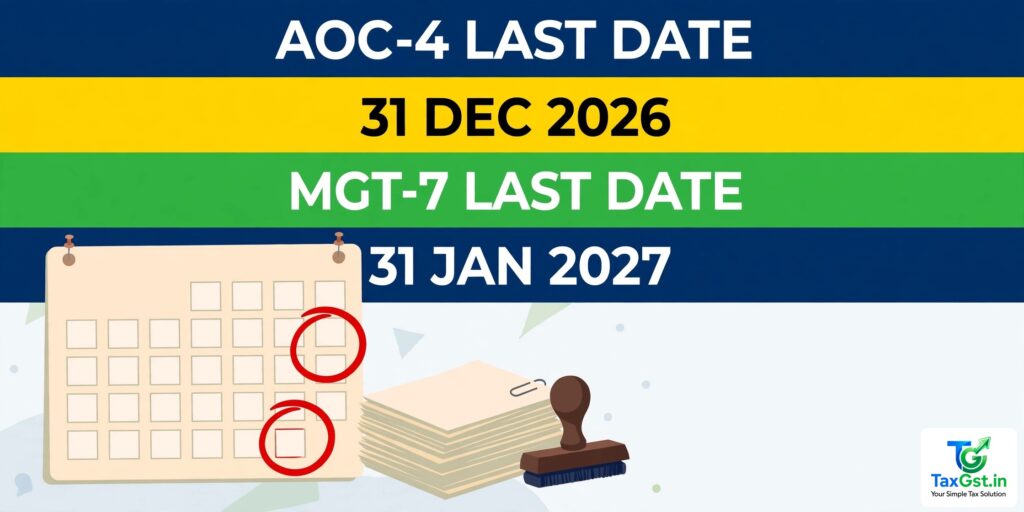
Your company held its AGM on 30 September and the audited accounts are still with the auditor. The AOC-4 was due 30 days after the AGM, and that date has already passed. Before you start calculating the late fee, stop: the Ministry of Corporate Affairs has given every company a fee-free window for FY 2025-26 filings. AOC-4 can go in by 31 December 2026 and MGT-7 by 31 January 2027 with no additional fee at all. But the relief is narrower than it looks, and the trap in it is expensive. Here is exactly what the circular gives, what it does not, and what a late filing actually costs.
What General Circular No. 05/2026 actually says
General Circular No. 05/2026, dated 24 October 2026, was issued after the MCA received representations from stakeholders asking for more time to complete annual filings for FY 2025-26. It allows two sets of filings without payment of additional fees: financial statements in e-forms AOC-4, AOC-4 (CFS), AOC-4 (XBRL), AOC-4 NBFC (Ind AS) and AOC-4 CFS NBFC (Ind AS) up to 31 December 2026; and annual returns in e-forms MGT-7 and MGT-7A up to 31 January 2027. MGT-7A is the abridged annual return for One Person Companies and small companies. The normal filing fee still applies — only the additional fee for delay is waived. And the relief covers only FY 2025-26 filings in the named forms; it does not clear pending filings from earlier years. The compliance calendar hub lists these dates alongside the December GST and income-tax deadlines, so the ROC work can be planned around them rather than colliding with them.
The AGM deadline is not extended — this is the trap
Here is the catch, and it is the single most misunderstood part of this circular. The circular expressly states that it must not be read as extending the statutory time for holding annual general meetings. Your AGM still had to be held within its own deadline — 30 September 2026 for most companies — and a company that missed the AGM remains liable under the Companies Act, 2013. The extra time is for uploading the forms, not for approving the accounts. The same logic applies to ADT-1, the form for appointing the auditor, which is due 15 days from the AGM and gets no relief from this circular at all. If your AGM is done and only the filings are pending, you are inside the relief. If the AGM itself is late, the circular does not help you. The AOC-4 and MGT-7 annual filing checklist covers the documents, attachments, digital signatures and certification checks to run before you file, so the extra weeks are spent on the filing itself rather than on discovering a missing board report at the last minute.
What a late filing costs once the window closes
| Form | Original due date (AGM 30 Sep 2026) | Fee-free until | Additional fee after that |
|---|---|---|---|
| AOC-4 and variants | 30 Oct 2026 (30 days after AGM) | 31 Dec 2026 | ₹100/day, no cap |
| MGT-7 / MGT-7A | 29 Nov 2026 (60 days after AGM) | 31 Jan 2027 | ₹100/day, no cap |
The additional fee is ₹100 per day of delay for each form, with no upper limit, on top of the normal filing fee, under section 403 of the Companies Act, 2013 read with the Companies (Registration Offices and Fees) Rules, 2014. Take a company whose AGM was on 30 September 2026. Its AOC-4 was originally due on 30 October 2026. If it files on 15 January 2027 — two weeks after the relaxed window closes — the delay runs from 31 October 2026 to 15 January 2027, which is 77 days, and the additional fee is 77 × ₹100 = ₹7,700, plus the normal fee. A company late on both AOC-4 and MGT-7 pays ₹200 a day in total, and the meter keeps running for as long as the forms stay unfiled. On top of the fee, sections 137(3) and 92(5) carry separate penalties — ₹10,000 plus ₹100 per day of continuing default, up to ₹2 lakh for the company and ₹50,000 for each officer in default. The fee and the penalty are different things, and the circular waives neither the penalty nor the normal fee. The December 2026 tax deadlines roundup puts the 31 December AOC-4 date next to the other year-end deadlines, including the 31 December belated-ITR and FAST-DS cut-offs, so nothing slips past in the same week.
A practical plan for the next five weeks
First, confirm the AGM actually happened on time and the minutes are signed — if it did not, talk to your company secretary before anything else, because no filing window fixes a late AGM. Second, treat 31 December as the real deadline for AOC-4 even though the fee clock is paused; the last week of December is when portals slow down and auditors go on leave. Third, file MGT-7 in January only after the AOC-4 is accepted, because the annual return draws on the same financials and a correction to one usually means a correction to the other. Fourth, if you are already past the relaxed dates, do not wait for a further extension — the circular says filings after the window attract all fees, including additional fees, counted from the original due date, so every week of waiting adds ₹700 per form. The transfer pricing ITR deadline guide is a useful reminder of the other 30 November cut-off that has already passed for companies with international transactions — that one had no extension at all.
Frequently asked questions
What is the last date to file AOC-4 for FY 2025-26 without additional fees?
31 December 2026, under MCA General Circular No. 05/2026 dated 24 October 2026. The original statutory due date is 30 days after the AGM; the circular waives only the additional fee, not the normal filing fee.
What is the last date to file MGT-7 for FY 2025-26 without additional fees?
31 January 2027. MGT-7A, the abridged return for One Person Companies and small companies, gets the same date.
Does the circular extend the AGM deadline?
No. It expressly does not extend the statutory time for holding AGMs. Companies that missed the AGM deadline remain liable under the Companies Act, 2013.
How much is the late fee if I file after the relaxed dates?
₹100 per day per form, with no upper limit, counted from the original due date — not from 1 January or 1 February 2027. A company 77 days late on AOC-4 pays ₹7,700 in additional fees plus the normal fee.
Does the relief cover earlier years’ pending filings?
No. It applies only to FY 2025-26 financial statements and annual returns in the e-forms named in the circular.
Sources
- Ministry of Corporate Affairs, General Circular No. 05/2026, dated 24 October 2026, “Relaxation of additional fees and extension of time for filing of Financial Statements and Annual Returns under the Companies Act, 2013” — AOC-4 series up to 31 December 2026 and MGT-7/MGT-7A up to 31 January 2027 without additional fees; AGM timelines not extended; fees after the relaxation counted from the original due date.
- Companies Act, 2013, sections 92 (annual return within 60 days of the AGM), 137 (financial statements within 30 days of the AGM) and 403 (additional fees), read with the Companies (Registration Offices and Fees) Rules, 2014 — additional fee of ₹100 per day per form for AOC-4 and MGT-7, with no upper limit; penalties under sections 92(5) and 137(3) of ₹10,000 plus ₹100 per day up to ₹2 lakh for the company and ₹50,000 per officer in default.
Discover more from TaxGst.in
Subscribe to get the latest posts sent to your email.