 C.K. Gupta
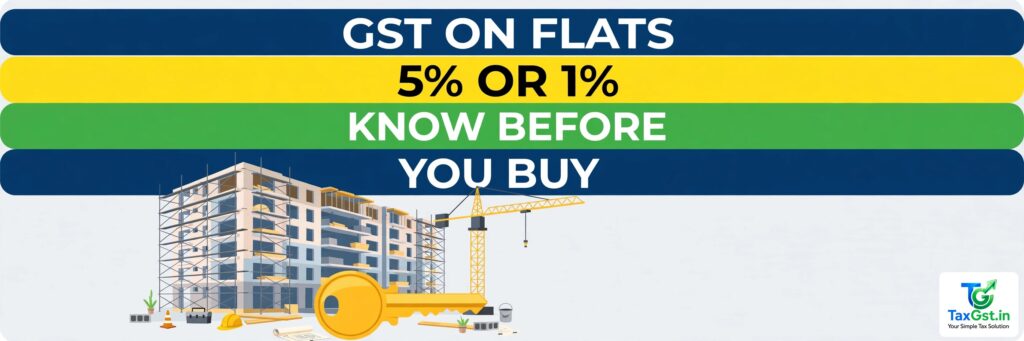
You have found the flat. The builder quotes ₹1 crore, and then the demand letter adds a line you did not budget for: GST, several lakh rupees, payable with the next instalment. Most buyers either overpay because they accept whatever the builder charges, or under-budget because they assume GST does not apply to homes. Both mistakes are avoidable. The GST on an under-construction flat follows a fixed, checkable formula — 5% or 1%, on two-thirds of the price — and a ready-to-move flat pays nothing at all. Here is how to work it out before you sign.
The two rates, and the land deduction that decides the amount
Since 1 April 2019, under Notifications No. 3/2019 to 8/2019-Central Tax (Rate) dated 29 March 2019, construction of a residential apartment sold before completion attracts GST of 5% for ordinary flats and 1% for affordable housing, in both cases without input tax credit. The rate is applied after deducting one-third of the total consideration as the deemed value of land, so GST is charged on two-thirds of the price. The notification rates are 7.5% and 1.5% on that two-thirds value, which works out to 5% and 1% of the total price. This is where a common error creeps in: some blogs apply 5% to the two-thirds value and quote 3.33% of the total. That double-counts the land deduction and understates the tax by a third. The correct figures are 5% and 1% of the total agreement value. The complete GST guide hub carries the current GST rate structure, and these residential rates were not changed by the September 2025 GST 2.0 rationalisation.
Worked examples: what you actually pay
| Flat | Agreement value | Less 1/3 for land | Taxable value | GST |
|---|---|---|---|---|
| Ordinary, under construction | ₹1,00,00,000 | ₹33,33,333 | ₹66,66,667 | ₹5,00,000 (7.5% = 5% of total) |
| Affordable, under construction | ₹45,00,000 | ₹15,00,000 | ₹30,00,000 | ₹45,000 (1.5% = 1% of total) |
| Ready-to-move, completion certificate obtained | ₹1,00,00,000 | — | — | ₹0 |
Two things follow from the numbers. First, the GST is a final cost: neither you nor the developer can claim input tax credit on it under this scheme, so the ₹5 lakh on a ₹1 crore flat is money gone, not money you recover later. Second, the difference between the two rates is large — ₹4.55 lakh on the examples above — which is why the affordable-housing test matters so much. Run the loan numbers alongside the tax: the home loan EMI calculator shows what the GST-inclusive price does to your monthly instalment, because banks lend on the agreement value and the GST usually comes out of your own pocket.
Does your flat qualify for the 1% rate?
Affordable housing needs both conditions, not either one. The carpet area must be up to 60 square metres in metropolitan cities — Mumbai, Delhi NCR, Chennai, Kolkata, Bengaluru and Hyderabad — or up to 90 square metres in non-metropolitan cities and towns. And the total value must be up to ₹45 lakh. A 55 sqm flat in Mumbai at ₹60 lakh fails the value test and pays 5%. A 100 sqm flat at ₹40 lakh fails the area test and pays 5%. The ₹45 lakh cap has not been revised since 2019, so in most metros very few new flats qualify on value at all — which is worth knowing before a builder advertises “1% GST” on a ₹70 lakh flat. Two more conditions sit behind the rate. The developer must buy at least 80% of inputs and input services from registered persons; on any shortfall, the promoter pays 18% on reverse-charge basis. And commercial apartments — shops and offices — inside a residential project pay 5% too, but only where their carpet area is not more than 15% of the total carpet area of all apartments. The GST rates 2026 guide sets out how the 5%, 18% and 40% slabs work across other goods and services, so you can see where the housing rates sit in the wider structure.
When you pay no GST at all — and the other taxes that still apply
The biggest saving is not a lower rate but no rate. Once a building has its completion certificate, or has been occupied for the first time, the sale is neither a supply of goods nor a supply of services under Schedule III, paragraph 5 of the CGST Act — so a ready-to-move flat attracts zero GST, whatever its price. If you are choosing between an under-construction flat at ₹1 crore plus ₹5 lakh GST and a ready flat at ₹1.03 crore with no GST, the ready flat is cheaper on tax alone, before you count the rent you save by moving in now. What GST does not remove is stamp duty and registration, which are state levies charged on top, on the transfer of the property itself. And do not forget the buyer’s TDS: buying any property above ₹50 lakh attracts 1% TDS, which is a separate obligation from GST — the Form 141 property TDS guide walks through the form, the challan and the five errors that trigger notices. When you eventually sell, the capital gains side matters too: the Section 54 house-purchase exemption guide explains how reinvesting in another house can wipe out the long-term capital gains tax.
Frequently asked questions
What is the GST rate on an under-construction flat?
5% for ordinary residential flats and 1% for affordable housing, applied after a one-third deduction for land — so effectively 5% or 1% of the total agreement value, with no input tax credit.
Is GST charged on a ready-to-move flat?
No. Once the completion certificate is obtained or the building is first occupied, the sale is outside GST entirely. Only stamp duty and registration charges apply.
What counts as affordable housing for the 1% rate?
A flat with carpet area up to 60 sqm in metro cities or 90 sqm elsewhere, and a total value up to ₹45 lakh. Both conditions must be met; the ₹45 lakh cap has not changed since 2019.
Can I claim input tax credit on the GST paid on my flat?
No. Under the 1%/5% scheme the developer cannot claim ITC either, and as a homebuyer you have no mechanism to claim it. The GST is a final cost.
Does GST 2.0 change the rates on flats?
No. The September 2025 rate rationalisation left the residential real-estate rates untouched — 1% and 5% without ITC, as they have been since 1 April 2019.
Sources
- Press Information Bureau, 34th GST Council meeting press release, 19 March 2019 — operational details for the 1% affordable and 5% other residential rates, the 60/90 sqm and ₹45 lakh affordable-housing definition, the 80% registered-purchases condition and the 18% reverse-charge on shortfall.
- Notifications No. 3/2019 to 8/2019-Central Tax (Rate), all dated 29 March 2019, effective 1 April 2019 — the rate notifications prescribing 1.5%/7.5% on the value after the one-third land deduction, i.e. 1%/5% effective, without input tax credit.
- CGST Act, 2017, Schedule III, paragraph 5 — sale of a building after the completion certificate or first occupation is neither a supply of goods nor a supply of services, so no GST applies to ready-to-move flats.
Discover more from TaxGst.in
Subscribe to get the latest posts sent to your email.