 C.K. Gupta
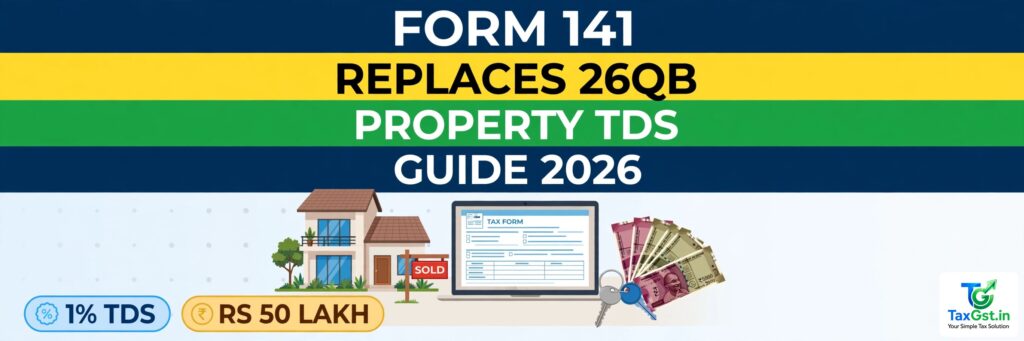
Buying property worth ₹50 lakh or more makes you a tax deductor, whether you are a first-time homebuyer or an investor. Under section 393(1) of the Income-tax Act, 2025 (section 194-IA of the old Act), you must deduct 1% TDS on the higher of the sale price or the stamp duty value, and deposit it through Form 141 Schedule B — the form that replaces Form 26QB from tax year 2026-27 — within 30 days of the end of the month of deduction. Miss the deadline, and interest of 1% to 1.5% a month starts running. Verified November 2026 · TaxGST.in
Meera found a 2BHK in Noida for ₹82 lakh. She paid the seller in full, registered the flat, and moved in — and only learned months later that she was supposed to deduct tax before paying. The seller’s stamp duty value was ₹85 lakh, so her TDS should have been ₹85,000, deducted from the payment itself. Instead she paid the full ₹82 lakh, and the ₹85,000 — plus interest — became her problem. Nobody at the registration desk had told her. This is the most common property-TDS trap in India: buyers think TDS is the seller’s headache. It is not. The law puts the duty squarely on the buyer.
When the rule applies
Section 393(1), Table Sl. No. 3(i) of the Income-tax Act, 2025 — the provision that continues old section 194-IA — applies when you buy immovable property other than rural agricultural land from a resident seller, and the consideration or the stamp duty value is ₹50 lakh or more. The 1% rate has applied since 1 October 2024. Two points trip people up. First, the ₹50 lakh test looks at the total transaction value: since 1 October 2024, the Finance Act, 2024 clarified that if the property costs ₹60 lakh and two buyers each pay ₹30 lakh, TDS still applies — you cannot split your way below the threshold. Second, the 1% is charged on the higher of the sale consideration and the stamp duty value, not whichever number you agreed in the sale deed.
Individual buyers need no TAN for this — the form runs on the buyer’s and seller’s PANs. If the seller is an NRI, stop: this route does not apply at all, and the purchase follows the non-resident TDS rules under section 195 instead. And if the seller has no PAN, the TDS rate jumps to 20% under section 397(2) of the 2025 Act — get the PAN verified before you pay a rupee.
What changed from tax year 2026-27: Form 141 replaces 26QB
From tax year 2026-27 (1 April 2026), Form 26QB has been merged into the new consolidated Form 141 under the Income-tax Act, 2025. For a property purchase from a resident seller, you use Schedule B of Form 141 — “TDS on transfer of immovable property”. The old 26QB label still appears in bank checklists and registration-desk notes, so check the transaction year before selecting the form: payments made on or after 1 April 2026 go through Form 141 Schedule B. The TDS certificate you issue to the seller has also been renumbered — Form 132 replaces the old Form 16B. For the full picture of how the new form numbers map to the old ones, see the TaxGST tax forms guide covering 12BB, 15G, 15H, 10E and 26QB.
The 30-day clock, worked out
The deadline is not 30 days from the payment. It is 30 days from the end of the month in which you deducted the tax. Pay in November and deduct the same month, and your deposit is due by 30 December. Worked example: Meera’s flat had a stamp duty value of ₹85 lakh, higher than the ₹82 lakh agreement value. TDS = 1% of ₹85,00,000 = ₹85,000. Had she deducted it, she would have paid the seller ₹81,15,000 and deposited ₹85,000 with the government. Instead, the full amount went to the seller, and the interest meter started: 1% a month for delay in deduction and 1.5% a month for delay in deposit. On ₹85,000, a six-month delay costs roughly ₹7,650 in interest alone — before any late-filing fee.
For the step-by-step filing route, read the complete TDS hub guides and rates, which covers the portal flow, challans and certificates in one place.
How to file, step by step
- Log in to the Income Tax e-filing portal (incometax.gov.in) and select the TDS on property option — Form 141 Schedule B for tax year 2026-27 onwards.
- Enter both PANs — buyer and seller — plus the property address, the sale consideration and the stamp duty value. The portal computes 1% on the higher value.
- Pay online through net banking or the other modes offered, and submit. The form is a combined challan-cum-statement, so payment and reporting happen together.
- Download the TDS certificate (Form 132) from TRACES and give it to the seller within 15 days of the Form 141 due date, so the seller can claim the credit in their return.
- Keep the acknowledgement. If the seller later says the credit is missing from their records, the fix path for TDS missing from 26AS/AIS starts with exactly this acknowledgement number.
Where there are multiple buyers or sellers, each buyer-seller pair files its own form for its share of the value — but remember, the ₹50 lakh test is applied to the total property value first.
The 5 errors that trigger notices
- Filing the old Form 26QB for a 2026-27 payment. The form is Form 141 Schedule B now; an old-form filing for a new-year transaction can be treated as not filed.
- Deducting on the agreement value and ignoring the stamp duty value. The law taxes the higher figure — under-deduction is the single most common shortfall the department picks up.
- Missing the 30-day window. The clock runs from month-end, not from registration. Put the date in your calendar the day the sale deed is signed.
- Using this route for an NRI seller. Non-resident sellers follow section 195 with a TAN-based process; a Form 141 filing does not discharge that obligation.
- Forgetting the certificate. No Form 132 to the seller means the seller cannot claim the credit — and an unhappy seller is often the person who files the complaint that brings the department to your door.
If you are selling rather than buying, the capital-gains side of the same transaction has its own rules — see how the 12.5% vs 20% indexation choice works when you sell a house.
FAQs
Is Form 26QB still valid?
For payments made up to 31 March 2026, yes — that was the old-Act form. From tax year 2026-27, property TDS is reported through Form 141 Schedule B under section 393(1) of the Income-tax Act, 2025.
What is the TDS rate on property purchase?
1% of the higher of the sale consideration or the stamp duty value, where that value is ₹50 lakh or more. The rate has been 1% since 1 October 2024.
Do I need a TAN to file Form 141?
No. Individual buyers file on the basis of the buyer’s and seller’s PANs. A TAN is needed only for the NRI-seller route under section 195.
What if the seller has no PAN?
TDS must be deducted at 20% under section 397(2) of the Income-tax Act, 2025. Verify the seller’s PAN before payment — a missing PAN is far more expensive than a delayed deal.
What happens if I forget to deduct TDS entirely?
You remain liable for the tax plus interest (1% a month for non-deduction, 1.5% for late deposit), and the seller may not get credit. File the form late with interest rather than not filing at all — the department’s data matching on property registrations catches most omissions.
Sources
Section 393(1), Table Sl. No. 3(i), Income-tax Act, 2025 (corresponding to section 194-IA, Income-tax Act, 1961) — TDS on transfer of immovable property, 1% on the higher of consideration or stamp duty value at ₹50 lakh and above; Finance Act, 2024 clarification that the ₹50 lakh threshold applies to the aggregate transaction value, effective 1 October 2024; Form 141 (Schedule B) and Form 132 under the Income-tax Rules, 2026, replacing Form 26QB and Form 16B from tax year 2026-27; Income Tax Department e-filing portal and TRACES guidance on Form 141 filing and the 30-day deposit window.
Discover more from TaxGst.in
Subscribe to get the latest posts sent to your email.