 C.K. Gupta
In short
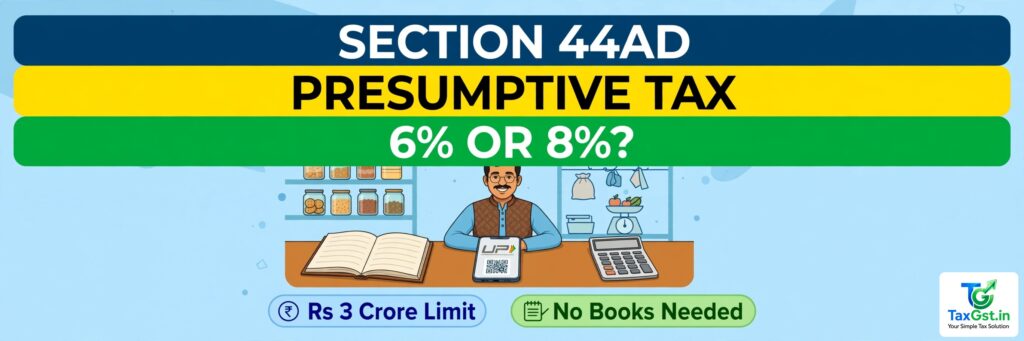
Under Section 58 of the Income-tax Act, 2025 (old Section 44AD), a resident individual, HUF or partnership firm with turnover up to ₹2 crore, or ₹3 crore where cash receipts stay at or below 5% of turnover, can declare income at 8% of turnover, or 6% on the part received through banking or digital modes, and skip maintaining books of account. Declare less than the presumptive figure and books plus audit become compulsory, and opting out after using the scheme locks you out of it for the next five tax years.
Verified November 2026 · TaxGST.in
A trader in Jaipur does ₹1.8 crore of turnover a year, mostly through UPI and bank transfer, and pays ₹25,000 a year in audit fees. Then someone points out that the law lets him declare 6% on digital receipts and 8% on the cash part, pay tax on ₹1,13,400, and keep no books at all.
For the wider picture, start with the income tax hub’s guides to the Income-tax Act, 2025. Freelancers should read the presumptive tax guide for freelancers, then the ITR form guide. Advance tax works differently here: the advance tax guide on instalments and interest. First, work out your numbers on the income tax calculator.
What presumptive tax actually means
Presumptive tax is the law guessing your profit for you: instead of proving every expense with bills, you declare a fixed percentage of turnover as income and the department accepts it. The scheme lives in Section 58 of the Income-tax Act, 2025. It is a floor, not a ceiling: if your actual profit is higher, the higher figure is your taxable income.
Who can use it, and who cannot
The scheme is open to a resident individual, a Hindu Undivided Family, or a partnership firm, excluding a limited liability partnership. Companies and LLPs are out. Commission or brokerage income, agency business and specified professions are also out of the general category: professionals have their own entry at 50% of gross receipts, capped at ₹50 lakh, or ₹75 lakh where cash receipts stay at or below 5%. Goods carriage operators have their own entry too.
The turnover limits: ₹2 crore, or ₹3 crore if you stay mostly digital
| Situation | Turnover limit |
|---|---|
| Cash receipts above 5% of turnover | ₹2 crore |
| Cash receipts at or below 5% of turnover | ₹3 crore |
The test is on cash receipts only: a trader at ₹2.9 crore with 4% cash qualifies, while one at ₹2.1 crore with 15% cash does not.
The rates: 6% on digital receipts, 8% on the rest
Presumptive income is 8% of turnover, except that the part received through banking or digital modes is taxed at 6%. The 6% rate applies to amounts received through those modes during the tax year or before the return due date under Section 263(1).
Worked example 1: the ₹1.8 crore trader who pays no tax
Take an individual trader with turnover of ₹1.8 crore, of which 85% comes through digital modes and 15% in cash. The digital part is ₹1,53,00,000, and 6% of that is ₹91,800. The cash part is ₹27,00,000, and 8% of that is ₹21,600. Presumptive income is ₹91,800 plus ₹21,600, which is ₹1,13,400. Cash receipts are 15% of turnover, above the 5% mark, so the ordinary ₹2 crore limit applies, and ₹1.8 crore sits comfortably inside it.
Now the tax. Under the new regime in Section 202 of the 2025 Act, income up to ₹4 lakh is taxed at nil. ₹1,13,400 is below that line, so with no other income, the tax is zero. Compare that with the same trader’s real margin: at a genuine 12% margin on ₹1.8 crore, actual profit would be ₹21.6 lakh. The presumptive figure of ₹1,13,400 is far lower, and that gap is exactly why the scheme exists. But be careful with the logic here. Declaring the presumptive figure is lawful only if you genuinely opt for the scheme and meet all its conditions. It is not a licence to hide a real profit you have already recorded in proper books. If your books show ₹21.6 lakh of profit and you declare ₹1,13,400 without opting into the scheme properly, that is not tax planning, it is a wrong return.
Worked example 2: the ₹2.9 crore trader at the top of the scheme
Take a trader with turnover of ₹2.9 crore, cash receipts of 4% of turnover, and everything received digitally. Cash receipts are ₹11,60,000, under 5%, so the enhanced ₹3 crore limit applies and ₹2.9 crore qualifies. Presumptive income is 6% of ₹2,90,00,000, which is ₹17,40,000.
The tax on ₹17,40,000 under the new regime, worked slab by slab: nil on the first ₹4 lakh; 5% on the next ₹4 lakh, which is ₹20,000; 10% on the next ₹4 lakh, which is ₹40,000; 15% on the next ₹4 lakh, which is ₹60,000; and 20% on the remaining ₹1,40,000, which is ₹28,000. Tax before cess is ₹1,48,000. Add 4% health and education cess of ₹5,920, and the total is ₹1,53,920. The Section 156 rebate does not apply here, because total income of ₹17.4 lakh is above the ₹12 lakh rebate limit. This assumes no other income and no deduction claimed against the presumptive income, which brings us to the newest trap in the scheme.
The new trap: Section 58(4) blocks set-offs against presumptive income
The 2025 Act added something old Section 44AD did not have. Section 58(4) says no loss, allowance or deduction allowable under the Act shall be allowed against presumptive income. The Economic Times illustrated it with ₹18 lakh of presumptive income and a ₹6 lakh short-term capital loss: the loss cannot be adjusted, and taxable income stays at ₹18 lakh.
Declaring less: books, audit and a five-year lock-out
If you claim actual profit lower than the presumptive figure and your total income exceeds the ₹4 lakh exemption limit, Section 58(3) requires books of account and an audit under Section 63. Under Section 58(7), declaring outside the scheme in any of the next five tax years bars you from it for five tax years after the year you opted out.
Advance tax: one payment, by 15 March
Presumptive taxpayers pay advance tax in a single instalment by 15 March, not four instalments. Miss it and interest follows.
FAQs
Can a private limited company use presumptive tax?
No. The scheme is open only to resident individuals, HUFs and partnership firms other than LLPs. A company must maintain books and compute profit the regular way.
My turnover is ₹2.5 crore and 3% of my receipts are cash. Do I qualify?
Yes. Cash receipts of 3% are within the 5% limit, so the enhanced ₹3 crore ceiling applies and ₹2.5 crore is inside it. Your presumptive income is 6% on the digital part and 8% on the cash part.
Can I declare a profit higher than 6% or 8%?
Yes, and the law expects it where your actual profit is higher. Presumptive income is a floor. If your real profit is ₹5 lakh on ₹1 crore of turnover, declare ₹5 lakh, not ₹60,000 or ₹80,000.
What happens if I declare less than the presumptive income?
If your total income is above the ₹4 lakh exemption limit, you must maintain books of account and get them audited under Section 58(3). And if you had used the scheme in an earlier year, opting out triggers the five-year lock-out under Section 58(7).
Sources
Income-tax Act, 2025, Section 58 (presumptive taxation: Serial No. 1 general business, Serial No. 2 goods carriage, Serial No. 3 specified professionals), including Section 58(3) (books and audit where lower profit is claimed), Section 58(4) (no loss, allowance or deduction against presumptive income) and Section 58(7) (five-year lock-out), and Section 202 (new tax regime slabs) with Section 156 (rebate up to ₹60,000 on income up to ₹12 lakh). Old provisions for reference only: Sections 44AD, 44ADA and 44AE, Income-tax Act, 1961; Finance Act, 2023 (enhanced ₹3 crore turnover limit). The Economic Times, “Presumptive taxation: Rebate to losses and deductions, what is the practical impact of changes under Income Tax Act, 2025”, on the Section 58(4) set-off ban and its worked illustration. Taxmann, “Complexity within Simplicity: Presumptive Taxation under the Income Tax Act 2025”, quoting Sections 58(2), 58(3), 58(4) and 58(7), including the 6% timing condition tied to the return due date under Section 263(1).
Discover more from TaxGst.in
Subscribe to get the latest posts sent to your email.