
 C.K. Gupta
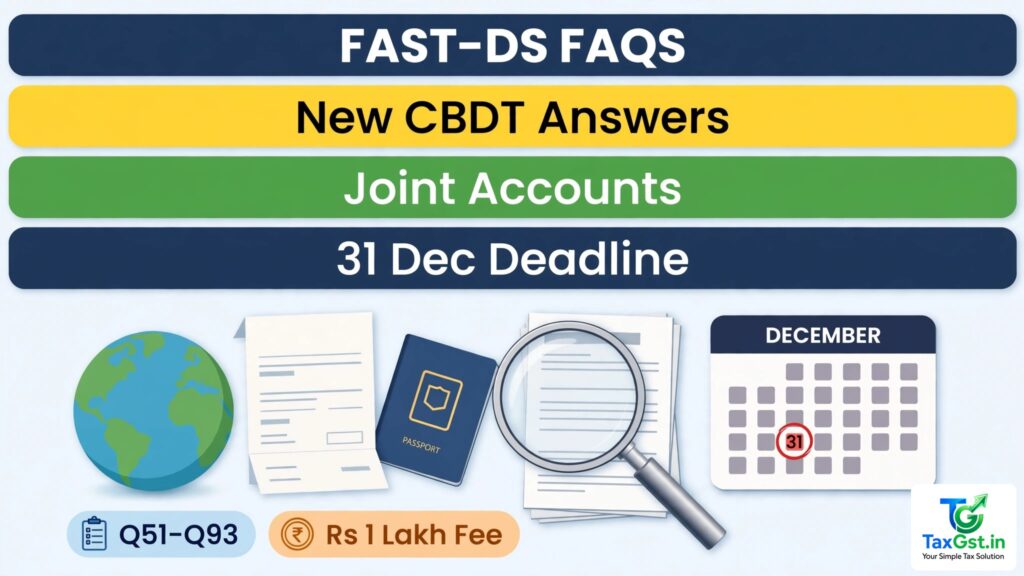
When FAST-DS opened on 16 August 2026, the scheme looked simple on paper: undisclosed foreign assets up to ₹1 crore at 60%, or assets bought from taxed income but left out of Schedule FA up to ₹5 crore for a flat ₹1 lakh fee. Then people sat down to actually file, and the questions started. What if only one of my three foreign income streams was never taxed? What if two of my three assets were declared and one was not? My account is joint with my spouse — who declares what? The first set of FAQs (Q1 to Q50) did not answer these. The supplementary FAQs, Q51 to Q93, released on 20 November 2026, do. Here are the answers that change decisions, with the worked numbers the CBDT itself used. If you have not read the scheme itself yet, start with the full FAST-DS guide, which explains both categories, the valuation rules and the 2+2 month payment clock — this article covers only what the new FAQs add.
Declare only what was never offered to tax
The single most useful clarification is Q51. A resident taxpayer with income from several overseas sources, who offered only some of it to tax, declares only the streams that were never offered. The CBDT’s own example makes it concrete: rental income of ₹2 crore, already offered to tax — not required. Interest income of ₹30 lakh, not offered — may be declared. Dividend income of ₹40 lakh, not offered — may be declared. The declaration is stream by stream, not all-or-nothing. Q52 applies the same logic to assets under Category B: a taxpayer owns ESOPs worth ₹20 lakh and land worth ₹3 crore, both declared in Schedule FA, plus mutual funds worth ₹2.5 crore that were never declared. Only the mutual funds go into the Category B declaration. And Q53 closes the loophole in the other direction: if you declare only part of your undisclosed income under Category A, immunity covers only what you actually declared. Whatever you leave out stays fully exposed to the Black Money Act. The income tax hub carries the wider foreign-income and disclosure guides, and the second FAST-DS article explains how the two categories interact when a taxpayer has both kinds of lapse.
The ₹1 lakh fee is one fee for everything — but only for clean money
Q82 and Q83 settle a question that had kept people guessing: Category B is one flat fee of ₹1 lakh for all your assets and all the years, as long as their total in your Form 1 is within ₹5 crore. It is not ₹1 lakh per asset, and not ₹1 lakh per year. But Q70 draws the hard line around it. An asset bought even partly from income that was not taxed cannot go into Category B at all. It can be declared in Category A, at 60%, if eligible. So a US brokerage account funded half from your NRI salary and half from Indian income you never declared is a Category A asset, not a Category B one — and getting that classification wrong is the single most expensive mistake in the scheme. Work it through with real numbers: a ₹40 lakh account, half clean and half not, declared under Category B would cost ₹1 lakh; declared correctly under Category A it costs 60% of ₹40 lakh, which is ₹24 lakh. The difference is why the FAQs spend so much space on mixed sources of acquisition, gifted and inherited assets, and fractional shares. If any part of the money is unexplained, assume Category A and get professional advice before filing.
Joint accounts, dollars and the valuation date
Q57 and Q58 answer the joint-account question plainly: each holder whose name is on the account declares it, at their share — or an equal share if no share is fixed. So a joint account of ₹60 lakh with your spouse, with no shares specified, means ₹30 lakh each in your respective declarations, and each of you tests your own ₹1 crore or ₹5 crore limit against your own share. Q55 fixes the dollar conversion that trips up every valuation: US dollars convert at ₹94.6543, the RBI reference rate of 30 March 2026, because no rate was published on 31 March 2026. Every asset is valued as on 31 March 2026, and Rule 5(2) still gives a 20% valuation tolerance — if the Assessing Officer later values an asset up to 20% higher than you declared, the declaration is not treated as invalid. The FAQs also confirm the alternative indexed-cost method, and they address company directorships and authorised signatories: being a signatory does not by itself make the money yours, but the underlying beneficial ownership is what the department will examine.
The revised-return shortcut — and who cannot use it
Q68 is the quiet gift in the new FAQs. If tax year 2025-26 is the only year in which a disclosure was missed, a revised return for that year filed by 31 March 2027 is treated as enough — you do not need FAST-DS for that year at all. That matters because the revised-return window for tax year 2025-26 now runs to 31 March 2027, as the revised and updated return guide explains. But read the condition carefully: only year. If you missed disclosures in earlier years too, the shortcut does not apply, and FAST-DS is still the route. The FAQs also draw the line on concluded versus pending proceedings under the Black Money Act — a declaration cannot be used to reopen a matter that is already concluded — and they confirm the eligibility of former residents and RNOR taxpayers, who were resident in India in the year the asset was acquired or the income arose. Before you decide which route fits, check the ITR form guide — a wrong form can make a return defective, and a defective return is no return at all.
What to do in the next 36 days
The window closes on 31 December 2026 and there is no hint of an extension. If you are considering FAST-DS, the sequence is: first, list every foreign asset and every foreign income stream, year by year, and mark each one offered-to-tax or not; second, split the list into Category A (untaxed source) and Category B (taxed source, reporting lapse only), remembering Q70 — any untaxed part pushes the whole asset to Category A; third, value everything as on 31 March 2026, converting dollars at ₹94.6543; fourth, file Form 1 electronically on the e-filing portal before 31 December 2026. After that, the authority issues Form 2 fixing the amount payable, you pay through the designated challan and intimate in Form 3, and the authority issues Form 4, the immunity certificate, within one month of the end of the month in which Form 3 was filed. The payment clock is strict — two months from the end of the month of Form 2 without interest, up to two more months at 1% a month, and beyond four months the declaration is void. And remember the boundary the first FAST-DS guide warned about: the immunity covers tax, penalty and prosecution under the Income-tax Act and the Black Money Act only. It does not settle FEMA or PMLA exposure.
Frequently asked questions
Do I have to declare foreign income I already paid tax on?
No. Under Q51, you declare only income or assets that were not offered to tax in the ITR. Rental income of ₹2 crore already taxed needs no declaration; interest of ₹30 lakh and dividends of ₹40 lakh never offered to tax may be declared.
I declared two of my three foreign assets in Schedule FA. Can I use FAST-DS for the third?
Yes, under Q52. Only the asset omitted from Schedule FA goes into the Category B declaration, subject to the ₹5 crore aggregate limit and the flat ₹1 lakh fee.
Can I declare only part of my undisclosed foreign income?
You can, but under Q53 immunity covers only what you actually declare. Income left out of the declaration stays exposed to the Black Money Act, including its 120% liability and prosecution.
How do I convert US dollars for the 31 March 2026 valuation?
At ₹94.6543 per dollar, the RBI reference rate of 30 March 2026, per Q55. No RBI reference rate was published on 31 March 2026 itself.
I only missed the disclosure in tax year 2025-26. Do I still need FAST-DS?
Probably not. Under Q68, if tax year 2025-26 is the only year missed, a revised return filed by 31 March 2027 is treated as enough. If earlier years are also missed, FAST-DS is still the route.
Sources
- CBDT supplementary FAQs on FAST-DS, Q51 to Q93, released 20 November 2026 — clarifications on partial declarations (Q51–Q53), the US dollar conversion rate (Q55), joint accounts (Q57–Q58), the revised-return shortcut (Q68), mixed sources of acquisition (Q70), and the single ₹1 lakh Category B fee (Q82–Q83). Reported by The Economic Times, 21 November 2026, and TaxGuru.
- CBDT Notification No. 114/2026-Income Tax, dated 14 August 2026 — Foreign Assets of Small Taxpayers-Disclosure Scheme Rules, 2026, under Chapter IV (Sections 130 to 144) of the Finance Act, 2026; Form 1 window 16 August to 31 December 2026; valuation date 31 March 2026; Rule 5(2) 20% valuation tolerance.
- Finance Act, 2026, Section 135 — the 2+2 month payment architecture: two months without interest, up to two further months at 1% simple interest per month, declaration void beyond four months.
Discover more from TaxGst.in
Subscribe to get the latest posts sent to your email.