 C.K. Gupta
Meera retired from a private company last year with a monthly pension of ₹45,000 and a commuted lump sum of ₹12 lakh. Her husband’s friend, a retired central government officer, took a similar lump sum and paid no tax on it at all. Meera paid tax on most of hers. Neither of them did anything wrong. The difference is the type of pension, the employer, and one small fact: whether gratuity was also received. Pension looks like one income, but the tax law treats it as three different things, and mixing them up is how retirees overpay.
Uncommuted pension: taxed as salary
The monthly pension you receive after retirement, the uncommuted pension, is taxed under the head Salaries, exactly like salary income. It is added to your total income and taxed at your slab rates. The good news is that pensioners get the same standard deduction as salaried employees: ₹75,000 in the new regime and ₹50,000 in the old regime for tax year 2026-27. Work it out with a simple case. A pension of ₹60,000 a month is ₹7,20,000 a year. Less the ₹75,000 standard deduction in the new regime, taxable income is ₹6,45,000. At new-regime slabs that is ₹12,250 of tax before cess, and in practice the rebate under Section 156 wipes out tax entirely up to ₹12 lakh of total income, so a pensioner at this level pays nothing. The Section 87A rebate guide explains that ₹12 lakh zero-tax limit in full, and the income-tax hub carries the new-regime slabs for tax year 2026-27. Check your own numbers on the income-tax calculator before assuming you are inside the limit, because pension plus interest plus any other income is what counts, not the pension alone.
Commuted pension: the lump sum, and who escapes tax on it
Commutation means taking part of your future pension as a lump sum at retirement, in exchange for a lower monthly pension afterwards. The tax treatment depends entirely on who your employer was, and it is governed by Section 19(1) Table Sl. 7 of the Income-tax Act, 2025, which carries forward the old Section 10(10A) of the 1961 Act. If you retired from the Central Government, a State Government, a local authority, or a specified statutory corporation, the commuted pension is fully exempt. Every rupee of the lump sum is tax-free. If you retired from any other employer, only a portion is exempt, and the portion depends on gratuity. Where gratuity was also received, one-third of the full commuted value is exempt. Where no gratuity was received, one-half of the full commuted value is exempt. The balance is taxable as salary.
Take a real example. A private-sector employee commutes pension with a full commuted value of ₹30 lakh and receives gratuity of ₹8 lakh. One-third of ₹30 lakh, or ₹10 lakh, is exempt. The remaining ₹20 lakh is taxable in the year of receipt. Had the same employee received no gratuity, one-half, or ₹15 lakh, would be exempt and ₹15 lakh taxable. That ₹5 lakh difference is worth about ₹1,56,000 of tax at the 30% slab plus cess, which is why the gratuity question is the first thing to check. Two practical points: the exempt portion still has to be disclosed in the Exempt Income schedule of your ITR, and the commutation percentage itself is capped by your pension rules, usually at 40% of the pension, so you cannot commute everything to escape tax. Retirees who also received gratuity should read the guide on the ₹20 lakh gratuity exemption, and those who encashed leave should check the ₹25 lakh leave-encashment exemption, because all three land in the same retirement year.
Family pension: different head, different deduction
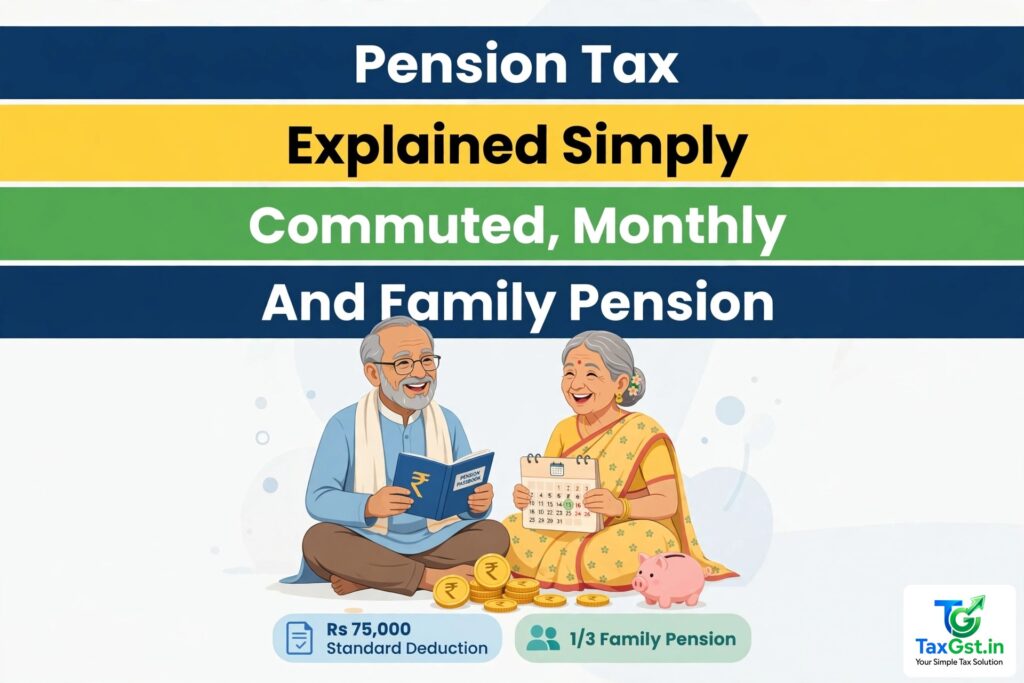
Family pension is what a spouse or eligible family member receives after the pensioner dies. Here is the trap most families fall into: it is NOT taxed as salary. It is taxed under Income from Other Sources, which means the salary standard deduction does not apply to it at all. Instead there is a separate deduction under Section 93(1)(d) of the Income-tax Act, 2025, the successor to Section 57(iia) of the old Act: one-third of the family pension, subject to a cap of ₹25,000 a year in the new regime and ₹15,000 a year in the old regime, whichever is lower.
Work it out. A widow receives ₹30,000 a month as family pension, or ₹3,60,000 a year. One-third is ₹1,20,000, but the cap applies, so the deduction is ₹25,000 in the new regime and taxable family pension is ₹3,35,000. In the old regime the deduction is ₹15,000 and taxable family pension is ₹3,45,000. At a 5% slab rate that ₹10,000 difference in deduction is only ₹500 of tax, but the bigger mistake is claiming the ₹75,000 standard deduction against family pension, which the law does not allow. A family pensioner with no salary income also cannot claim the standard deduction at all. If the family pensioner is 75 or older and the pension comes through a bank, the bank may file the return under Section 194P, as explained in the guide on how the bank files the return for senior citizens aged 75 and above.
NPS, annuity and the other retirement receipts
Not every retirement receipt is pension. If you exit the National Pension System at 60, up to 60% of the corpus taken as lump sum is exempt, and the remaining 40% must go into an annuity, whose monthly payouts are taxable as income from other sources in the year received. The NPS exit guide works through the lump-sum-versus-annuity choice with numbers. Annuity payouts from insurance pension plans are taxed the same way, at slab rates, with no special exemption. And if your employer contributed to NPS for you, that contribution is deductible up to 14% of salary even in the new regime, as the employer NPS contribution guide explains. The point is to map every receipt to its own head before you file: salary for your own pension, other sources for family pension and annuities, exempt income for the qualifying commuted portion and the NPS lump sum. Pensioners with interest income should also check the 80TTA versus 80TTB comparison, because senior citizens get a ₹50,000 interest deduction under the old regime that pairs with pension income.
A five-point checklist before you file
First, separate your receipts: own pension, commuted lump sum, family pension, annuity, NPS. Second, apply the right deduction to each: standard deduction only against salary pension, one-third capped deduction only against family pension. Third, check the commuted exemption against your employer type and gratuity receipt before you report the lump sum. Fourth, disclose the exempt portion in the Exempt Income schedule; exempt does not mean invisible, and the department matches it against the employer’s reporting. Fifth, compare regimes. The new regime’s ₹75,000 standard deduction and ₹12 lakh rebate usually win for pensioners, but the old regime can win if you have large 80C, 80D and 80TTB deductions, so run both before you file.
Frequently asked questions
Is my monthly pension fully taxable?
Yes, as salary income, but you get the standard deduction of ₹75,000 in the new regime or ₹50,000 in the old, and the Section 156 rebate can bring tax to zero up to ₹12 lakh of total income in the new regime.
Is commuted pension tax-free for private-sector employees?
Only partly. One-third of the full commuted value is exempt if gratuity was received, one-half if no gratuity was received. The rest is taxable. Government employees get full exemption.
Can I claim the standard deduction on family pension?
No. Family pension is taxed under other sources, not salary, so the standard deduction does not apply. You get a separate deduction of one-third of the family pension, capped at ₹25,000 in the new regime and ₹15,000 in the old.
Do I need to report exempt commuted pension in my ITR?
Yes. The exempt portion must be disclosed in the Exempt Income schedule of your return, even though no tax is payable on it.
Is NPS lump sum on exit at 60 taxable?
Up to 60% of the corpus taken as lump sum is exempt. The balance must buy an annuity, and the annuity payouts are taxable in the year you receive them.
Sources
- Income-tax Act, 2025, Section 19(1) Table Sl. 7 (commuted pension exemption, formerly Section 10(10A) of the Income-tax Act, 1961) and Section 93(1)(d) (family pension deduction, formerly Section 57(iia)); standard deduction of ₹75,000 for salary and pension income under the new regime and ₹50,000 under the old regime, for tax year 2026-27.
- Income-tax Act, 2025, Section 156 (rebate up to ₹60,000 for resident individuals with total income up to ₹12 lakh under the new regime, formerly Section 87A) and Section 194P (bank filing for senior citizens aged 75 and above).
- Income Tax Department e-filing guidance on pension taxation and the Exempt Income schedule; Aditya Birla Capital Life Insurance, “Are Retirement Benefits Taxable in India in 2026?” and HDFC Pension, “Is Pension Taxable?” (verified 22 November 2026) for the commuted-pension fractions and family-pension caps.
Discover more from TaxGst.in
Subscribe to get the latest posts sent to your email.