C.K. Gupta
Rohan earns ₹12.4 lakh a year. His colleague earns ₹11.9 lakh. The colleague pays no tax at all. Rohan, whose salary is only ₹50,000 higher, expected a tax bill of about ₹67,000. His actual bill was ₹40,000, and it could have been lower still. The difference is not a trick. It is the Section 156 rebate, the provision most people still call Section 87A, plus a safety valve called marginal relief. Here is how the zero-tax limit really works, where it stops working, and the three mistakes that cost people money every year.
The rebate is not an exemption
First, the point most explainers get wrong. Section 156 does not make your income exempt. Your tax is computed first on the normal slab rates, and then the rebate wipes it out, up to a limit. That matters because the rebate only applies to tax on income charged at slab rates. It does not reduce tax on income charged at special rates, and it is available only to resident individuals, not to NRIs, HUFs or firms.
Under the Income-tax Act, 2025, which governs tax year 2026-27 onwards, the provision sits at Section 156. Before 1 April 2026 it was Section 87A of the 1961 Act. The new regime itself is Section 202(1) of the 2025 Act (old Section 115BAC). The numbers are unchanged: in the new regime the rebate is up to ₹60,000 where total income does not exceed ₹12 lakh. In the old regime it is up to ₹12,500 where total income does not exceed ₹5 lakh.
The new-regime slabs, worked out
For tax year 2026-27 the new-regime slabs are: nil up to ₹4 lakh; 5% from ₹4 lakh to ₹8 lakh; 10% from ₹8 lakh to ₹12 lakh; 15% to ₹16 lakh; 20% to ₹20 lakh; 25% to ₹24 lakh; and 30% above ₹24 lakh. Add 4% health and education cess on the tax. At exactly ₹12 lakh of taxable income, the slab tax comes to ₹60,000, and the rebate cancels it in full. That is the whole secret of the ₹12 lakh zero-tax headline.
| Taxable income | Slab tax before rebate | Rebate / marginal relief | Tax payable* |
|---|---|---|---|
| ₹10,00,000 | ₹40,000 | ₹40,000 rebate | Nil |
| ₹12,00,000 | ₹60,000 | ₹60,000 rebate | Nil |
| ₹12,10,000 | ₹61,500 | Marginal relief: tax capped at ₹10,000 | ₹10,000 |
| ₹12,50,000 | ₹67,500 | Marginal relief: tax capped at ₹50,000 | ₹50,000 |
| ₹13,00,000 | ₹75,000 | Marginal relief: tax capped at ₹1,00,000, so no benefit | ₹75,000 |
*Before 4% cess. At ₹13 lakh the slab tax of ₹75,000 is already below the ₹1,00,000 excess, so marginal relief stops helping and full tax applies.
Marginal relief: the cliff softener
Without marginal relief, earning ₹1 more than ₹12 lakh would cost you the entire ₹60,000 rebate in one jump. That is the cliff everyone feared when the ₹12 lakh limit was announced in the 2025 Budget. Marginal relief, built into the new regime, says the extra tax you pay cannot exceed the amount by which your income crosses ₹12 lakh. Earn ₹12,10,000 and your tax is capped at ₹10,000. Earn ₹12,50,000 and it is capped at ₹50,000. The relief fades out once the slab tax itself is lower than the excess, which happens at around ₹12,75,000 of taxable income. Note that marginal relief exists only in the new regime. In the old regime, crossing ₹5 lakh by ₹1 costs you the full ₹12,500 rebate.
The salaried ₹12.75 lakh threshold
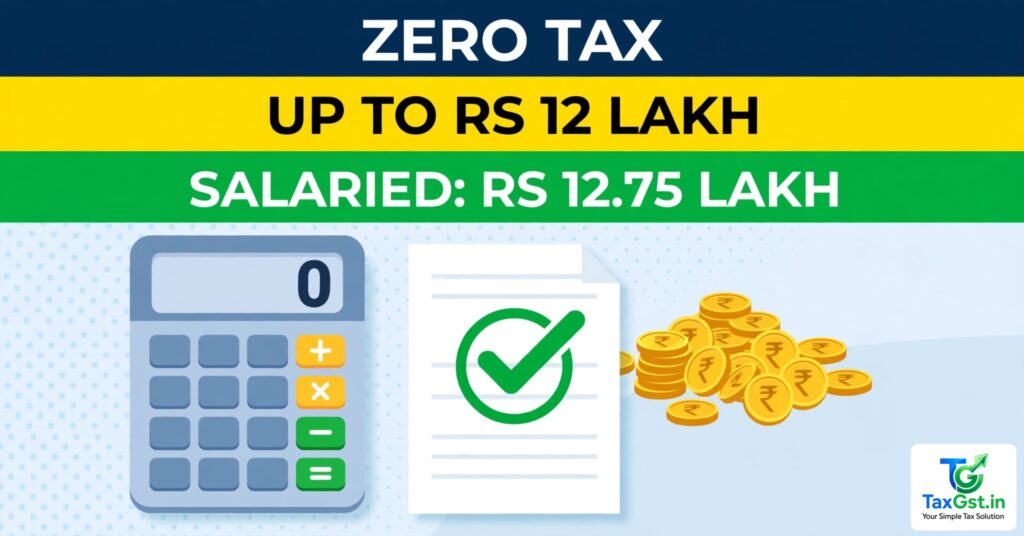
Here is where the headline number quietly grows. Salaried employees and pensioners get a standard deduction of ₹75,000 in the new regime (₹50,000 in the old). The rebate limit applies to taxable income, after the standard deduction. So a salaried person with gross salary of ₹12,75,000 has taxable income of ₹12,00,000 after the standard deduction, and pays no tax. That is why you will see two numbers quoted, ₹12 lakh and ₹12.75 lakh, and both are right. If you are self-employed or a freelancer with no salary income, your zero-tax line stays at ₹12 lakh. Check your own numbers on the income-tax calculator before you assume you are inside the limit.
Where the rebate does not work
The rebate covers only tax computed at slab rates. The Finance Act, 2025 and a CBDT clarification issued in February 2026 confirm that it is not available against tax on income charged at special rates. The two cases that catch people out are short-term capital gains on listed equity shares and equity mutual funds (Section 111A, taxed at 20%) and long-term capital gains on listed equity (Section 112A, taxed at 12.5% above the ₹1.25 lakh annual exemption). If your total income is ₹11 lakh but ₹2 lakh of it is listed-equity capital gains, the rebate shelters the slab-rate tax, not the gains tax. File carefully: the e-filing utility applies this split automatically, but many taxpayers discover it only when the processed return shows a demand. The income-tax hub carries the full guide to which incomes are taxed at special rates and which are not.
A second trap is the regime itself. The rebate limits differ sharply between regimes, and the new regime is now the default. If you opted for the old regime for its deductions, your rebate ceiling is ₹5 lakh, not ₹12 lakh. That trade-off is exactly what the complete Section 80C guide helps you weigh: ₹1.5 lakh of deductions is worth ₹46,800 at the 30% slab, but only if your income is high enough that the old regime wins overall.
Three mistakes to avoid this December
First, confusing gross salary with taxable income. Your employer deducts TDS on an estimate that already includes the standard deduction, but bonuses, arrears and perquisites all count. A December bonus can push you over ₹12 lakh after you assumed you were safe. Second, forgetting that the rebate is claimed in the return, not in advance. Your employer cannot apply Section 156 while deducting TDS; the refund comes when you file. Third, assuming the old regime is better because of 80C. At incomes near ₹12 lakh, the new regime’s rebate is usually worth far more than ₹1.5 lakh of deductions. Run both regimes before you lock your declaration, and if your employer has already asked for proofs, the December investment-proof guide explains what to submit and what changes nothing in the new regime.
Frequently asked questions
Is income up to ₹12 lakh really tax-free, or is that a myth?
It is real, but conditional. Your taxable income must not exceed ₹12 lakh, you must be a resident individual, and the rebate applies only to slab-rate tax. Salaried taxpayers reach ₹12.75 lakh of gross salary because of the ₹75,000 standard deduction.
What happens if my income is ₹12,01,000?
Marginal relief caps your tax at ₹1,000, the amount by which your income exceeds ₹12 lakh, plus 4% cess. You do not suddenly owe ₹60,000.
Does the rebate apply to capital gains?
No, not to gains taxed at special rates. Short-term gains on listed equity (20%) and long-term gains on listed equity (12.5%) are outside the rebate. Other capital gains taxed at slab rates are covered.
Can NRIs claim the Section 156 rebate?
No. The rebate is available only to resident individuals.
Does the old regime have marginal relief too?
No. Marginal relief applies only in the new regime. In the old regime, crossing ₹5 lakh of total income removes the entire ₹12,500 rebate.
Sources
- Finance Act, 2025 — enhanced Section 87A rebate to ₹60,000 for total income up to ₹12 lakh under the new regime; revised new-regime slabs under Section 115BAC(1A).
- Income-tax Act, 2025, Section 156 (rebate, formerly Section 87A) and Section 202(1) (new regime, formerly Section 115BAC), effective 1 April 2026.
- CBDT clarification, February 2026 — Section 87A/156 rebate not available against tax on income chargeable at special rates, including Sections 111A and 112A capital gains.
- Income-tax Act, 2025, standard deduction of ₹75,000 for salaried individuals and pensioners under the new regime (₹50,000 under the old regime).
Discover more from TaxGst.in
Subscribe to get the latest posts sent to your email.