C.K. Gupta
Imagine this. You win your appeal. The Commissioner (Appeals) examines your books, accepts your explanation, and directs the department to give you the full TDS credit you claimed. The order becomes final — the department does not even challenge it. Three months later, a reassessment notice lands in your inbox, demanding tax on ₹65.52 lakh of “escaped income” built on the exact same figures the CIT(A) had just decided.
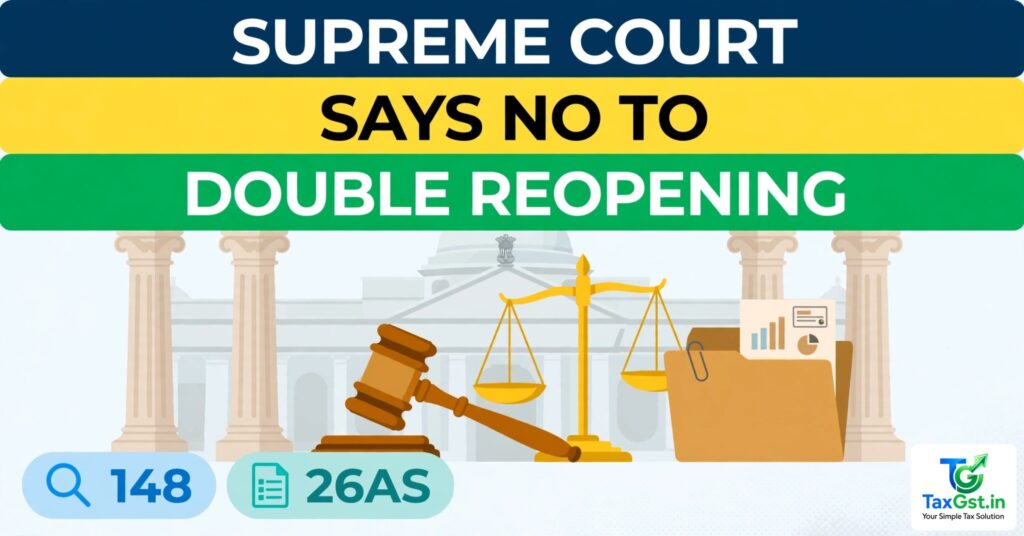
That is what happened to Ashok Kumar Manish Kumar HUF. And on 18 November 2026, the Supreme Court refused to revive the reassessment, dismissing the Revenue’s special leave petition. The case is a sharp reminder of a limit the department cannot cross: it cannot reopen what an appellate authority has already decided, on the same material, by calling it new information.
For the full framework of how reassessment works, see the Income Tax hub — notices, assessments, appeals and refunds explained.
How a ₹65.52 lakh demand grew out of a TDS credit
The story starts with a routine return. For assessment year 2022-23, the HUF declared total income of ₹8,24,770 and claimed TDS credit of ₹7,15,391. When the return was processed under Section 143(1) of the Income-tax Act, 1961, the Centralised Processing Centre cut the credit down to ₹2,83,663, citing a mismatch with Form 26AS.
The HUF asked for rectification under Section 154. Its explanation was specific: ₹73,94,574 of interest income had been recorded in the business accounts of M/s Ranka Dyeing Mills, against which interest expenditure of ₹74,83,321 had been accounted for — the net figure sat under the business head. A further ₹6,47,842 was disclosed under Income from Other Sources. The CPC rejected the rectification.
The HUF appealed. On 4 December 2025, the CIT(A) passed an order under Section 250 accepting the reconciliation and directing that the full TDS credit be granted after verification with Form 26AS, with consequential relief. The appellate authority had examined where the interest was accounted for and how it had been disclosed in the return. The Revenue did not challenge that order. It attained finality.
The reopening: same figures, new label
Even so, the Assessing Officer issued a notice under Section 148 on 23 March 2026, based on a sanction note dated 20 March 2026. The note compared deposit interest of ₹71,99,135 identified during e-verification with deposit interest of ₹6,47,429 shown under Income from Other Sources — and treated the difference of ₹65,51,706 as potential escaped income.
The comparison left out the one thing that mattered: the interest disclosure in the business accounts that the CIT(A) had already examined. The ₹73,94,574 in the business books was simply not in the note’s arithmetic.
The department’s route was the e-Verification Scheme, 2021, notified under Section 135A. The sanction note treated the verification report as information under Section 148(3)(iv) and invoked Section 148A(4) to issue the notice directly under Section 148. The Revenue also argued the writ petition was premature, since the taxpayer had approached the High Court before responding to the notice.
If you have received a 143(1) intimation with a similar credit cut, the Section 143(1) intimation guide explains how to read the computation and reply to mismatches.
What the Rajasthan High Court decided
The Rajasthan High Court (D.B. Civil Writ Petition No. 8724/2026, decided 1 May 2026) looked past the label and examined the material underlying the portal flag. It found the sanction note drew on the same figures and information that had been before the CIT(A). The earlier appeal had already resolved the factual premise of the proposed reopening — namely, whether the interest had been disclosed.
In the absence of fresh material, revisiting that premise amounted to a change of opinion and an impermissible challenge to a final appellate adjudication. The Court set aside the notice, the sanction note and all consequential proceedings.
The Court relied on CIT v. Kelvinator of India Ltd. (2010) 320 ITR 561 (SC), the landmark authority that a reassessment cannot rest on a mere change of opinion: the Assessing Officer must have tangible material suggesting escapement of income. A portal flag that re-packages figures already examined in appeal is not tangible material.
What the Supreme Court did on 18 November 2026
The Revenue went to the Supreme Court in Joint Commissioner of Income Tax & Ors. v. Ashok Kumar Manish Kumar HUF, SLP (Civil) Diary No. 67250/2026, before Justices J.B. Pardiwala and K. Vinod Chandran. The Court condoned the delay, heard senior counsel for the Revenue, and dismissed the petition, recording that it found “no good ground to interfere” with the High Court’s order.
A dismissal at the special-leave stage is not a detailed judgment on the merits — the reasoned ruling on Section 148 remains the Rajasthan High Court’s judgment. But the effect is the same: the quashing stands, and the ₹65.52 lakh reopening is dead.
This is the second Supreme Court reassessment decision in a month that favours taxpayers. The November 2026 Supreme Court reassessment rulings — Khyati Popat and the YK Sabharwal ₹255 crore reopening covers the companion cases, and the October 2026 ruling that reassessment is invalid without a Section 143(2) notice sets out the other procedural guardrail.
The practical lesson: your first defence is the paper trail
The most significant feature of this case is where the dispute started: a Section 143(1) intimation. The underlying interest disclosure was expressly examined in appeal — and that appellate finding became the taxpayer’s strongest shield. Three things to take from it (and if you are facing scrutiny rather than reassessment, the income tax scrutiny notice guide explains why cases get picked and what to file in reply):
1. Build a receipt-wise reconciliation. When Form 26AS shows interest, map every rupee to where it sits in your return — business head, other sources, or wherever it belongs. The HUF won because it could show, line by line, that the ₹73.94 lakh was in the business accounts and the ₹6.47 lakh was under other sources. A one-line “already disclosed” would not have carried the same weight.
2. Compare the sanction note with the appellate findings. If you receive a Section 148 notice, the first question is not whether the figures look alarming — it is whether the “information” behind the notice is anything the department did not already have. Read the sanction note against your CIT(A) order. If the note’s figures are the same ones the appeal decided, that is the core of your reply.
3. A portal flag is not fresh material by itself. A High Risk e-Verification flag on the Insight Portal re-surfaces data; it does not create new facts. If the verification report adds nothing beyond figures already examined, the reopening rests on a change of opinion — and Kelvinator says that is not enough.
One caution: this does not mean every reassessment is invalid. Genuine fresh material — a transaction the department genuinely did not know about — can still support reopening. The protection here is narrow and specific: the same issue, the same figures, already decided in appeal.
Key dates and figures
| Event | Date / figure |
|---|---|
| Assessment year | 2022-23 |
| Income declared | ₹8,24,770 |
| TDS credit claimed | ₹7,15,391 |
| Credit allowed by CPC under Section 143(1) | ₹2,83,663 |
| CIT(A) order accepting the reconciliation | 4 December 2025 |
| Section 148 notice issued | 23 March 2026 |
| Amount treated as escaped income | ₹65,51,706 |
| Rajasthan High Court quashes the notice | 1 May 2026 |
| Supreme Court dismisses the Revenue’s SLP | 18 November 2026 |
FAQs
Can the Income Tax Department reopen a case on the same issue already decided in appeal?
No — not on the same material. In this case the Supreme Court let stand the Rajasthan High Court’s order quashing a Section 148 notice, because the CIT(A) had already examined and decided the same Form 26AS mismatch. Reopening on the same facts is a mere change of opinion, which CIT v. Kelvinator of India Ltd. (2010) 320 ITR 561 (SC) bars.
What is a change of opinion in reassessment law?
It is when the Assessing Officer revisits a conclusion already reached on the same material, without any new tangible material suggesting income escaped assessment. A change of opinion alone cannot justify reopening under Section 148.
Does an e-Verification flag on the Insight Portal count as fresh information?
Not by itself. In this case the High Court found the verification report relied on the same figures already before the CIT(A). A portal flag that re-packages examined data is not fresh material.
What should I do if I get a Section 148 notice after winning an appeal?
Compare the sanction note’s figures with your appellate order, receipt by receipt. If the notice rests on the same material the appeal decided, say so in your reply and in your objection under Section 148A, and keep the CIT(A) order ready as your first exhibit. Take professional advice before the reply deadline — reassessment timelines are short.
Which sections apply under the new Income-tax Act, 2025?
Assessment year 2022-23 was governed by the Income-tax Act, 1961 (Sections 148, 148A, 143(1), 154, 250). Under the Income-tax Act, 2025, which applies from 1 April 2026, the reassessment framework sits in Sections 279 to 281. The change-of-opinion principle from Kelvinator continues to apply.
Sources
- Supreme Court of India — Joint Commissioner of Income Tax & Ors. v. Ashok Kumar Manish Kumar HUF, SLP (Civil) Diary No. 67250/2026, order dated 18 November 2026 (Justices J.B. Pardiwala and K. Vinod Chandran): “Delay condoned… we find no good ground to interfere with the impugned Order passed by the High Court. The Special Leave Petition is, accordingly, dismissed.”
- Rajasthan High Court — Ashok Kumar Manish Kumar HUF v. Joint Commissioner of Income Tax & Ors., D.B. Civil Writ Petition No. 8724/2026, decided 1 May 2026.
- CIT v. Kelvinator of India Ltd. (2010) 320 ITR 561 (SC) — reassessment on a mere change of opinion and the requirement of tangible material.
- Kunhayammed v. State of Kerala (2000) 6 SCC 359 — doctrine of merger on dismissal of a special leave petition.
- TaxGuru report, “Section 148 Reopening Barred on Same Form 26AS Mismatch Already Decided by CIT(A): SC Dismisses Revenue’s SLP”, 19 November 2026.
Discover more from TaxGst.in
Subscribe to get the latest posts sent to your email.