C.K. Gupta
Rohan’s father was diagnosed with Parkinson’s disease last year. The medicines cost ₹6,000 a month, the physiotherapy another ₹4,000, and Rohan pays for all of it. When he filed his return, he claimed the ₹40,000 his colleague had mentioned — and missed another ₹75,000 he was entitled to, because nobody told him the two deductions sit in different sections and cover different things.
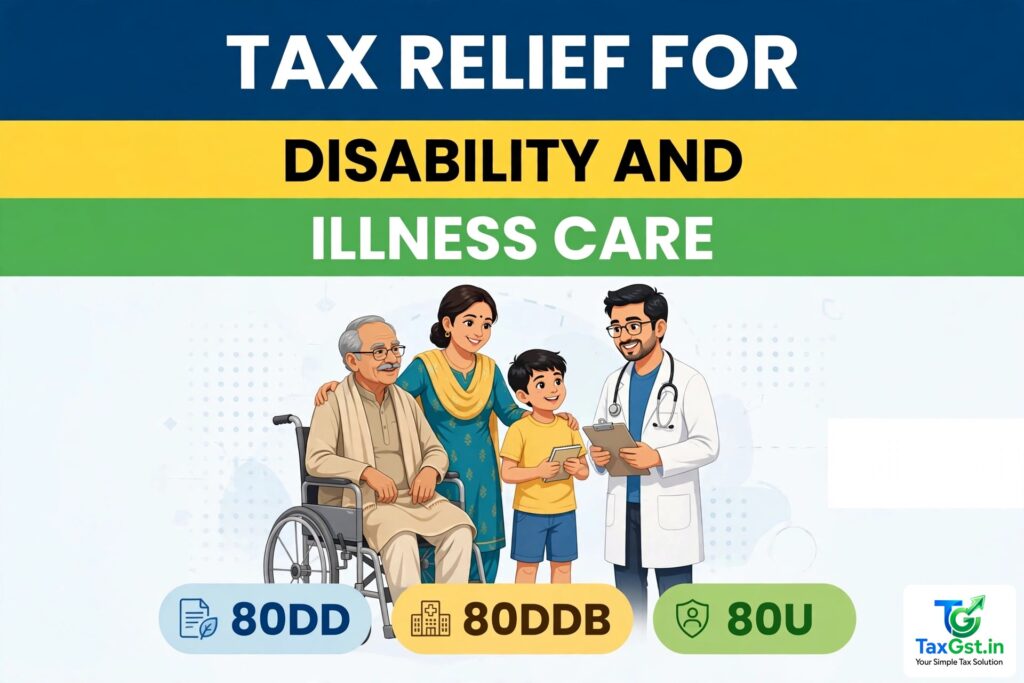
This is the most common mistake with disability and medical deductions: people mix up Sections 80DD, 80DDB and 80U, claim one, and leave the other on the table. They are three separate doors. Here is which one is yours, what each pays, and what certificate you need before you claim it.
All three sit in Chapter VIII of the Income-tax Act, 2025 — Sections 127, 128 and 154 (old Sections 80DD, 80DDB and 80U of the 1961 Act). And all three share one hard limit: they are available only under the old tax regime. If you file under the default new regime, none of them applies — so check your regime choice first.
For the full map of old-regime deductions, see the deductions hub — every Section 80C to 80U deduction in one place.
Section 127 (old 80DD): the flat ₹75,000 for a disabled dependent
Section 127 is for a resident individual or HUF who maintains a dependent with a disability. The dependent, for an individual, means your spouse, children, parents, brothers or sisters; for an HUF, a member of the HUF.
The deduction is flat — ₹75,000 for a disability of 40% or more, and ₹1,25,000 for severe disability (80% or more). Flat means exactly that: you get the full amount whether you spent ₹20,000 or ₹2,00,000 on the dependent’s care. No bills to add up, no receipts to total. The deduction covers expenditure on medical treatment, nursing, training and rehabilitation of the dependent — and also any premium paid for an insurance scheme for the dependent’s maintenance.
Disability here has a defined meaning: blindness, low vision, leprosy-cured, hearing impairment, locomotor disability, mental retardation and mental illness, among the categories certified by a medical authority. The disability must be certified — a certificate in the prescribed form (Form 10-IA) from the medical authority is mandatory. Without the certificate, the claim fails, however genuine the expenses. And note: Section 127 is about the dependent. If you yourself have the disability, this section does not apply — Section 154 does (below).
Section 128 (old 80DDB): actual treatment costs for specified diseases
Section 128 works the opposite way. It is not flat — it is the lower of your actual expenditure and a cap: ₹40,000 where the patient is below 60, and ₹1,00,000 where the patient is a senior citizen (60 or above). It applies to a resident individual or HUF paying for medical treatment of specified diseases — for yourself or a dependent.
And “specified” is the operative word. Only the diseases listed in Rule 11DD of the Income-tax Rules qualify:
- Neurological diseases with disability of 40% or more — dementia, dystonia musculorum deformans, motor neuron disease, ataxia, chorea, hemiballismus, aphasia, Parkinson’s disease
- Malignant cancers
- Full-blown AIDS
- Chronic renal failure
- Haematological disorders — haemophilia and thalassaemia
Diabetes, hypertension, a bypass surgery, a general hospitalisation — none of these qualifies, however large the bill. If the disease is not on the Rule 11DD list, Section 128 gives nothing.
Two more conditions. First, the treatment must be certified — a certificate in Form 10-I from a prescribed specialist (a neurologist, oncologist, urologist, haematologist or immunologist, depending on the disease). Second, the deduction is reduced by any amount reimbursed by an insurer or an employer. If your father’s cancer treatment cost ₹90,000 and the insurer paid ₹50,000, only ₹40,000 counts — and the cap is ₹40,000 anyway.
For health cover itself, the Section 80D health insurance guide explains premiums, preventive check-ups and the senior-citizen limits.
Section 154 (old 80U): if you yourself have a disability
Section 154 is the mirror image of Section 127 — for a resident individual who is himself or herself a person with disability. Same flat amounts: ₹75,000 for a disability of 40% or more, ₹1,25,000 for severe disability (80% or more). Same certification requirement from a medical authority. No bills needed.
The difference is only who the disabled person is. You cannot claim Section 127 for yourself and you cannot claim Section 154 for a dependent. Families where both situations exist — say, a taxpayer with a disability who also supports a disabled parent — can claim both sections, because they cover different people.
Can you claim 80DD and 80DDB together?
Yes — when the conditions for each are met separately. Section 127 is a flat amount for maintaining a disabled dependent; Section 128 is actual expenditure on a specified disease. If your dependent has a disability and undergoes treatment for a specified disease, both claims can stand in the same year. What you cannot do is count the same rupee twice: the flat 80DD amount needs no expenditure proof at all, while 80DDB is capped at what you actually spent (minus reimbursements).
A worked example. Rohan, 38, salary ₹12,00,000, old regime, 20% slab. His father, 67, has Parkinson’s disease (a specified neurological disease) with 60% certified disability. Rohan pays ₹1,20,000 a year for his father’s treatment and maintenance.
| Claim | Amount |
|---|---|
| Section 127 (old 80DD) — flat, dependent with 40%+ disability | ₹75,000 |
| Section 128 (old 80DDB) — actual spend ₹1,20,000, senior patient cap | ₹1,00,000 |
| Total deduction | ₹1,75,000 |
| Tax saved at 20% slab + 4% cess (20.8%) | ₹36,400 |
Had Rohan claimed only the ₹40,000 his colleague mentioned, he would have left ₹1,35,000 of deduction — about ₹28,000 of tax — unclaimed. Note the senior-patient cap matters: because his father is over 60, the 80DDB cap is ₹1,00,000, not ₹40,000.
To see what the total saving looks like against your full tax bill, work out your numbers on the income tax calculator before choosing between the old and new regimes.
Quick comparison
| Section 127 (80DD) | Section 128 (80DDB) | Section 154 (80U) | |
|---|---|---|---|
| Who is disabled / ill | Your dependent | You or your dependent | You |
| What it covers | Maintenance, treatment, training, rehabilitation | Treatment of specified diseases only | Your own disability |
| Amount | Flat ₹75,000 / ₹1,25,000 | Actual spend, capped ₹40,000 / ₹1,00,000 | Flat ₹75,000 / ₹1,25,000 |
| Bills needed? | No | Yes — actual expenditure | No |
| Certificate | Form 10-IA, medical authority | Form 10-I, prescribed specialist | Form 10-IA, medical authority |
| Regime | Old only | Old only | Old only |
Before you claim: the checklist
- Regime: all three deductions need the old regime. If you are in the new regime, switching costs you the standard deduction structure — run both and compare.
- Certificate first: get Form 10-IA (disability) or Form 10-I (specified disease) before filing. A claim without the certificate is routinely disallowed.
- Senior-patient cap: for Section 128, the patient’s age decides the cap — ₹1,00,000 if the patient is 60 or above, even if the taxpayer claiming is younger.
- Reduce for reimbursements: Section 128 is net of insurance or employer reimbursement.
- Keep the certificate with the return: you do not attach it, but keep it ready — the department can ask for it in scrutiny.
Senior citizens have a wider set of benefits beyond these sections — the senior and super senior citizen tax benefits guide covers the 60/80 age thresholds, higher exemption limits and Section 80TTB. And if you are mapping your full old-regime claim, the complete Section 80C guide lists all 13 options under the ₹1.5 lakh cap, while the Section 80E guide covers education-loan interest with no upper limit.
FAQs
What is the difference between Section 80DD and Section 80DDB?
Section 127 (old 80DD) is a flat ₹75,000/₹1,25,000 for maintaining a dependent with a disability — no bills needed. Section 128 (old 80DDB) reimburses actual medical expenditure, capped at ₹40,000 (₹1,00,000 for a senior patient), and only for the specified diseases in Rule 11DD, such as cancer, chronic renal failure and Parkinson’s disease.
Can I claim both 80DD and 80DDB in the same year?
Yes, when the conditions for each are met separately — for example, a disabled dependent who also receives treatment for a specified disease. The flat 80DD amount and the actual-expenditure 80DDB amount are independent claims, but the same expense cannot be counted twice.
Is diabetes covered under Section 80DDB?
No. Section 128 covers only the diseases listed in Rule 11DD — neurological diseases, malignant cancers, AIDS, chronic renal failure, haemophilia and thalassaemia. Diabetes, hypertension and general hospitalisation are not covered.
What certificate do I need for 80DD and 80DDB?
For disability (Sections 127 and 154), a certificate in Form 10-IA from a medical authority. For specified diseases (Section 128), a certificate in Form 10-I from a prescribed specialist — a neurologist, oncologist, urologist, haematologist or immunologist, depending on the disease.
Are 80DD, 80DDB and 80U available in the new tax regime?
No. All three are Chapter VIII deductions available only under the old regime. If you opt for the default new regime, you cannot claim them.
Sources
- Income-tax Act, 2025 — Section 127 (deduction for maintenance of a dependant with disability), Section 128 (deduction for medical treatment of specified disease), Section 154 (deduction for a person with disability); corresponding to Sections 80DD, 80DDB and 80U of the Income-tax Act, 1961.
- Income-tax Rules — Rule 11DD (specified diseases for Section 128) and the prescribed certificates Form 10-I (specified disease) and Form 10-IA (disability).
- Finance Act, 2025 — confirms the deduction limits (₹75,000/₹1,25,000 and ₹40,000/₹1,00,000) carried into the Income-tax Act, 2025 from 1 April 2026.
Discover more from TaxGst.in
Subscribe to get the latest posts sent to your email.