 C.K. Gupta
In short
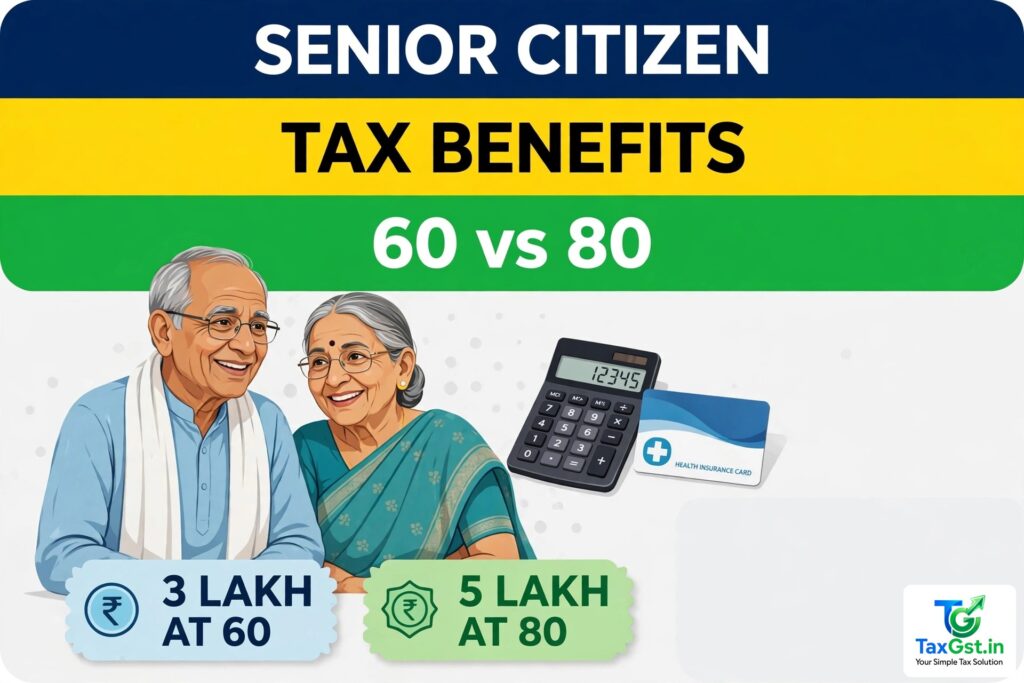
For income tax, you are a senior citizen at 60 and a super senior citizen at 80 — and only if you are resident in India. The old-regime payoff is real: a ₹3 lakh tax-free limit at 60–79 and ₹5 lakh at 80+, a ₹50,000 deduction on deposit interest, up to ₹50,000 (₹1,00,000 in specified cases) on health insurance and medical costs, no advance tax if you have no business income, and, at 75+, no return at all if your only income is pension plus interest from the same bank. Under the new regime the age-based basic limits flatten to ₹4 lakh — so which regime wins depends on your deductions, not your birthday alone.
Verified October 2026 · TaxGST.in
Two neighbours, both 72, both with ₹6 lakh of pension and interest income, paid very different tax last year. One filed under the new regime and paid on ₹2 lakh above the ₹4 lakh limit. The other stayed in the old regime, claimed his ₹3 lakh basic limit plus ₹50,000 of interest deduction and ₹50,000 of health-insurance deduction, and paid on ₹2 lakh too — but at lower effective rates and with a refund of TDS already cut. The lesson is not that one regime always wins. It is that the senior-citizen benefits only help if you actually claim them, and most of them are not automatic.
Start with the deduction side: the deductions guide hub covers 80C, 80D and the other chapters in one place. If retirement cash-flow is the question, the NPS exit-at-60 guide explains what part of your pension pot is taxable, and the mid-year tax-moves checklist lists the moves still open before March. For the TDS side of deposit interest, see the TDS rates and thresholds chart, and for the full income-tax framework, the income-tax guide hub.
Who counts, and from when
A senior citizen is a resident individual aged 60 or more but below 80 at any time during the relevant previous year; a super senior citizen is a resident individual aged 80 or more at any time during that year. Two details trip people up. First, residence matters: a non-resident of the same age gets none of these benefits. Second, the test is age during the year, not age at filing — if you turn 60 in February, you are a senior citizen for that whole financial year. And in practice, the age that counts is the age on the last day of the previous year for the super-senior category in some provisions, so check the specific section rather than assuming.
The benefits, side by side
| Benefit | Senior (60–79) | Super senior (80+) |
|---|---|---|
| Basic exemption, old regime | ₹3,00,000 | ₹5,00,000 |
| Basic exemption, new regime | ₹4,00,000 | ₹4,00,000 |
| Interest deduction (80TTB, old regime) | Up to ₹50,000 | Up to ₹50,000 |
| Health insurance / medical (80D, old regime) | Up to ₹50,000 premium; medical spend counts in specified cases | Up to ₹1,00,000 including medical expenditure |
| Specified-disease treatment (80DDB, old regime) | Up to ₹1,00,000 | Up to ₹1,00,000 |
| Advance tax | Not required if no business income | Not required if no business income |
| Paper return filing | — | Allowed in ITR-1 / ITR-4 where eligible |
Read that table with the new-regime warning attached: the new regime’s ₹4 lakh basic limit applies equally to a 62-year-old and an 82-year-old, and it allows none of the 80TTB, 80D or 80DDB deductions above. So a super senior with large medical bills and ₹50,000 of deposit interest will almost always do better in the old regime, while a senior with little deduction-eligible spending and income well above ₹4 lakh may do better in the new one. Run both computations every year; the answer changes as medical spending and interest income change.
Three benefits people leave unclaimed
1. The ₹50,000 interest deduction (80TTB). It covers interest on savings accounts, fixed deposits, recurring deposits and post-office deposits — not just FDs — but only under the old regime and only for resident seniors. It replaces the ₹10,000 savings-interest deduction younger taxpayers get; you cannot claim both. And it is separate from the TDS threshold: your bank may deduct no TDS below ₹1,00,000 of interest, but you still claim only ₹50,000 as a deduction.
2. Medical expenditure without insurance (80D). A senior who pays health-insurance premiums gets up to ₹50,000; a super senior (and, in specified cases, a senior) who incurs actual medical expenditure can also count that spending, up to ₹1,00,000 in total in the super-senior case. Keep every bill and prescription — the deduction is only as good as its paperwork.
3. No return at all at 75+ (the 194P route). A resident senior aged 75 or above, with no income other than pension and interest from the same bank that pays the pension, need not file a return at all if that bank deducts the full tax due. Here’s the catch: the exemption covers only that narrow income pattern. Add rental income, capital gains or interest from a second bank, and the exemption falls away — you file like everyone else.
A worked comparison
Take a 68-year-old with ₹5,50,000 of pension and ₹1,00,000 of deposit interest: total ₹6,50,000. Old regime: basic limit ₹3,00,000, less 80TTB ₹50,000 and 80D premium ₹50,000, leaves ₹2,50,000 taxable — roughly ₹12,500 of tax before cess at old-regime slab rates. New regime: ₹4,00,000 basic limit, no deductions, leaves ₹2,50,000 taxable as well — but under the new-regime slabs that slice falls in the nil-to-low band, and the rebate structure may wipe it out entirely. In this example the new regime wins; add ₹1,00,000 of medical spending to the old-regime side and the answer flips. There is no shortcut around running both numbers.
Checklist for the year you turn 60 — and 80
- Tell your bank your date of birth is on record, so the ₹1,00,000 TDS threshold applies from the right year.
- Switch your return computation to compare both regimes; do not auto-continue last year’s choice.
- Collect 80D bills through the year, not in March — medical expenditure is the deduction most often lost to missing paper.
- At 75, check the 194P conditions before deciding not to file — one extra income source ends the exemption.
- At 80, remember the paper-filing option exists if the portal is a barrier; it is not a lesser return.
FAQs
At what age do I become a senior citizen for tax?
At 60, if you are resident in India. Super senior status starts at 80. The test is your age during the financial year.
Is the ₹5 lakh super-senior limit available in the new regime?
No. The ₹5 lakh limit is an old-regime figure. In the new regime the basic limit is ₹4 lakh for seniors and super seniors alike.
Can I claim both 80TTA and 80TTB?
No. Senior citizens claim 80TTB (up to ₹50,000 on deposit interest) instead of the ₹10,000 80TTA savings-interest deduction.
Do I really not need to pay advance tax after 60?
If you are a resident senior with no business income, yes — you pay self-assessment tax instead. With business income, advance tax still applies.
I am 76 with only pension and one bank’s interest. Must I file?
Not if that bank deducts the full tax due on your pension plus interest. Any other income source brings the filing obligation back.
Sources
Income-tax Act provisions for senior and super senior citizens: basic exemption limits under the old regime (₹3,00,000 senior, ₹5,00,000 super senior) and the new-regime ₹4,00,000 limit; Section 80TTB (₹50,000 deposit-interest deduction, resident seniors, old regime); Section 80D (₹50,000 health-insurance premium for seniors, up to ₹1,00,000 including medical expenditure for super seniors); Section 80DDB (up to ₹1,00,000 specified-disease treatment); advance-tax exemption for resident seniors without business income; paper filing for super seniors in ITR-1/ITR-4; and the Section 194P no-return route for specified seniors aged 75+ with pension plus same-bank interest only. Finance Act, 2025 TDS thresholds (₹1,00,000 senior-citizen bank-interest threshold) for the TDS figures quoted.
Discover more from TaxGst.in
Subscribe to get the latest posts sent to your email.