
 C.K. Gupta
In short
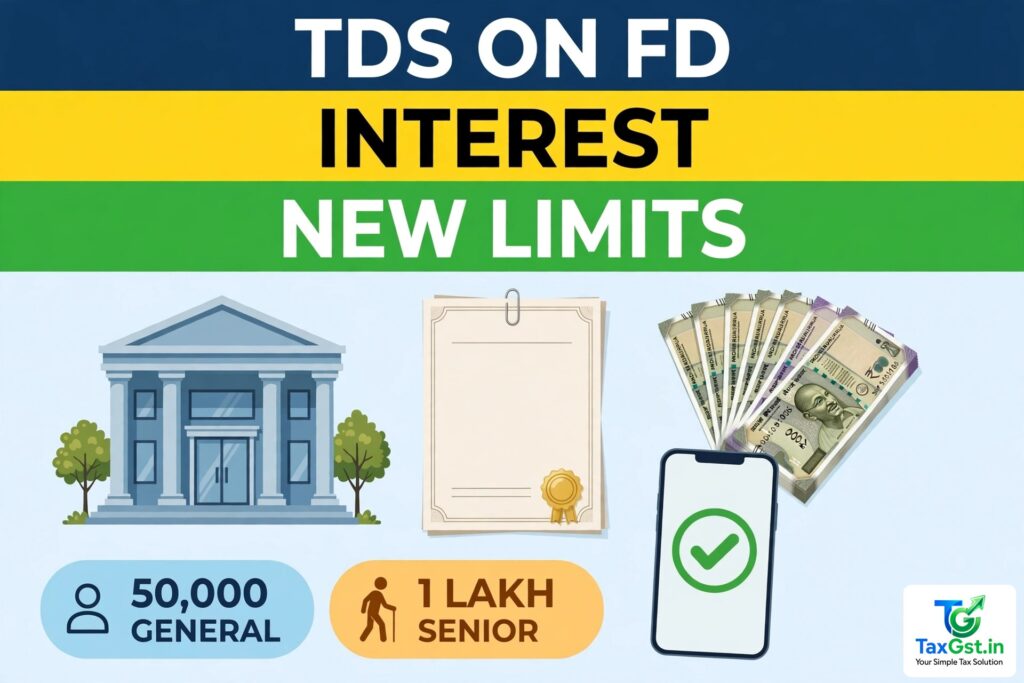
Your bank cuts TDS on FD and deposit interest at 10% once the interest from that bank crosses ₹50,000 in a financial year — or ₹1,00,000 if you are a senior citizen — and at 20% if you have not given your PAN. Those are the Finance Act, 2025 thresholds in force from 1 April 2025, carried into the Income-tax Act, 2025 as Section 393, Table Serial 5. TDS is not your final tax: the interest is still taxable income, and the TDS is simply credited against the tax you actually owe when you file.
Verified October 2026 · TaxGST.in
A retired teacher in Lucknow earned ₹1,20,000 of FD interest last year and was surprised twice: first that no TDS appeared until late in the year, then that ₹2,000 was deducted in a single month. Both surprises had the same explanation. She is 67, so her bank’s TDS threshold is ₹1,00,000, not ₹50,000 — and once her cumulative interest crossed that line, 10% TDS applied to the interest above it. The bank was not taxing her extra; it was collecting, in advance, tax she would owe anyway. Understanding that threshold is the difference between a nasty surprise and a planned one.
For the full TDS picture, see the complete TDS guide hub and the TDS rates and thresholds chart for FY 2025-26. If TDS already deducted is missing from your records, the missing-TDS fix guide walks through the correction path, and if your salary TDS is running higher than your real tax, the Form 12BB fix explains the mid-year correction. The wider income-tax rules sit in the income-tax guide hub.
Which interest, and whose threshold
TDS on interest covers interest other than interest on securities: bank fixed deposits, recurring deposits, savings-account interest above the threshold, post-office deposits, co-operative bank deposits, and interest on loans and advances paid by companies, firms and other deductors. It applies to residents; interest paid to non-residents follows a different route. The deduction happens at the earlier of credit or payment — for a cumulative FD, that is usually at maturity or at each interest credit, depending on the deposit terms.
The threshold is per payer, per financial year — not per deposit, and not across all your banks combined. Interest from three banks, each below its own threshold, triggers no TDS at any of them even if your total interest is far higher. In practice, a bank aggregates all your deposits across its branches under core banking, so splitting FDs across branches of the same bank does not help.
| Payer | Recipient | TDS starts above |
|---|---|---|
| Bank, co-operative bank, post office | Individual below 60 | ₹50,000 per year |
| Bank, co-operative bank, post office | Senior citizen (60+) | ₹1,00,000 per year |
| Any other payer (company, firm, individual deductor) | Any resident | ₹10,000 per year |
These are the Finance Act, 2025 figures, effective 1 April 2025: the general bank threshold rose from ₹40,000 to ₹50,000, the senior-citizen threshold doubled from ₹50,000 to ₹1,00,000, and the other-payer threshold doubled from ₹5,000 to ₹10,000. If you are reading an older article that still quotes ₹40,000 and ₹50,000, it is describing FY 2024-25, not the current year.
Rates, and the no-PAN trap
The standard rate is 10% with your PAN on record, with no surcharge or cess added at the deduction stage. Without a PAN, the rate jumps to 20% under Section 397(2) of the Income-tax Act, 2025 — and the threshold benefit effectively disappears in practice, because the deductor will cut tax on the whole amount. Here’s the catch that costs people real money: a 20% deduction is not a 20% tax. If your actual slab rate is lower, you recover the excess only when you file your return and claim the credit. Giving the bank your PAN is the cheapest tax planning you will ever do.
Worked example: a 45-year-old with ₹80,000 of FD interest from one bank. The threshold is ₹50,000, so TDS applies to the ₹30,000 above it: ₹3,000 at 10%. A 67-year-old with the same ₹80,000 from one bank pays no TDS at all — she is below her ₹1,00,000 threshold. But in practice, both must still offer the full ₹80,000 as income when they file; the senior citizen then claims the ₹50,000 interest deduction available to seniors under the old regime (see the senior-citizen benefits guide), while the younger taxpayer claims nothing on that interest.
How to stop TDS you do not owe
If your total income is below the taxable limit, file Form 15G (below 60) or Form 15H (senior citizen) with the bank at the start of the financial year, and renew it every year — it does not carry forward automatically. The declaration must be truthful: it states that your estimated total income is below the taxable limit, and a false declaration carries its own penalty. If TDS has already been cut, do not chase the bank for a refund; claim it as a credit in your return, where it appears in your AIS and TDS statement, and it will come back as a refund if your total tax is lower.
One more trap: Form 15G/15H is per payer. Filing it with one bank does not stop another bank deducting, and filing it late in the year does not undo TDS already deducted. File early, file everywhere you hold deposits, and file again next April.
Checklist before you renew an FD
- Add up interest from that bank across all deposits — that is the figure the threshold is tested against.
- Check whether you cross ₹50,000 (or ₹1,00,000 as a senior citizen) this year, not last year.
- Confirm your PAN is on record with the bank; a missing PAN means 20%.
- File Form 15G/15H in April if your total income is below the taxable limit.
- Reconcile the TDS in your AIS before filing — if it is missing, fix it before you file, not after.
FAQs
Is FD interest tax-free up to ₹1,00,000 for senior citizens?
No. ₹1,00,000 is only the point at which the bank starts deducting TDS. The interest is taxable income; the real relief is the separate ₹50,000 interest deduction for seniors.
Does the threshold apply across all my banks together?
No. It is per payer, per year. Each bank tests only the interest it pays you.
What if my bank deducts TDS but my total income is below the taxable limit?
Claim the TDS as a credit in your return; the excess comes back as a refund. For next year, file Form 15G/15H in April.
Why was 20% deducted when my friend paid 10%?
Almost always a missing PAN. Update your PAN with the bank and the rate returns to 10% on future interest.
Does TDS apply to savings-account interest?
Savings interest from a bank counts towards the same threshold, and senior citizens get the ₹50,000 interest deduction on it as well; younger taxpayers get a separate ₹10,000 savings-interest deduction under the old regime.
Sources
Finance Act, 2025, amending Section 194A of the Income-tax Act, 1961 with effect from 1 April 2025 (bank/post-office threshold ₹50,000 general and ₹1,00,000 senior citizen; other-payer threshold ₹10,000; prior-year figures ₹40,000, ₹50,000 and ₹5,000 respectively). Income-tax Act, 2025, Section 393, Table Serial 5(ii) (bank/post-office interest) and 5(iii) (other interest), carrying the same thresholds and the 10% rate, and Section 397(2) for the 20% no-PAN rate. Income Tax Department TDS rate chart for FY 2025-26, as reproduced on TaxGST.in’s TDS rates page.
Discover more from TaxGst.in
Subscribe to get the latest posts sent to your email.